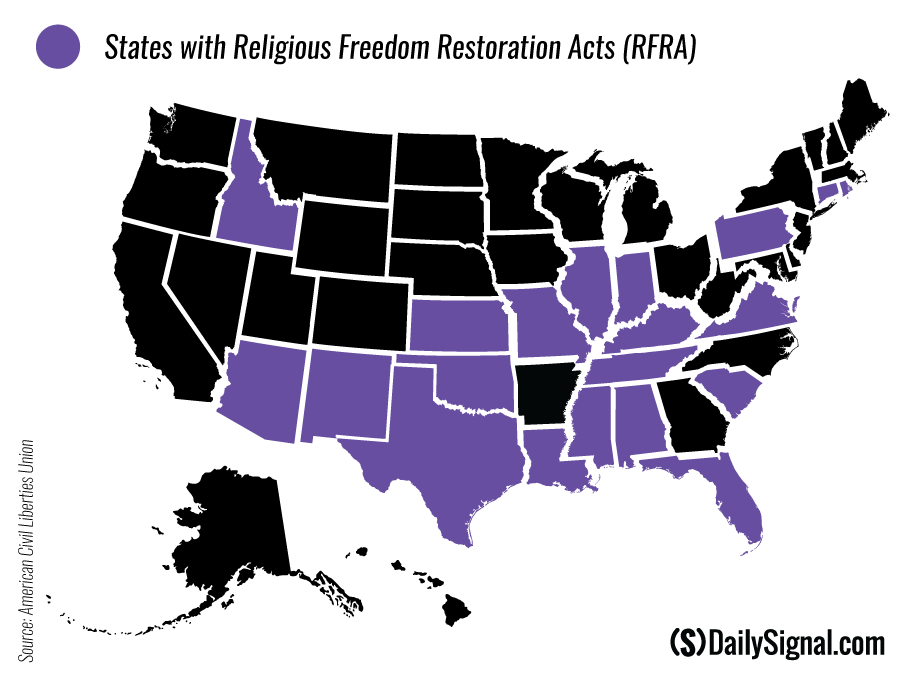
As of this writing, it appears that the Indiana state government is taking steps to undermine its own Religious Freedom Restoration Act. According to the Associated Press, Gov. Mike Pence has called for legislation “clarifying that [the RFRA] does not allow discrimination on his desk by the end of the week ... to address concerns that the law will allow businesses to deny services to gays and lesbians.” Arkansas Gov. Asa Hutchinson, facing similar pressure, has already preemptively called for changes to an RFRA bill on his desk.
Nineteen states have RFRAs. Of these, eleven have
non-discrimination laws at the city or township level, and two (Illinois and
New Mexico) have state laws protecting gays, lesbians, and bisexuals. Another
eleven have RFRA-like restrictions based on SCOTUS decisions. (Source: Daily
Signal.) On the surface, the problem with Indiana’s RFRA is that it’s
loosely written; critics claim that businesses can refuse gay people’s
business, and that the civil-rights legislation and decisions of the last sixty
years have determined that “you don’t have the right to choose who gets to sit
at the counter.”
The truth of the matter, though, is that the other states
all caught the RFRA wave at the right time, before SCOTUS’ decision in Lawrence v. Texas (539 US
558, 2003) made it “okay to be gay”. Now that wave has long passed; the
LGBT lobby has command of a sizeable chunk of the culture factories, as well as
the allegiance of the majority of our celebrities and politicians.
This makes the conditions most favorable for anti-RFRA moral
posturing, along with its attendant obliviousness. For instance, the
Daily Caller reports, “Connecticut Gov. Dannell Malloy will issue an
executive order on Monday calling for a ban on state-funded travel to Indiana” …
conveniently forgetting that Connecticut
has an arguably more restrictive RFRA. Oops.