Showing posts with label The Pope. Show all posts

Saturday, February 11, 2017

La Civiltà Cattolica and the “Spirit of the Age”

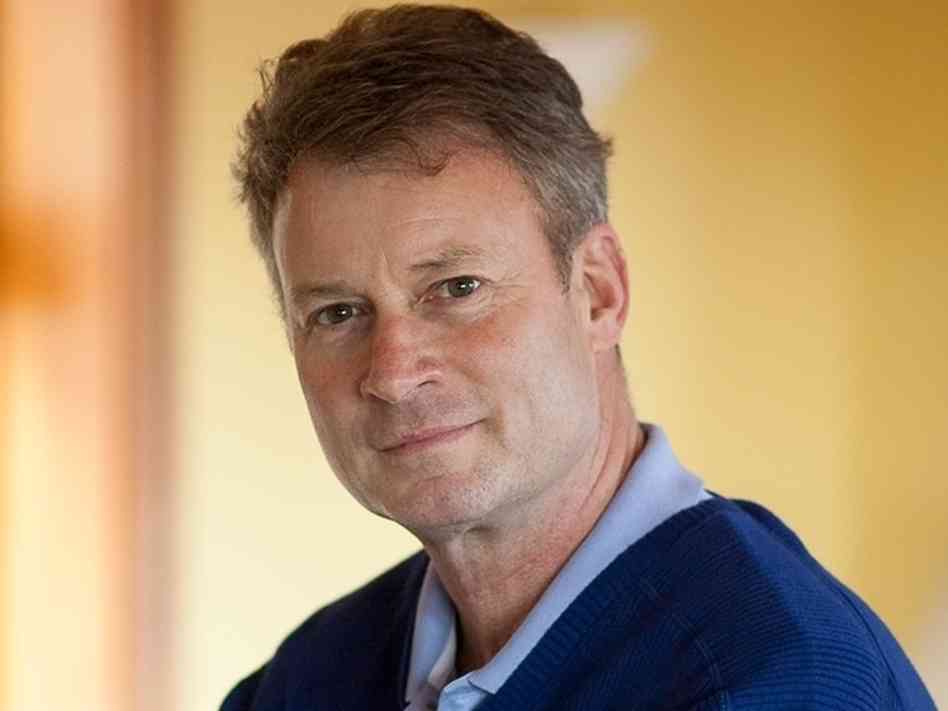
Rev. Antonio Spadaro, SJ. (Photo: Magyar Kurír.)
Brace yourselves. Once again, someone in the Vatican has challenged Church doctrine in a way that implicates Pope Francis, on an issue about which he has already spoken — women’s ordination to the priesthood. (Surprise, surprise, the culprit is a Jesuit.) Arguably, the last pope to have total control over his staff was St. Gregory the Great. Certainly, it’s dubious whether any pope since Pius XII has had a curia and bureaucracy that were all striving to the same end. But even the most doughty of papal defenders must occasionally find himself irritated by Francis’ seeming unwillingness to ride herd on the Vatican administration.

This is Where We Came In …

On Tuesday, February 7, Sandro Magister reported on an article published in the Italian Jesuit magazine La Civiltà Cattolica, written by Fr. Giancarlo Pani, SJ. Titled “La Donna e il Diacono,” Magister claims that in the article, “Fr. Pani calmly rips to shreds the ‘last clear word’ — meaning the flat no — that John Paul II spoke against women’s priesthood.”

Yawn, you say; haven’t we seen this movie before, during the reigns of Benedict XVI and St. John Paul himself? Ah, says Magister, but this is different! You see, the Holy See inspects and authorizes every line it publishes! Plus, the editor is none other than papal confidant Fr. Antonio Spadaro, and Fr. Pani is not only a deputy editor but his closest colleague!

And Francis is the first “not to limit himself to what is already known, but wants to delve into a complex and relevant field, so that it may be the Spirit who guides the Church,” concludes La Civiltà Cattolica, evidently with the pope’s imprimatur.

The first rule in dealing with news from the Vatican: Not everybody in the Vatican is on the same page. In fact, going off-script is almost an intramural sport. Most bureaucracies have functionaries whose agendas differ from the person supposedly in charge of the mess. The Vatican differs only in that the subversion is more rampant and sometimes more blatant. Since Pius XII, the popes have as often had to work against the bureaucracy as with it. Nobody should assume that anybody in the Holy See does anything unusual with the full knowledge of the Pope, or even with the minimum knowledge of the next person up the food chain.

Thursday, August 25, 2016

Four Life Issues and Catholic Social Doctrine

There are several political issues commonly wrapped in the social-justice banner that are also issues affecting life and the family. In theory, a Catholic ought to support those policies which support life and family regardless of which party proposes them. However, when the two parties split on abortion and (later) euthanasia, so did American Catholics. Now the nation is so polarized politically that, as Scott Eric Alt explains, any Catholic who demands we pay attention to life issues outside of abortion and euthanasia is accused of “trying to kill opposition to abortion”.

“A Catholic CANNOT Vote Democrat”

On August 23, my friend and Catholic Stand colleague Matthew Tyson published “Yes, You Can Be Catholic AND Vote Democrat” on his Patheos blog Mackerel Snapper. On the face of it, I can’t conceive a more quixotic and desperate cause than trying to convert the Democrat Party to a “whole life” position, as the Democrats for Life want to do. Besides, the demographics have been shifting leftward (and away from party labels) for the last three generations, and the Republican Party is shredded in two. There’s arguably as much hope for converting the Democrats to the “seamless garment” as there is for converting the Republicans. (Yes, I went there.) But, as GKC said, hope only begins to be really useful when things appear to be hopeless.

For the record: Though I probably agree with many if not most of Matthew’s positions (I don’t fully know what they are), I refuse the label liberal. Classical liberalism, as I recently pointed out, was and is premissed on a faulty anthropology; the postmodern left’s social liberalism is progressing towards an authoritarian statism, and the postmodern right’s economic liberalism enables crony capitalism. Precisely because I am a Catholic, I hold neither the Republicans’ nor the Democrats’ ideological biases and policy preferences to be above challenge or criticism.

The post’s title was guaranteed to attract a knee-jerk contradiction. Sure enough, a reader (whom I’ll call Cato) declared, “A Catholic CANNOT vote Democrat,” and that “being a [Catholic] Democrat is indistinguishable from being a pro-equality KKK member, a Catholic Nazi, or a Catholic Stalinist.” Why? Apparently, because Cato, bless his heart, believes the national platform makes all the party’s members co-conspirators, despite the fact that individual candidates are not and cannot be required to support every platform plank. It’s stupid sweeping generalizations like this which are driving Gen-Xers and millennials away from party identification.

Saturday, April 16, 2016

Timothy Egan and the Reverent Subject of Sex

Timothy Egan. (Photo: Barry Wong.)
The last few days, I’ve been focused on the hyperventilating by Catholic radical traditionalists over Amoris Laetitia, Pope Francis’ overlong summation of the work of the last two Synods on the Family. The reactions from the left were, for the most part, entirely predictable — some despaired because it didn’t go as far as they thought it should, while others rejoiced because they thought it went farther than it did. Of the latter category, we have Timothy Egan of the New York Times, who penned what Phil Lawler has called “surely ... the dumbest column published on the topic.”

“Sex was Dirty”

Egan, Lawler states, “rolls out the stale complaints of the 1970s about the Bad Old Church, opening and closing his column with citations from the late comedian George Carlin. The reader will look in vain for references to any other authority. Nor is there evidence that Egan has paid attention to Catholic writers who have reflected on the Church’s approach to human sexuality more recently, and just maybe more profoundly, than Carlin—such as, just for example, St. John Paul II.”

Actually, Egan does worse than go without authoritative references: he cites the Baltimore Catechism in such a way that it appears to support the tropes.

Sex was dirty. Sex was shameful. Sex was unnatural. Thinking about it was wrong. Premeditation itself was a sin, and so was flirting. Sex had one purpose: procreation, the joyless act of breeding. “The sixth commandment forbids all impurity and immodesty in words, looks and actions,” was admonition No. 256 in the Baltimore Catechism, the standard text used to teach the faith from 1885 to the late 1960s.
No. 256 [sic; the actual answer number is 257] also warned about the dangers of “sinful curiosity, bad companions, drinking, immodest dress and indecent books, plays and motion pictures.” If that sounds now like the dynamics of a good dinner party, you can also see this pope joining the fun at the table.

In my post on Amoris Laetitia, I spoke of the distinction the Church makes between the doctoral (“What do we teach?”) and the pastoral (“How do we integrate this teaching into parish life?”). The same kind of distinction ought to be observed between doctrine and indoctrination: religious formation, also known as catechesis. What the Catholic Church teaches is one thing; what Tim Egan and George Carlin “learned”, however, is another thing entirely, and may not be entirely their fault for not paying attention in class.

Saturday, April 9, 2016

What Did the Pope Really Say? (The Amoris Laetitia Edition)

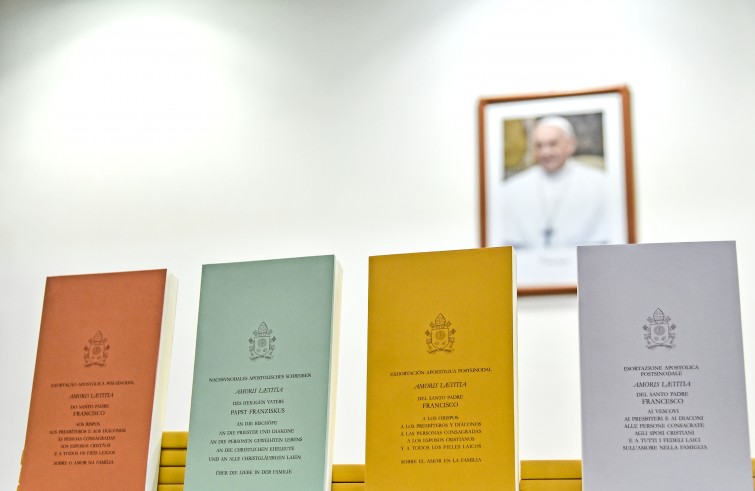
Image source: ancoraonline.it.
On Friday, as I’m sure most of you know, the Vatican Press released Pope Francis’ post-synodal exhortation Amoris Laetitia (The Joy of Love). Predictably, everyone who foresaw sweeping changes in Church doctrine and practice were proved wrong, though that didn’t stop The Usual Gang of Radical Traditionalists from proclaiming it a heretical disaster.

Amoris Laetitia Not a Wrecking Ball

If you’re going to read it, be prepared: at 264 pages (closer to 245, if you take out blank pages and such), it’s longer than any encyclical I’ve ever read, including St. John Paul’s Evangelium Vitae, longer even than Laudato Si’. It’s a wide-ranging and somewhat undisciplined ramble, as Francis occasionally breaks from the main line of his thoughts to directly address sections of his readership. For example, in paragraph 212, in the middle of discussing short-term preparations for marriage, he offers some quick advice to the engaged couples. But while fully half of the text is enclosed in quotation marks — three-quarters of one of the longest paragraphs consists of one extensive citation of a sermon given by Dr. Martin Luther King, Jr. — still Francis’ irrepressible enthusiasm comes through.

Nevertheless, the fact remains that Amoris Laetitia is an apostolic exhortation, not an apostolic constitution nor a motu proprio. Very early on, Francis defines his purpose: “to gather the contributions of the two recent Synods on the family, while adding other considerations as an aid to reflection, dialogue and pastoral practice, and as a help and encouragement to families in their daily commitments and challenges.” (AL § 4)

Since Francis’ focus is pastoral not doctrinal, no doctrine has been upset, no dogma contradicted, no norm disestablished. While Dave Armstrong exaggerates its importance to the life and future of the Church (“Francis’ ‘Humanae Vitae moment’”? Seriously?), it’s certainly not the wrecking ball many feared it would be.

Saturday, September 5, 2015

Absolution, excommunication, and abortion

Photo credit: Giampiero Sposito/Reuters.
Welcome to another edition of What Did the Pope Really Say? Today’s confusion is over Pope Francis’ recent letter to the President of the Pontifical Council for the Promotion of the New Evangelization, Abp. Salvatore “Rino” Fisichella. Specifically, what did the Pope command to be done about abortion for the Extraordinary Jubilee of Mercy year that is not already being done in parishes throughout the world? Did the Pope declare abortion to not be a sin? Were women unable to be absolved of the sin before? What gives?

In this case, the normal amount of mainstream-media misinformation is compounded by what Edward Peters calls “the pervasive ignorance of canon law among rank-and-file faithful brought about by fifty years of ecclesiastical antinomianism.”[*] Abortion is not only a sin in traditional Christian moral doctrine; in the Code of Canon Law it’s also a delict, analogous to a tort in civil law, with a defined punishment. Per Canon 1398, “A person who procures a completed abortion incurs a latae sententiae excommunication.”[†]

The confusing part of Pope Francis’ letter is his stated decision “to concede to all priests for the Jubilee Year the discretion to absolve of the sin of abortion those who have procured it and who, with contrite heart, seek forgiveness for it.” Boston archbishop Cdl. Seán O’Malley reinforces the bewilderment when he tells us, “Under the provisions of canon law, absolution of certain serious sins, including abortion, was reserved to the diocesan bishop. For many years in the United States, including in the Archdiocese of Boston, diocesan bishops have granted their priests the faculty to absolve the sin of abortion.” [Bold type mine.—ASL] In all fairness, canon law is a recondite subject, and neither Francis nor Cdl. O’Malley were educated as canon lawyers.

Tuesday, January 20, 2015

Pope Francis, Humanae Vitae, and Margery Eagen’s devastating fallacies—UPDATED ALREADY?

Filipinos at Pope Francis’ Mass in Manila, Jan. 18.
(Photo: AFP/Ted Aljibe.)
You would think that a writer billed as a “spirituality columnist” for a website that professes to cover “all things Catholic” would have some familiarity with Catholic teaching, especially the most controversial doctrines. However, Margery Eagen, writing for Crux, talks about Pope Francis’ recent speech at the Mall of Asia as though her only knowledge of Catholicism came from Planned Parenthood.

Although he has not lived it himself, I had thought [Pope Francis] understood something about good people living real lives in real marriages. I had thought he even understood something about the beauty of sex in marriage, the need for sex in marriage.

I was wrong.

In the United States, his words will have little practical impact. Most Catholic women have used birth control for decades. There are no more families with 12 and 14 kids in the Sunday morning pews. But his words do reveal a heartbreakingly backward perspective: that the highest calling of married women is sacrificing all to rear children, as many as come along, no matter those women’s talents or skills or dreams.

These aren’t the words of a person who’s well-educated in Catholic doctrine, let alone someone who should be discussing Catholic spirituality. These are the words of a journalist content to work with the straw-man “Catholic beliefs” constructed for her by second-wave feminism, the kind of nonsense which led Elizabeth Dias at TIME to write that “the mainstream media has nearly no understanding of the Church.”

In fact, Francis’ words reveal no such chauvinist nonsense. To be sure, he offered a doughty defense of the goodness of family and childrearing against “ideological colonization”, a branch of “cultural imperialism”. Eagen’s criticism presents us with the kind of false dilemma demagogues love: you’re either for contraception or you’re against women working outside the home.

Friday, January 16, 2015

Talking smack about the Pope

It’s been over a week now, and certain people still haven’t gotten over the spanking Maureen Mullarkey received for her rather slanderous attack on Pope Francis. And a spanking it was; R. R. Reno, the editor-in-chief of First Things, not only washed his hands of her post but offered his own rebuttal to it, calling her criticisms and caricatures of Francis “overdrawn and ill-tempered”.

Oh, wait a minute — that’s not the spanking they’re not over. Rather, they’re not over the explosion from the Patheos blog, Catholic and Enjoying It, written by The Blogger Whom I’m Damn Well Going to Name for Just This Once, Mark Shea.

You see, Shea had just written the day before about the Catholic right’s pre-dismissal of Francis’ yet-to-be-completed encyclical on climate change; and lo and behold, out comes Mullarkey’s hit piece. (You could almost hear him yelling at the clay pigeon launcher, “Pull!”) So he unloaded on Mullarkey, as well as her First Things combox followers, calling it a “festival of crazy contempt for Francis” and a “revolting (in every sense) smear job”.

Christopher Ferrara at The Remnant promptly got upset on Mullarkey’s behalf, deploying even more right-wing buzzwords and straw men, along with a healthy dollop of radical-traditionalist contempt for “neo-Catholics”. (Apparently, Francis “kissed the Koran” when he posed for that shot holding the anti-fracking T-shirt.) Nevertheless, we might have been able to walk away from the shindy — certainly it doesn’t appear Shea’s given the matter any further attention — had not my Catholic Stand colleague Donald R. McClarey weighed in with further acid, preceded with the biggest straw man of them all:

“…[C]riticism of this Pope is verboten in the eyes of some bloggers.”

Saturday, November 15, 2014

Are Pope Francis’ defenders missing the point?

If you haven’t been following the story of Cdl. Raymond L. Burke’s transfer from Cardinal Prefect of the Apostolic Signatura (the High Court of the Catholic Church, if you will) to Patron of the Sovereign Military Order of Malta … well, I can’t say as I blame you. Overall, the reactions have been a classic illustration of the Catholic Circular Firing Squad back in action: traditionalist overreaction, liberal jubilation, and my little group of ultramontanists — to be honest — somewhat missing the point.

There’s some fun to be had watching the Vatican Follies, and speculating over what happens backstage and in the wings. Nevertheless, I agree with Simcha Fisher: there’s much too much agonizing over the shambling monster Frank Weathers is pleased to call the KasperBurke.

A “Calamitous Pope”?

Michelle Arnold of Catholic Answers recently made the excellent point that to call St. John Paul “the worst pope ever” is to show an appalling ignorance of papal history. Similarly, to imply that Pope Francis is “calamitous”, as Rorate Caeli has done in a post uncritically copied and pasted by other rad-trad blogs, is to exaggerate hysterically.

But in our zeal to defend the orthodoxy of Papa Bergoglio against the cheers of the left and the jeers of the right, I’ve begun to think that we’ve discounted criticism we should be listening to, whether we agree fully with it or not. To put it differently, it’s past time for the honeymoon to come to an end and face the reality of Francis’ reign.

This started for me when The Blogger Who Must Not Be Named wrote a piece about the facepalm-inducing, completely Holy-Dude-what-were-you-thinking selection of Cdl. Godfried Danneels for the Synod on the Family — an appointment that could only be overshadowed in insensitivity by nominating Fort Lauderdale mayor Jack Seiler to head up the Office of Papal Charities. Whatever the choice says about Francis’ orthodoxy, it was a bonehead play.

Friday, August 15, 2014

Pope Francis, Islam and jihad


A troubling passage in Evangelii Gaudium

Andrew Bieszad, a scholar on Islam, seems to believe Pope Francis is teaching error — or, at least, opiniones intolerata — about the “Ishmaelites”:

For Islamic scholars, there is a statement in the apostolic exhortation of Pope Francis, Evangelii Gaudium, which is particularly troubling:
Faced with disconcerting episodes of violent fundamentalism, our respect for true followers of Islam should lead us to avoid hateful generalisations, for authentic Islam and the proper reading of the Koran are opposed to every form of violence. (p. 253)
As the situation in the Middle East escalates, and the violence of the Islamic State of Iraq and al-Sham (ISIS) spills rivers of innocent Christian blood, this statement seems incongruous with reality.

From Bieszad’s perspective, Francis is apparently taking an attitude not taken by our forefathers in the faith; to assert this, Bieszad not only quotes the defiance spoken by a big handful of martyrs, but also theological heavyweight Saints John Damascene, Thomas Aquinas, and Alphonse Ligouri, not to mention latter-day hero Hilaire Belloc. If Bieszad doesn’t go so far as to call the pope a heretic, he does manage to imply that Francis is both wrong and a Neville Chamberlain-type appeaser.

The funny thing, though, is that the Islamic scholar doesn’t directly dispute Francis’ assertion, “authentic Islam and the proper reading of the Koran are opposed to every form of violence,” with any citation of the Koran or mainstream Islamic scholars. Rather, he seems content to let the juxtaposition of Francis’ words and ISIS’ deeds do the work for him.

Another funny thing: When I began writing about eleven years ago, I was initially writing to defend the Catholic faith against the slanders and misunderstandings of Protestants and non-believers. Now, I spend an increasing amount of time correcting fellow Catholics. And thereby hangs a point.

Wednesday, June 11, 2014

Why don’t we try trusting the Holy Spirit?

I was going to hold my tongue, please believe me. I’d already written a “Circular Catholic Firing Squad” post last week. I’ve already written posts explaining what I find valuable and admirable about traditionalism, what I dislike about a certain kind of traditionalist, and what’s wrong with sedevacantism (which is not coterminous with traditionalism).

Nope; no matter how many spittle-flecked nutties the Usual Suspects would throw about Pope Francis praying with Patriarch Bartholomew I (Eastern Orthodox), Israeli president Shimon Peres (Jewish) and Palestinian president Mahmoud Abbas (Moslem), I wasn’t going to say bubkes.

Then, a more popular blogger than I, with whom I’m “Facebook friends” and whom I’ll decline to identify, posted a quick status note: “Can we please stop showing love and concern toward false religions and start showing love to those who follow them?” This, taken by itself, wasn’t bad. But what followed was ugly:

But wait. That would imply that we care about their souls. The pope doesn’t seem concerned about that, so I guess I shouldn’t be either? … There needs to be a schism, so that people who want to be Catholic will have a chance to. We can get ourselves a Catholic pope, too.

That did it. I blew up: “Here’s a wild idea: Why don’t we try trusting the leadership and guidance of the Holy Spirit promised to the Apostles (John 14:36, 16:13) instead of nitpicking every act of the Pope for signs of apostasy? I’m not saying you have to love everything he does, or that he’s above criticism. I will say, though, that schism’s been tried before; you can see how well THAT worked out.”

Thursday, June 5, 2014

Pope Francis and the libertarians

Cdl. Oscar Rodríguez Maradiaga.
So far up to this point, I’ve been deafened by the lack of libertarian reaction to Cdl. Oscar Rodríguez Maradiaga’s keynote speech at Catholic University of America’s conference on Catholicism and libertarianism. After all, it’s been more than forty-eight hours since Religion News Service’s David Gibson and Church whisperer Rocco Palmo broke the story.

Perhaps there’s some confusion among the ranks; as Kevin and Teresa Rice explain in Catholibertarian, “As it is uncommon to find two Libertarians who agree on very much, there is a wide room for difference of opinion and degree of commitment to at least the latter part of this composite.” Is what Cdl. Rodríguez condemned something that at least three out of four self-described libertarians assert?

Or perhaps libertarians and other conservatives have just stopped listening to the Church on economic matters. Cdl. Rodríguez cited an article in the National Catholic Fishwrap by Michael Sean Winters, who further references the ineffable Fr. John Zuhlsdorf: “I wonder how many people are still listening to [Pope Francis] seriously on this issue …. It comes across as naive, out of step with history.” This extract, partial and out-of-context as it is, is gentler than the nutty thrown by John Moody of FOX News:

By appearing to sanction what amounts to forced redistribution, Francis grievously exceeded his authority and became what amounts to a robe-wearing politician. He also exposed his Church, one of the wealthiest institutions in the world [one of the most pernicious myths in Western history], to inevitable charges of hypocrisy. And he put himself in a position of having to back up his frothy talk with ruinous action.
As I’ve noted in The Impractical Catholic, political progressives aren’t the only Americans who practice “cafeteria Catholicism”; not all conservatives and libertarians are above doctrinal cherry-picking.

Thursday, March 20, 2014

On criticizing Church leadership

The Catholic Church is an institution I am bound to hold divine — but for unbelievers a proof of its divinity might be found in the fact that no merely human institution conducted with such knavish imbecility would have lasted a fortnight.
—Hilaire Belloc (1870 – 1953)
In 1963 Bl. John XXIII created a commission of six non-theologians to study questions of birth control and population. In 1965, Paul VI expanded the commission to fifty-eight members, including bishops, theologians and married couples; at its final meeting, an executive committee of sixteen bishops was also present. As you may not have guessed, the majority concluded that the pope could use his authority to approve at least some form of contraception for married couples.

After two further years of study and reflection, Papa Montini rejected the majority position, explaining in Humanae Vitae, “… [T]he conclusions arrived at by the commission could not be considered by Us as definitive and absolutely certain, dispensing Us from the duty of examining personally this serious question. This was all the more necessary because, within the commission itself, there was not complete agreement concerning the moral norms to be proposed, and especially because certain approaches and criteria for a solution to this question had emerged which were at variance with the moral doctrine on marriage constantly taught by the magisterium of the Church” (op. cit., 6).

I bring this up because Pat Archbold posits a hypothetical case:

Say … [that] the outcome of the Synod on the Family on the question of admission of divorced and remarried to communion follows the suggestions of Papal advisers Cardinals [Reinhard] Marx and [Walter] Kasper. That the remarried are admitted to communion after some pastoral counseling and the annulment process is moved from tribunal to pastor. In this case, the Church does not change its immutable teaching on the indissolubility of marriage, but the newly implemented pastoral praxis dramatically alters the landscape.

Leaving aside the predictable cheering from progressives, Archbold asks, what should the orthodox do: go along, remain silent, or speak out?

Saturday, February 22, 2014

“Who am I to judge?”

The fateful post-WYD conference. (Photo: CNS)
Okay, let’s take it from the top: The Catholic Church exists to preserve and teach the revelation Jesus gave to his disciples during his earthly ministry. “Go therefore and make disciples of all nations, baptizing them in the name of the Father and of the Son and of the Holy Spirit, teaching them to observe all that I have commanded you …. (Matthew 28:19-20)”

That means the Catholic Church does not exist to teach whatever fashionable notions its members want to embrace today, even though Jesus’ earthly mission took place almost 2,000 years ago. Theological inferences and deductions are permissible; doctrine can grow and develop; discipline may change to a degree to better teach the faith according to the culture and the times. But where doctrine is settled and dogma defined, no change is admissible because it would functionally “change” (i.e. distort) the revelation.

Semper Ecclesia reformanda: “The Church is always to be reformed.” However, there’s authentic reform, and then there’s mere innovation. C. S. Lewis, in The Abolition of Man, described the difference between the authentic reformer and the innovator most memorably: “It is the difference between a man who says to us: ‘You like your vegetables moderately fresh; why not grow your own and have them perfectly fresh?’ and a man who says, ‘Throw away that loaf and try eating bricks and centipedes instead.’”

It should be no surprise that the Church doesn’t adopt all the “reforms” many Westerners think it should. And it should be no surprise that the Church’s sexual teachings haven’t changed. However, some people still manage to cough up shock and outrage that Pope Francis’ out-of-context quote, “Who am I to judge?”, didn’t completely undo 2,000 years’ worth of moral dogma.

Monday, September 23, 2013

Pope Francis and the “issues trap”

Joanne McPortland’s amusing “Parable of the Papal Interview” expressed a simple truth: orthodox Catholics who have actually read the interview Pope Francis gave Fr. Antonio Spadaro, SJ have mostly loved it. Forget what you’ve read elsewhere: Pope Francis may be unorthodox in his style, but his substance is by no means heterodox.

So I had to chuckle when a troll popped up in the combox to say, “Not at all a good parable because it is so predictable. Right wing cognitive dissonance over the Pope’s interview prevents them from really hearing what he said.”

You see, this piece of complacent snottiness popped up after the rest of the progressive world was gobsmacked by what the AP’s Nicole Winfield, in her original lede, called Francis’ “bizarre U-turn”: a speech given Thursday to Italian gynecologists, in which he slammed abortion and euthanasia as parts of a “throwaway culture”. Talk about cognitive dissonance — Matthew Balan of NewsBusters observes that Winfield’s new lede still tries to preserve the “progressive” box in which media liberals have put Papa Bergoglio by calling it an “olive branch” offered to the “more doctrine-minded, conservative wing”.

This is what comes of not paying close attention to what the Pope is saying, of trying to pigeonhole any pope — hell, any major player. My buddy Frank Weathers, for instance, points us to a 2006 speech in which Pope Emeritus Benedict XVI also spoke of the “issues trap” to Swiss bishops on their ad limina visit. And Marcel LeJeune of Aggie Catholics includes other quotes that, taken by themselves, would lead one to conclude that B16 is a liberal. Quoth the wise man Thomas L. McDonald, “There is not a hairsbreadth of difference between the theology of Francis and Benedict.” Different styles, same substance.

Thursday, March 14, 2013

“We have a papa …”

A couple of weeks ago, in “Has the papacy become ‘just a job’?” I lumped concerns that emeritus Pope Benedict’s resignation had changed the nature of the papacy in with other bits of “silliness inflicted on us by the incessant noisemakers well described as ‘the chattering classes’”. This, I think, goes to show that I can miss the point just as anyone else can.

The basics, I think, are still valid. People who don’t buy into Catholic theology of the papacy, especially the Pope as vicarius Christi, can be found inside the Church as well as outside; you can’t be disillusioned if you don’t have an illusion to begin with. For those of us who do believe it — and to be in communion with the Holy See, you must — what does Benedict’s resignation really change? “The ‘cult of the strong leader’ may suffice for those who hang on to late nineteenth/early twentieth century speculative anthropology.  However, it’s bad history and bad theology, not to mention a total misread of Joe Catholic in the pews.”

That’s the response of the mind. But the heart often discerns truths the mind doesn’t wish to face, and can tell the difference between explaining and explaining away.

Robert Moynihan wrote of an encounter he had with a cardinal before the conclave, a man very troubled in his heart. Said the cardinal, “I love [Benedict], but this should never have happened. He never should have left his office. It is like a man and a woman, a husband and wife, a mother and father in relation to their children. What do they say? They say, ‘until death do us part!’ They stay together always.” And the ineffable Fr. John Zuhlsdorf confessed that he’d been (among other things) angry over the resignation.

I missed it totally. The word “pope” comes from the old Greek papa, “father”. Many people around the world, who know Benedict only though his books and the media, still felt abandoned by their Papa.

Thursday, March 7, 2013

The times need to get with the Church — UPDATED

Fox News offered its unique perspective on the coming conclave, with a report entitled “What kind of new pope would America’s Catholics like to see?” I don’t know about you, but I’d be more interested in knowing: “What kind of American Catholics would the new Pope like to see?”
Phil Lawler, Popular misconceptions IV in CatholicCulture.org, 3/5/13


“Roman Catholics in the United States say that their church and bishops are out of touch, and that the next pope should lead the church in a more modern direction on issues like birth control and ordaining women and married men as priests, according to the latest New York Times/CBS News poll,” reads the lede in the New York Times.

So okay, the story already has two strikes against it: 1) The poll was conducted by NYT, which is pretty much the closest thing American progressives have to a party organ like Pravda; and 2) the story is co-authored by Laurie Goodstein, who has her own axe — or rather, Jeff Anderson’s axe — to grind. But the sampling methodology looks as though they took reasonable care to get random picks, and I’m satisfied that the numbers reasonably reflect the current state of American Catholics. Here is the link to the full report.

The URL, however, tells the story as well as does the lede, if not better — POLL SHOWS DISCONNECT BETWEEN US CATHOLICS AND CHURCH.

For instance, while between 66% and 79% of American Catholics are in favor of such liberal action items as allowing priests to marry, ordaining women and using contraceptives, only 46% hold that the Pope is not infallible in matters of faith and morals, while another 14% don’t know or didn’t answer. This (seemingly) proves that there are Catholics who disagree with the Pope even though they admit he can’t be wrong, and who follow their consciences in opposition to Church teaching knowing that they can only err in doing so.

Monday, February 25, 2013

Has the papacy become “just a job”?

Over the last couple of weeks, we’ve had quite a bit of silliness inflicted on us by the incessant noisemakers well described as “the chattering classes” concerning Pope Benedict’s decision to step down from the papacy.  Yes, I know I belong to that group, and that I’m fully capable of saying silly things too; witness my arrogant confidence that Mitt Romney would beat Barack Obama.

All papal reigns at their start are fraught with promise, and have potential for dramatic acts.  The cardinal electors can’t elect a “caretaker pope” without the possibility that said pope, theoretically picked to keep the Chair of Peter warm for a better successor, will suddenly take it into his head to do something climactic … like call an ecumenical council.  And even a pope widely regarded as an empty cassock (e.g. Ven. Paul VI) can drop an atomic bomb on everyone’s expectations (the prophetic Humanae Vitae).  In this respect, the upcoming conclave is no different from previous conclaves, even with the off-stage presence of a Bishop Emeritus of Rome. 

Those hoping, advising and demanding that the Church change its moral teachings, as I’ve written elsewhere, will most likely grumble of the next pope, in the words of Pete Townsend, “Meet the new boss /Same as the old boss.”  But more irritating than those who expect some kind of dogmatic dive to the left are those who claim that B16’s resignation introduces a fundamental change to the Petrine office, that it either makes or proves the papacy “just another job”.  “And by so doing,” Giles Fraser of the Guardian, who styles himself a “Catholic Protestant”, exults, “it rightly challenges some of the cult of personality that has built up around that office, as if the job affords the office holder some special proximity to God.  It doesn’t.”

Thursday, February 14, 2013

Progressives: Don’t hold your breath waiting for Vatican III

What are Ukrainian feminists doing in Paris, anyway?

As is to be expected when the Chair of Peter is vacated, encomiums for the departed pope are quickly replaced by speculation about the next.  This is a game anyone can play, whether you’re Catholic or not.  The only difference now is that the departing pope can read the speculations along with the rest of us.

As is also to be expected, at least since the dual conclaves of 1978, much of the speculation will follow the lines of secular politics, taking absolutely no account of the Catholic Church’s peculiar imperatives.  By that, I mean that you’ll read a lot of silly talk about prospects for the Church changing its “policies” on various action items, as if a change in pope meant a change in doctrine.  That there might be a reason for the Church to teach the same things in 2013 as it did in 1013 or AD 113 seems not to occur to certain people.

One thing that is different from eight years ago: various self-styled progressives have not only greeted the news of Benedict XVI’s renunciation with glee — almost a “Ding, dong, the witch is dead” attitude — but are almost certainly convinced that, with “God’s Rottweiler” out of the way, the Spirit of Vatican II will finally sweep away the last vestiges of the homophobic, patriarchal “old Church” and blow in a kind of “Catholic spring”.  “The church has such influence worldwide that it would be great to see a Vatican III!” gushed Nicholas Kristof in the New York Times, while Rainbow Sash opined, “The new Pope will have an opportunity like Pope John XXIII to open wide windows of the Church so that fresh ideas may fill the Church by calling for a new Ecumenical Council of the Church, Vatican III.”

Monday, January 23, 2012

Paul VI read the signs of the times prophetically

One of the hardest things for many people to understand is, “Why would the Catholic Church insist, after all these years, that contraception is wrong?  Moreover, why do they insist on resisting the tide?  After all, most Catholic women practice some form of it!  Can’t they tell that no one is listening to them anymore on birth control?”

Well, that’s not quite true.  While 98% of Catholic women have practiced birth control at some point in their lives, the most recent Guttmacher study only claims that nearly 70% currently practice birth control.  In this area, the Church is beginning to gain some traction.

Nevertheless, it is true that, when Pope Paul VI promulgated Humanae Vitae in 1968, it caused a severe rift within the Church, as many Catholics of the time expected and hoped for a change in doctrine.  Since then, it’s been the one area in which otherwise-orthodox Catholics have entrusted themselves to God’s forgiveness even when they confess other sins … that is, when they agree that it is a sin, which many don’t.

Of course, many people understand that the Church shouldn’t change its teaching to match every whim and fad of the people.  But after fifty years, it’s not really a “fad” anymore, is it?  Can’t the Church recognize the signs of the times?

Sunday, May 1, 2011

How much is "enough"?—UPDATED


If I am made to walk the plank by a pirate, it is vain for me to offer, as a common-sense compromise, to walk along the plank for a reasonable distance. It is exactly about the reasonable distance that the pirate and I differ. There is an exquisite mathematical split second at which the plank tips up. My common-sense ends just before that instant; the pirate’s common-sense begins just beyond it. But the point itself is as hard as any geometrical diagram; as abstract as any theological dogma.
—G. K. Chesterton, “Wanted, An Unpractical Man”,
What’s Wrong with the World

I don’t wish to waste time dissecting Maureen Dowd’s gasbag collection of gripes over John Paul II’s beatification. Frankly, most of it is the usual garbage: JP2 didn’t follow the mainstream Protestant communions’ bad examples. The one charge that merits looking into is this: “… John Paul forfeited his right to beatification when he failed to establish a legal standard to remove pedophiles from the priesthood, and simply turned away for many years.”

Beatification isn’t a “right”, but that’s not my point. Factually, Dowd’s charge is incorrect as well: a legal process was already established, although it was horrifically slow. And he did make changes to increase the speed in 2001, before the scandals broke open in 2002.