Showing posts with label Economics 101. Show all posts

Tuesday, May 30, 2017

Scarcity No Excuse For Avoiding Health Care Reform

Image Source: Center for American Progress.
Plenty of people have written ad nauseam about liberal smugness. Heck, even liberals have written about liberal smugness. I’ve already pointed out that liberals’ supposed intellectual superiority is oversold. But for sheer condescension, try reading a conservative on economic issues. It’s hard to find a conservative talking head who doesn’t assume liberals know nothing about economics, who doesn’t treat liberals like third-graders in need of a stern talking-to about grown-up stuff. Case in point: Kevin D. Williamson, whose National Review piece, “Health Care, from the Top”, can serve as a model for How to Write Like a Patronizing Ass.

“Those Poor, Simple Liberals”

“Our ongoing troubles with health care,” Williamson begins, “stem from an unwillingness to deal with certain facts. One of those facts is scarcity.” Just from the way Williamson tees up the ball you can see where he’s aiming: “Those poor, simple liberals think everything is available in mind-dazzling abundance and shouldn’t have to be paid for (except by other people).” Apparently, to Williamson liberals are all college-age kids going to school on Mommy and Daddy’s nickel, who don’t have to pay for anything except Jell-O shots and the occasional reefer (thanks to Obamacare, the Trojans are covered).

To give Williamson his due, his attitude never verges into a Scroogean desire for the unfortunate to die and decrease the surplus population. “There is a certain libertarian tendency,” he writes,  “to … throw up one’s hands, exclaiming: ‘Just let markets work!’ We should certainly let markets work, but not ‘just.’ We aren’t going to let children with congenital birth defects suffer just because they might have stupid and irresponsible parents [people are poor because they’re stupid and irresponsible, don’cha know], and we are not going to let old people who have outlived their retirement savings die of pneumonia because we don’t want to spend a couple of thousand bucks treating them.” He even writes approvingly of “giving poor people money and money analogues (such as food stamps) to pay for food,” which makes him a rarity among conservatives.

However, these heartwarming glimpses of Williamson’s humanity aren’t enough to dispel the irritation produced by his ham-handed belaboring of the obvious. It might distress him to learn that not all liberals are spoiled-brat millennials mindlessly parroting Bernie Sanders’ Facebook memes. Indeed, it might cause him consternation to know that liberals are fairly evenly distributed among income strata and that college graduates are a bit more likely to lean left than right. I can’t imagine what would happen to Williamson if it were revealed to him that there are even a few liberal economists still around.

Saturday, January 21, 2017

The Absurdity of “Values-Free” Economics

Image source: marketoracle.co.uk.
While reading John C. Médaille’s Toward a Truly Free Market: A Distributist Perspective on the Role of Government, Taxes, Healthcare, Deficits, and More (Wilmington, Delaware: ISI Books, 2010), I couldn’t help thinking of Pascal-Emmanuel Gobry’s admission three years ago that “economists actually know very, very little, and that a lot of what we thought we knew [prior to the last recession] turned out to be wrong.” Yet the defenders of what Gobry calls “the Washington consensus” still talk and think as though their economic dicta were enshrouded in papal infallibility. Toward a Truly Free Market helped me to realize that the economists were wrong because the entire discipline is not (and never could be) “values-free”; the very notion is inherently absurd. And the values enshrined in modern economic theory not only blind economists to impending market failures but make them inevitable.

What is Distributism?

Distributism holds that a community’s economic health is better secured when the ownership of capital — the means of production, including everything from office ball-point pens to factories, especially land — is spread out (distributed) widely among the population. It champions smaller, more localized businesses, especially cooperatives and employee-owned corporations, and considers globalism and the huge multinational conglomerates positive evils.

Distributism is not, however, a form of socialism. It rejects state ownership of property and demands a reordering of government power to prioritize the community over the nation. Nor does distributism necessarily require a forced redistribution of capital by the government, though Médaille doesn’t rule it out (see pp. 243-245).

Monday, November 14, 2016

Trump’s Plan: “Make America an Oligarchy”

I published Friday’s post a couple days later than I wanted to because my home Internet connection was down. In that post, I reflected on the degree to which elite arrogance had led to Donald Trump’s astonishing victory. But for anyone who thought voting for Trump was a vote for reform, I have news for you: We’re about to enshrine an oligarchy in power, where they can finish the wrecking of the American economic base. And We the People made it happen.

The Triumph of Neoliberalism

While liberals were wrecking windows and cars in a heartwarming display of love and inclusiveness, wearing safety pins for solidarity (because they don’t need them to hold their diapers together), and boomers and Gen-Xers were displaying their contrasting maturity and level-headedness by abusing Hispanics and committing hate crimes, the President-elect was putting a team together of the very people he promised to kick out of Washington to help him plan out the pillaging of the American economy and environment on behalf of the 1%. Speaking of promises, Trump is thinking of keeping some of Obamacare in place — most likely, the parts that keep your rates jacked up, while disposing of those parts that impose costs on the rich.

While you all were fretting over whether Trump would turn SCOTUS to the far right or Hillary would turn it to the far left, whether Christians would be herded into re-education camps or undocumenteds into deportation camps, whether we’d build a wall between us and Mexico or tear down the walls between “gendered” bathrooms, you missed the elements of Trump’s platform which signaled that he really is as much a member of the Establishment as Clinton … and that he really doesn’t empathize with the lower classes. All Trump’s race-baiting, rabble-rousing rhetoric was to distract you from the least appealing feature of his platform — his tax plan.

As I’ve argued elsewhere, it’s by no means unfair or unreasonable for those who own 89% of the nation’s assets and 95% of our financial wealth to pay 2/3rds or more of the government’s expenses. Those who rape — er, reap — more of the benefit of the laws should pay more for the establishment which guarantees those benefits. But Trump’s tax plan ignores all that. As Paul Waldman explains, “Trump’s tax plan would give 47 percent of its benefits to the richest one percent of taxpayers. Paul Ryan’s tax plan is even purer — it gives 76 percent of its cuts to the richest one percent in its first year, and by 2025 would feed 99.6 percent of its benefits to the top 1 percent.” Dodd-Frank is slated to be axed, freeing the financial industry to make risky gambles with other people’s money once more. And while there won’t exactly be an “energy-regulation bonfire”, expect clean-energy initiatives to be cut.

Wednesday, February 24, 2016

Republican Fixation on Sanders’ Socialism Misses the Point

Governments were intervening for the common good before
the first socialist theories were invented.
I know many of you Republicans right now are fixated on the awful prospect of Donald Trump becoming the party nominee for President. It may be of some comfort that the Democrats are also displaying cracks in their unity along much the same lines: they too are going through a revolt of the Populists against the Optimates. The only difference is, their Optimate candidate, Hillary Clinton, is in a much better position to steal — er, win the nomination than is the Republicans’ Optimate, Jeb! Bush. (However, if Clinton gets the nod, Republicans have a better chance of winning in November.)

Sanders Still Viable

Right now, though, explaining how we got to this point is of less interest than considering how we get out of this mess … or, at least, how we avoid repeating it four years down the line. Bernie Sanders is still a viable candidate, despite the poor turnout in Nevada; if he pulls off the nomination, the GOP will likely lose the White House no matter who they nominate.

This fact doesn’t seem to register with Republicans: Optimate Democrats are much less concerned about Sanders than Optimate Republicans are scared (yes, scared) of Trump and Cruz. There are fewer Democrats who would never vote for him than there are Republicans who would never vote for Trump or Cruz.

I hate writing about Sanders’ candidacy again so soon after my last post on the topic. However, in thinking about it, my last post was too indirect, too reflective. What needs to be said, has to be said bluntly:

Republicans, wake the [deleted] up. You’re missing the point.  You’re not paying attention, and that’s going to cost you every other November until you get the hint. Here’s why:

Saturday, February 6, 2016

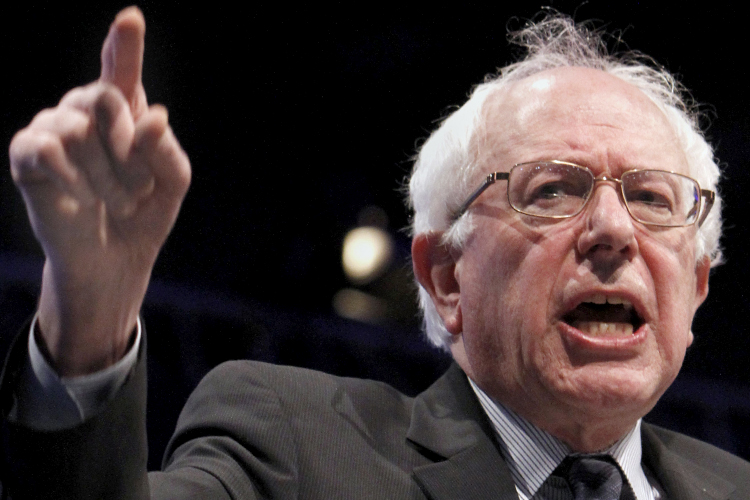
Bernie Sanders, OWS, and the Children of Allentown

Bernie Sanders. (Credit: AP/Rich Pedroncelli.)
Does anybody remember Occupy Wall Street? As nutty and quixotic as it was, it grew out of real social problems and concerns. And the improbable success of Bernie Sanders as a presidential candidate is a reminder that the problems didn’t go away just because the protesters did.

“We Are the 99%”

To refresh your memory: OWS never had a single public list of demands, although several people posted lists on their website which the press then published as “official”. Nevertheless, Roger Lowenstein wrote in Bloomberg.com, “the overall message is reasonably coherent. They want more and better jobs, more equal distribution of income, less profit (or no profit) for banks, lower compensation for bankers, and more strictures on banks with regard to negotiating consumer services such as mortgages and debit cards. They also want to reduce the influence that corporations — financial firms in particular — wield in politics, and they want a more populist set of government priorities: bailouts for student debtors and mortgage holders, not just for banks.”

This “reasonably coherent message”, give or take an exaggeration or two, could just as easily be Sanders’ platform.

Even near the end, OWS had support from about one-third of American voters, finding some little support even among Republicans, according to Public Policy Polling, while just over half the Democrats responded favorably. The cry “We are the 99%”, as inapposite as it was, found resonance with a significant percentage of the people; Paul Taylor of the Pew Research Center told Scott Horsley of NPR that it was “arguably the most successful slogan since ‘Hell no, we won’t go,’ going back to the Vietnam era. … [It] certainly triggered a lot of coverage about economic inequality.”

Monday, January 11, 2016

Defining the “Disappearing Middle Class”

Michael J. Perry
(Image source: sacbee.com.)
On December 30, 2015, economist Mark J. Perry published in his American Enterprise Institute blog Carpe Diem a couple of charts purporting to show that the American middle class, so far as it can be said to be disappearing, is doing so into higher-income households. Said Perry:

Over the last nearly 50 years the biggest gain for US households has been the 16.6 percentage point increase in the share of high-income households earning $100,000 or more per year, which accounts for the declining share of low-income and middle-income households (by two different measures). Yes, the middle-class has been disappearing over the last generation or more, but they have moved into higher-income categories of household income, not moving down into lower-income categories of household income.


“Cooking the Books”

Of course, Perry is a recognized economist, and I’m just a smart-aleck with a computer and three credit-hours in Econ 201. But I’m also a son of a bookkeeper, and have seen many interesting tricks people can play with numbers. Science is heavily dependent for its effectiveness on the honesty by which it applies numbers to phenomena, and is therefore vulnerable to anyone who knows how to “cook the books”. And the “dismal science”, like the others, tends to suffer when the numbers collide with policy preferences.

The picture Perry paints is of a middle class that was better off in 2014 than it was in 1967 — at the very least, that said middle class is making more money even after inflation is taken into account. However, to get an apples-to-apples comparison, he has to account for inflation. And here’s where the problem begins: there are a number of tools an analyst can use for inflating and deflating number … but none of them are 100% accurate. (For a comparison of four common price indexes used in policy analysis, see this post in The FRED Blog.)

Thursday, August 6, 2015

The Chittister Challenge

Sister Joan Chittister, OSB, is arguably the Church in America’s best-known “Spirit of Vatican II” relic, a visible reminder of why so many orders of nuns are failing. The Limousine Left loves Sr. Joan not only because she’s a programmatic liberal but also because she’s an exponent of the “primacy of conscience” argument, which is the Catholic left’s favorite fig leaf for its divergences from orthodoxy. Nevertheless, occasionally, like a broken clock, she’s right every once in a while.

Some years ago, Sr. Joan said (to the delight of the pro-abortion establishment):

I do not believe that just because you’re opposed to abortion, that that makes you pro-life. In fact, I think in many cases, your morality is deeply lacking if all you want is a child born but not a child fed, not a child educated, not a child housed. And why would I think that you don’t? Because you don’t want any tax money to go there. That’s not pro-life. That’s pro-birth. We need a much broader conversation on what the morality of pro-life is.

A person on Facebook asked a question that The Blogger Who Must Not Be Named reprinted: “Would you accept a 50% income tax if it ensured that no woman would ever feel compelled to have an abortion because of financial worries?” It’s the same question Sr. Joan asks from a different angle — how far is the pro-life movement prepared to go to diminish the incidence of abortion?

Despite what Leslie Salzillo of the Daily Kos thinks, there are plenty of pro-lifers who support government safety-net programs, especially those geared toward poor single mothers. Contrapositively, there are also those who plug abortion to save tax money paid in welfare; so it’s not as if the pro-life movement has a monopoly on anti-tax tightwads.

Still, as Elizabeth Stoker Bruenig points out, “If a woman considers herself too destitute to care for a child, there is no transvaginal ultrasound demoralizing enough and no accompanying narration excoriating enough to make her decision [to abort] seem any less plausible.” So are we prepared to pay higher taxes if by doing so we could see a reduction in abortions?

Monday, March 23, 2015

Paul Krugman Believes His Own Eyes—UPDATED

Photograph by David Levene/eyevine via Redux.
Tim Worstall’s recent Forbes.com piece, “Paul Krugman’s Amazing About Face On The Minimum Wage”, reminds me very much of the old joke that either came from or found its way into the musical Chicago: The woman who comes home to find her husband in bed with another woman. In the middle of protesting his innocence, the cad asks his angry spouse, “Who you gonna believe, me or your own eyes?”

Worstall’s piece is all about the differences between “good Krugman”, who in September 1998 published an article derisively dismissing minimum-wage arguments (because “the amorality of the market economy is part of its essence, and cannot be legislated away”), and “bad Krugman”, whose March 2 NYT op-ed “Walmart’s Visible Hand” made a devastating concession: “… [E]xtreme inequality and the falling fortunes of America’s workers are a choice, not a destiny imposed by the gods of the market. And we can change that choice if we want to.”

Old Krugman said that Walmart paying higher wages might lead to less turnover, better morale and higher productivity. But only at Walmart because the operative part was “higher wages than other employers”. And that’s the one thing that a general rise in wages, for example a rise in the minimum wage, cannot accomplish.
New Krugman tells us that a rise in the minimum wage will accomplish exactly that thing that Old Krugman tells us is impossible.

What might be the difference between Old Krugman and New Krugman? Seventeen years of observation? The intervention of a recession which exposed underlying fallacies in free-market thinking? Oh, no: according to Worstall, the difference is a paycheck from that “hotbed of liberal ideology,” the New York Times.

And that, my friends, is pretty much the full substance of Worstall’s refutation of Krugman: He writes for “Hell’s Bible”.

Friday, August 1, 2014

McDonald’s and the Screwing of the American Worker

Protesters outside of McDonald's Oak Brook, Ill. HQ,
20 May 2014. (© Fast Food Forward)
McDonald’s is facing more problems … and I’m not referring to their relatively disappointing revenue performance. Or their ill-considered sponsorship of VH-1’s absurd time-slot filler Dating Naked.

No, the new problem is that, on Tuesday, the National Labor Relations Board ruled that the Golden Arches could be named as “joint employer” in a number of workers’-rights complaints against franchise-owned stores. AP’s Candace Choi tells us that the franchisees aren’t happy about it either. “If franchisors are joint employers with their franchisees, these thousands of small business owners would lose control of the operations and equity they worked so hard to build,” said a statement released by the International Franchise Association. And that’s no small source of worry, because franchisees have little control over their operations and equity to begin with.

For those of you without any QSR experience, let me give you my perspective on it: In one way, buying a franchise is like buying a house —the only thing you really own is the promissory note you signed for the loan. On the other hand, there are significant differences: In your house, you can have the décor, the furniture, the food and the clothes you like. When you’re a franchisee, you’re not really your own boss; the major difference between you and a regional manager is that you have assets at risk.

General managers (the ones who run individual stores) see it clearly. Choi’s story mentions the frequent visits corporate reps make “to check up on how franchisees are running restaurants, including by standing outside the drive-thru to time how quickly cars go through. Said longtime employee Richard Eiker, ‘Managers go crazy when corporate comes in for these inspections.’”

They do; I know.

Monday, June 23, 2014

It’s still the wealth gap, stupid

Image source: Center for Financial Social Work, 2013.
According to former Secretary of Labor Robert Reich, some businessmen are looking at the economic data, and they’re worried. The problem, from their perspective, isn’t taxes. The problem isn’t regulation. No; from what they can see, the problem is that the middle class — the people who buy their products — don’t have enough money.

Mirabile dictu, some people are finally beginning to connect the dots.

As I’ve noted in this blog before, since 1999 real income has been declining for everyone in the bottom 80%. For those who need the explanation, you get paid today in nominal dollars; real dollars are nominal dollars after inflation has been taken into account. Theoretically, real wages stay flat when income increases match price increases, and rise when wage increases outpace price increases.

And in fact, nominal wage increases did outpace price increases throughout the Clinton Administration, such that the real wage increase by 2000 was 15.79% across the bottom 80%.[1] But from 1999 to 2012, real wages declined an average of 10.59% across the bottom 80%, until they were only marginally better than they had been in 1980; in the case of the bottom 20%, almost all gains were wiped out.

Real wages only tell part of the story. Between January 1983 and November 2013, personal savings dipped alarmingly, from 10.4% of disposable income to 4.2%, while the real consumer debt per household more than doubled, from $11,386 to $23,238. Between 1980 and 2012, the middle classes’ share of aggregate income diminished from 51.7% to 45.7%; as of 2010, the bottom 80% had only 11% of total net worth and 5% of financial wealth. And while median net worth and financial wealth decreased across racial lines, for the average black and Hispanic household such things practically disappeared between 2006 and 2010.[2]

Image source: Fed. Reserve Bank of San Francisco, 2013.

Thursday, June 5, 2014

Pope Francis and the libertarians

Cdl. Oscar Rodríguez Maradiaga.
So far up to this point, I’ve been deafened by the lack of libertarian reaction to Cdl. Oscar Rodríguez Maradiaga’s keynote speech at Catholic University of America’s conference on Catholicism and libertarianism. After all, it’s been more than forty-eight hours since Religion News Service’s David Gibson and Church whisperer Rocco Palmo broke the story.

Perhaps there’s some confusion among the ranks; as Kevin and Teresa Rice explain in Catholibertarian, “As it is uncommon to find two Libertarians who agree on very much, there is a wide room for difference of opinion and degree of commitment to at least the latter part of this composite.” Is what Cdl. Rodríguez condemned something that at least three out of four self-described libertarians assert?

Or perhaps libertarians and other conservatives have just stopped listening to the Church on economic matters. Cdl. Rodríguez cited an article in the National Catholic Fishwrap by Michael Sean Winters, who further references the ineffable Fr. John Zuhlsdorf: “I wonder how many people are still listening to [Pope Francis] seriously on this issue …. It comes across as naive, out of step with history.” This extract, partial and out-of-context as it is, is gentler than the nutty thrown by John Moody of FOX News:

By appearing to sanction what amounts to forced redistribution, Francis grievously exceeded his authority and became what amounts to a robe-wearing politician. He also exposed his Church, one of the wealthiest institutions in the world [one of the most pernicious myths in Western history], to inevitable charges of hypocrisy. And he put himself in a position of having to back up his frothy talk with ruinous action.
As I’ve noted in The Impractical Catholic, political progressives aren’t the only Americans who practice “cafeteria Catholicism”; not all conservatives and libertarians are above doctrinal cherry-picking.

Thursday, January 23, 2014

The tragedy of the corporations

In 1968, economist Garrett Hardin published an article in Science magazine titled “The Tragedy of the Commons”. Although the article has been criticized for its factuality, the concept itself — also known as “the tragedy of the fishers” — has been applied in other areas. Briefly stated: One business’ best practice, when replicated throughout an industry, may become a suicide pact. That is, each business may be acting independently and “rationally” as economists define rationality (that is, according to each business’ self-interest); yet taken as a whole they’re acting in a manner contrary to the best interests of the industry … and perhaps the national economy.

One good example is the buffalo-hide boom of the 1870s: The failure of the clothing industry to put a limit on demand through high prices practically insured that the great beasts would be hunted almost to extinction, with devastating effects on the Plains Indians who had built their lives and tribes around the buffaloes’ migrations. But none of this was the suits’ intent — they were simply trying to give the customers what they wanted, that’s all.

Economics is supposed to be an empirical discipline, concerned with how people do behave rather than how people ought to behave. Part of the problem with calling self-interested behavior rational is that self-sacrificial behavior is subtly, subconsciously apostrophized as irrational; any behavior becomes “moral” so long as you can make a business case for it. The boundary between is and ought is not only frequently crossed but was probably blurred to begin with. Moreover, it creates a false position in which economic laws become not just observed (or at least theoretical) relationships but something inviolable and self-enforcing as the laws of physics; invisible, indefinable “market forces” create an economic karma which punishes the unrighteous and creates order in the house.

Thursday, January 16, 2014

Dumb idea #6,258: Create jobs by paying poor people less

… [The] alternative to unbridled capitalism is not socialism but Catholicism.
Michael Coren, “Blessed are the poor

The main problem with most non-economists’ economic analyses is that they take one aspect of economic relations and then ride it into the ground. Case in point: “How Democrats Kill Jobs”, a piece in Defining Ideas by Richard A. Epstein.

Epstein is a libertarian looking to make a case against government intervention in the market via an increase in minimum wages. He begins by looking at the most recent jobs report:

The latest government labor report indicates that job growth has slowed once again. It is now at a three-year low, with only an estimated 74,000 new jobs added this past month. To be sure, the nominal unemployment rate dropped to 6.7 percent, but as experts on both the left and the right have noted, the only reason for this “improvement” is the decline of labor force participation, which is at the lowest level since 1978, with little prospect of any short-term improvement.

So far, so good. But it’s his second paragraph in which he sets out his theme:

One might think that these figures would be taken as evidence that a radical change in course is needed to boost labor market participation. The grounds for that revision rest on a straightforward application of the fundamental economic law of demand: As the cost of labor increases, the demand for labor will decrease [bold type mine.—ASL]. There are, of course, empirical disputes as to just how rapidly wage increases will reduce that demand for labor.

From this point on Epstein’s line of argument wanders off course. How will getting rid of the minimum wage and extended unemployment benefits boost labor force participation? Will businesses and buildings stop needing janitorial services if their contractors have to pay $11.10/hour rather than $7.25? Epstein is more concerned with slamming Democrats than with explaining himself.

Saturday, January 11, 2014

What is the problem with income inequality?

Click to view larger graphic.
Since Pope Francis promulgated Evangelii Gaudium, with its infamous passage on “‘trickle-down’ theories”, conservatives — especially conservative Catholics — have been rather touchy.

Most of them aren’t driven by their own personal greed. Many if not most aren’t even wealthy, but rather solidly part of the middle class. For the most part, they’re good, well-intentioned people … even the disciples of Ayn Rand. And most are well aware that capitalism rewards some ugly human traits even given positive legislation and effective regulation. They don’t defend the ugliness or the weaknesses; they simply hold that capitalism works better than do communism or socialism.

But while the increase of the “wealth gap” has been a source of some concern for a while now, from recent conservative reactions, you would never have guessed that anyone spoke of income inequality before Francis. “But what IS it exactly?” asks my friend Elise Hilton. “Does it mean that a teacher, a brain surgeon and a garbage collector should all earn the same wage? Does it mean the wealthy entrepreneur should simply give away her money, rather than investing it or leaving it to her heirs?”

These must be rhetorical questions. After all, with the exception of a handful of leftover Communists still dreaming in their academic refuges, liberals accept that different jobs will merit higher or lower wages. No one has a problem with entrepreneurs investing their income or leaving it to their kids; in fact, no one has a problem with people becoming or remaining rich.

It’s important to stress this because some writers, such as Pat Buchanan, dismiss the inequality issue as an attempt to ramp up class warfare based on envy of the wealthy. While this might be the case for some liberal politicians, the dismissal itself is an ad hominem; calling an opponent’s motives into question doesn’t disprove his argument or render it less credible.

Wednesday, January 1, 2014

The recovery that isn’t

In December, the federal government released information that the gross domestic product was up 4.1% for the third quarter of 2013, and that 203,000 people had been employed, bringing the unemployment rate to 7.0%. Time to pop the champagne corks; it finally appears the recovery is taking hold, right?

Jobs lost, October 2006 – October 2013
Increase in real disposable income, 1979 – 2010.
(Graphic source: Washington Post.)
Somebody forgot to tell the rest of us. While the Bloomberg consumer confidence level is the highest it’s been since August, it’s still not where it was in November 2007. A recent Gallup survey showed that almost twice as many Americans believe the economy is “poor” as believe that it is “excellent” or “good”, and that over half believe it’s getting worse. Over 4 million of the 8.656 million jobs lost from October 2006 to October 2009 are still missing from the economy; many of those who lost jobs left the market and haven’t returned.[1] Congress is shutting off extended unemployment benefits even though the average length of unemployment is still 37.2 weeks, over twice as long as in September 2007 (16.3). ABC News tells us, “While more than 2 million new jobs were created in 2013, a large share of them were low-income retail and restaurant positions.”

If that weren’t enough of a buzz kill: Alan Greenspan reminds us that businesses still aren’t making large investments in fixed assets or long-term Treasury bonds. While consumer spending is up, income isn’t rising to match. In fact, Peter Thiel shows us that the real average income of bachelor’s degree recipients has dropped over the last ten years even as student-loan debt and college tuition increased; and Sen. Chuck Schumer (D-NY) enjoins us to “focus like a laser” on the light blue line of the graphic to your left, which shows that the middle 60% of incomes has not increased as much as even the bottom quintile.

Saturday, December 14, 2013

The “starter job” myth and economic reality

After my post on Impractical Catholic, “Conservative ‘cafeteria Catholics’ on parade”, got linked into Facebook, my fellow Catholic Stand writer, screenwriter/producer John Darrouzet, asked me if I’d seen Jon Stewart roast the FOXNews business pundits on The Daily. Thoughtfully, he provided a link in case I hadn’t. I hadn’t, because I don’t follow either The Daily or The Colbert Report. (I just don’t watch a lot of TV anymore.)

If you haven’t seen it, go ahead and watch it now; I’ll still be here when you get done.

INTERMISSION


Stewart is at the top of his game; but then, morons of that caliber are almost too easy to mock. FOX must have some kind of satanic genius for picking commentators that liberals can laugh at; Megyn Kelly’s jaw-droppingly racist “white Santa” statement was an early Christmas — er, “holiday” present for left-wing wits all over the nation.

The one comment that really arrested my attention was made by — I’m sorry, I don’t know any of the players on The Kudlow Report, so I’ll just call her “Talking Head #2”: “I’m a big fan of ‘empowerment’ over ‘entitlement’, and these minimum-wage jobs aren’t meant to be life-long jobs; they’re supposed to get your foot in the door and get skills ….” Or, as a co-worker of mine spat, “They’re supposed to be ‘starter jobs’ for high-school kids, kids working their way through college!”

I don’t know where that myth got started. That it is a myth, a just-so story devised to confirm alrightniks like TH2 in their vocational superiority and material comfort, is incontestable. In the normal course of operations, businesses don’t create jobs to fit a particular kind of applicant; they create the job and then fit hiring criteria to it. TH2 and my coworker have the sequence exactly backward.

Saturday, August 17, 2013

What’s wrong with “What’s Wrong with Distributism”?—UPDATED

The nice thing is, David Deavel has some good things to say about distributism … in a previous post. However, Deavel’s understanding of distributism stops at about 1927.

Specifically, Deavel identifies four “areas of thought” where distributists’ critiques of the capitalist model strike tellingly: 1) the divorce of economics and ethics, 2) the collusion of large business and government and the resultant concentration of power, 3) the effect of the concentration of capital (Deavel says “wealth”, which is not the same thing) on entrepreneurship, and 4) the effect of the welfare state on the citizen’s relationship to the government. “Sadly,” Deavel moans, “distributist thinkers don’t stop at these solid insights. They offer concrete solutions to these social problems — solutions which betray grave misunderstandings of economics and even theology.”

From such a statement, you would expect at minimum a detailed economic critique illustrating distributist assumptions and contrasting them with How the Real World Works. On the theological side, Deavel, an associate editor of Logos: A Journal of Catholic Thought and Culture, might be expected to have an equally sound understanding of distributists’ reference to Catholic social theory.

What Deavel gives us, however, is a collection of straw men, attributing beliefs and statements (“Distributists like to say that …”) without pulling direct quotes to support his claims, and even stooping to smear tactics by implying admiration for fascism. The farthest Deavel goes toward naming names is to mention G. K. Chesterton, Hilaire Belloc and Arthur J. Penty, men long dead, while saying nothing of living distributists such as John C. Médaille, Thomas Storck and Race Matthews. It’s as if one were to critique modern psychiatry by analyzing only the works of Sigmund Freud, Carl Jung and B. F. Skinner.

Saturday, March 9, 2013

Income inequality a blessing?

When I give food to the poor, they call me a saint. When I ask why they are poor, they call me a communist.
—Dom Hélder Pessoa Câmara
The philosopher … rose up and departed with the air of a man that had co-operated with the present system.
Samuel Johnson, The History of Rasselas, Prince of Abyssinia


According to RealClearMarkets.com’s editor, John Tamny, income inequality is a good thing.

Keep in mind, I get this second-hand from Michelle Smith of MoneyNews.com. You could therefore argue that she quotes Tamny selectively. On the other hand, Smith says nothing to contradict or undercut Tamny, so she’s either in agreement with him (“He who is silent consents”) or letting him hang himself with his own words.


Tamny points to the rising popularity of cell phones, reminding us that back in the 1990s these devices were a source of awe. The wealth of the wealthy has also changed society by improving the masses access to a wide range of items, from music to healthcare. [Please hold the laughter in; the best is yet to come.]
“[T]he simple, life-enhancing truth [is] that when the wealth gap is increasing, that’s a certain signal that the lifestyle gap is shrinking —rapidly,” Tamny writes.
“[T]he sentient among us should cheer every time they read of rising inequality,” he adds. “The sentient should cheer because it signals enterprise being rewarded, freedom to keep the fruits of one’s labor, and then for all of us not rich it signals that our lives are getting better and better; the lifestyle disparity between us and them (the rich) shrinking precisely because economic achievement is taking place.”


Tuesday, January 15, 2013

The next fiscal battle (Part IV)

Here we go with what I hope will be the last installment on the budget war coming up next month:

If nothing else, I’ve been trying at least to convince you that cutting the federal budget is nowhere near as simple a task as slicing a few hundred billion dollars off defense or transfer payment spending — or at least, not if you want to do it right — and that doing it in the middle of a weak, uncertain recovery has insidious potential for pushing us into another, more severe recession.  But yes, we have to start paying on the national debt; it’s poor stewardship to allow debts to go unpaid when you have the funds to start paying them off.  If you don’t have the funds, then you strip off non-essentials until you do.

There’s the rub: What spending is essential, and what spending isn’t? 

Because the transfer of wealth from the top to the bottom isn’t intrinsically or necessarily a government function, it doesn’t follow that for the government to do so is wrong, or that it can’t be done on a limited, even ad hoc basis.  That’s not consequentialism; that’s simply asserting that the Austrian school is wrong: capitalism doesn’t need an absolute right of property to thrive.  The common defense, on the other hand, is not only a necessary and intrinsic function of government but one of the reasons we junked the Continental Congress in favor of our Constitutional government: the Continental Congress simply couldn’t collect any taxes the states didn’t want to pay, so they couldn’t pay either the Army or the Navy.

Nevertheless, it’s true that these two categories, put together, transfer payments and defense make up most of the budget.  Since 1959, they have never comprised less than 74.97% of current federal expenditures; as of July 2012, they were 85.9%, the highest they’ve been in twenty-five years.  The other 14.1% is worth $538.1 billion, which is still a lot of money … but it’s only 20.14% of $2.671 trillion dollars in current federal receipts.

Sunday, January 13, 2013

The next fiscal battle (Part III)


Sometimes we bring missiles; sometimes we bring medicine.
In the first part, we looked at the two major targets lined up in Republican crosshairs for spending cuts, asked why they’re targets, and asked why cutting them aren’t good ideas. 

What I left out is that, in classic economic model, decreasing expenditures and increasing taxes are both recessionary measures: they slow down a booming GDP and decrease a stagnant GDP.  At least in theory; analysis of the effect of marginal tax changes over the last forty years doesn’t give us confidence that tax cuts do anything towards job creation plus or minus.[*]  Theoretically, if we’re looking to boost the economy, then the last thing we should do is cut spending … in fact, if anything, we should spend more.

In the second part, I stopped to answer the question, “What’s specifically Catholic in your position?”  The answer is that, beyond some rough outlines, the Compendium of the Social Doctrine of the Church gives no specific policy directives.  On the one hand, it can be argued that a balanced budget is good and proper stewardship of the people’s money.  On the other, while the Church doesn’t mandate a statist answer to the problems of unemployment and business regulation — in fact, she has long rejected socialism and communism — she does encourage the State’s active participation in both. 

I also argued that too much dependence on deficit spending encourages an unhealthy closeness between government and the finance industry, facilitating cronyism and regulatory capture, and creating a “government of the 99% by the 1% for the benefit of the 1%”.  Enlightened self-interest is, in the end, still self-interest; if financing transfer payments requires massive government borrowing, will the banks say, “No, no, no, that would be harmful in the long run”?

In the first part, I also promised that we would delve a little further into defense spending: