Showing posts with label Hard Truths. Show all posts

Monday, August 15, 2016

Jon Stewart, The Daily Show, and the Trump Campaign

Jesse Bernstein of Tablet blames Donald Trump on Jon Stewart. Well, partially, at least; he does admit upfront that there are plenty of factors in the matter. But apparently Stewart and his The Daily Show compatriot Stephen Colbert are partially to blame because they “helped to create the very specific type of internet-era liberal smugness (and, consequently, ignorance) that, though far from the sole cause by any means, has been a significant factor in both the rise of Trump and our current political fracturing.”

The Daily Show’s Liberal Smugness

Here’s the centerpiece of Bernstein’s argument:

[Stewart’s] show [The Daily Show] was a cultural touchstone that dealt in mockery and ridicule, as good political comedy should. It parsed the bluster to find the nugget of insincerity that drives selfish politics. But as the democratization of media made it easier and easier to hear only from the sources you wanted to hear from, those who counted The Daily Show and its even jokier spawn, The Colbert Report, as news sources slowly but surely created an echo chamber.

The process went something like this: Someone said something on Fox News that mainstream liberalism didn’t like; Stewart and/or Colbert aired a sustained critique of the idea and the thinking behind it; liberal internet publications hailed it as the greatest rhetorical victory since Darrow argued for Scopes; liberals’ Facebook feeds full of liberal friends filled up with clips of the takedown. No one learned anything, no one engaged with an idea, and nothing outside of a very specific set of ideas was given any real credence. As Emmet Rensin so perfectly put it:

Finding comfort in the notion that their former allies were disdainful, hapless rubes, smug liberals created a culture animated by that contempt. The result is a self-fulfilling prophecy. … Over 20 years, an industry arose to cater to the smug style … and culminated for a time in The Daily Show, a program that more than any other thing advanced the idea that liberal orthodoxy was a kind of educated savvy and that is opponents were, before anything else, stupid.

As Rensin deftly discerns, this sort of intellectual elitism is probably part of the reason that the Democratic Party went from getting 66 percent of the manual laborer vote in 1948 to outpolling the GOP by just 2 points in 2012. It’s the inevitable consequence of eight years of reducing George W. Bush and all of his supporters to dumbass hicks, and choosing to denigrate the poor and uneducated (if only they read The Atlantic!), rather than doing real outreach to them. But as Christopher Hitchens learned on Bill Maher’s show, people don’t want to consider that possibility[.]

Saturday, June 18, 2016

Why We Can’t “Do Something” About the Gun Problem

Sig Sauer MCX, similar to rifle used at Pulse massacre.
(Image source: newweaponsandmore.blogspot.com)
In the wake of the horrific massacre in Orlando, people are once again demanding we “do something” about the massive number of guns in American hands — an estimated 357 million privately-owned guns as of 2013, or about 112 guns per 100 citizens. Some demand we get rid of guns altogether; others demand we loosen the legislation to put guns in the hands of more people. And both sides are churning out bogus “facts” to support their positions.

To be clear about my own biases: I believe the Second Amendment as written is outdated and needs revision. I favor reasonable legislation which includes mandatory training and certification as well as reasonable restrictions on carrying and purchasing. However, the research and statistical analysis I’ve done over the last couple of days highlighted for me both the drama and the intractability of the problem. To put it concisely, there’s plenty we can do about the American gun problem … most of which will do little if anything to solve it.

By the Numbers

To give you an idea of the legislative mess:

  • Only 17 states[*] require some form of permit or license to purchase a weapon; in many cases, the requirement only obtains for pistols.
  • Only 9 states require registration, mostly of handguns, sometimes only under certain circumstances.
  • Only 6 states require a license to own a handgun.
  • The concealed-carry laws of 42 states vary from very strict may-issue conditions to non-mandatory permits issued on request for the sake of reciprocity with other states.
  • Open-carry is permitted to some degree in 30 states.
  • There are only 8 states in which local ordinances can do more than limit discharge of weapons; in 22 states, state pre-emption is total.
  • Eleven states have no magazine capacity restrictions; 8 have no “assault weapon” restrictions.
  • Nineteen states require no background checks for private sales.
  • Only one state, California, imposes a mandatory waiting period as well as requiring a purchase permit.
  • Thirty-three states have some version of “castle doctrine” or “stand your ground” law, either on the books or through case law.

Wednesday, May 25, 2016

I Believe … But I Don’t Understand

Image source: gospelcoalition.org.
On Monday, May 23, Patheos published an article by Rebecca Bratten Weiss on suffering and “the clamor of insufficient explanations”. By “insufficient explanations”, Weiss means not only the myriad of clichés we Christians inflict on the suffering and despairing (“If God brings you to it, He will bring you through it;” “God shapes the back to fit the burden”), but also the assertion, “It must be God’s will.”

The Challenge of Suffering

The problem of suffering is the single most potent argument against Christian theology and cosmology, because it cuts past the dry hairsplitting of philosophy to pose a direct challenge to the heart. As Weiss puts it, “The fact that we need to suffer to be well is a symptom of a fallen world, but to suggest that the suffering itself comes not from the darkness of nature but from God on high is horrifying, sadistic.”

In Dostoevsky’s The Brothers Karamazov, the atheist brother Ivan refuses to believe in a God who allows the suffering of children, and says that even if there is some inexplicable benefit to be derived from this, he will not have it. “I respectfully return the ticket” he says. I sympathize. I respectfully return the ticket to whatever fun-house or extravaganza somehow necessitates this terrible suffering. I would rather join Ivan and deny God outright, than believe in a God who is up there pulling all the strings that lead us to torment and loss, because this was the only way, the best of all possible worlds. [N.B.: Weiss has not abandoned the Faith, either formally or informally.]

We can’t escape the challenge by blaming the darkness of nature; for if Nature is dark, it can only be by God’s Will. And it’s not even the best of all possible worlds (cf. St. Thomas Aquinas, Summa Theologiae I:25:6 ad 3). Whether God manipulates all events directly, or simply sits back and watches everything play out by itself, or some combination of the two, the buck stops at His desk.

Saturday, April 16, 2016

Timothy Egan and the Reverent Subject of Sex

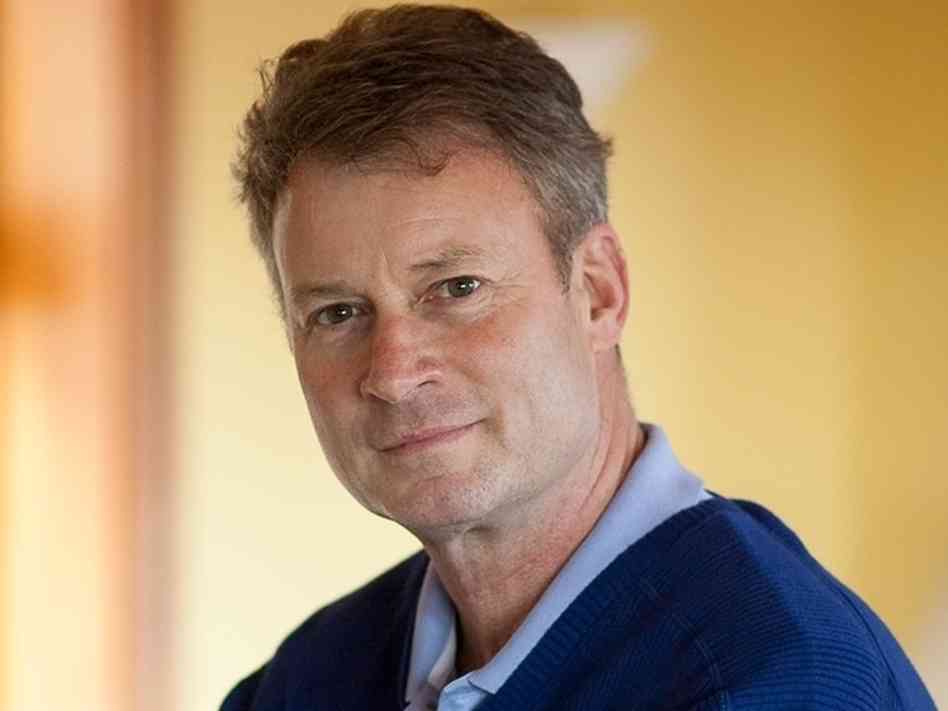
Timothy Egan. (Photo: Barry Wong.)
The last few days, I’ve been focused on the hyperventilating by Catholic radical traditionalists over Amoris Laetitia, Pope Francis’ overlong summation of the work of the last two Synods on the Family. The reactions from the left were, for the most part, entirely predictable — some despaired because it didn’t go as far as they thought it should, while others rejoiced because they thought it went farther than it did. Of the latter category, we have Timothy Egan of the New York Times, who penned what Phil Lawler has called “surely ... the dumbest column published on the topic.”

“Sex was Dirty”

Egan, Lawler states, “rolls out the stale complaints of the 1970s about the Bad Old Church, opening and closing his column with citations from the late comedian George Carlin. The reader will look in vain for references to any other authority. Nor is there evidence that Egan has paid attention to Catholic writers who have reflected on the Church’s approach to human sexuality more recently, and just maybe more profoundly, than Carlin—such as, just for example, St. John Paul II.”

Actually, Egan does worse than go without authoritative references: he cites the Baltimore Catechism in such a way that it appears to support the tropes.

Sex was dirty. Sex was shameful. Sex was unnatural. Thinking about it was wrong. Premeditation itself was a sin, and so was flirting. Sex had one purpose: procreation, the joyless act of breeding. “The sixth commandment forbids all impurity and immodesty in words, looks and actions,” was admonition No. 256 in the Baltimore Catechism, the standard text used to teach the faith from 1885 to the late 1960s.
No. 256 [sic; the actual answer number is 257] also warned about the dangers of “sinful curiosity, bad companions, drinking, immodest dress and indecent books, plays and motion pictures.” If that sounds now like the dynamics of a good dinner party, you can also see this pope joining the fun at the table.

In my post on Amoris Laetitia, I spoke of the distinction the Church makes between the doctoral (“What do we teach?”) and the pastoral (“How do we integrate this teaching into parish life?”). The same kind of distinction ought to be observed between doctrine and indoctrination: religious formation, also known as catechesis. What the Catholic Church teaches is one thing; what Tim Egan and George Carlin “learned”, however, is another thing entirely, and may not be entirely their fault for not paying attention in class.

Saturday, March 12, 2016

God, Galileo, and the Transgendered

On February 27, Melinda Selmys, a self-described “queer convert to Catholicism”, wrote a post for her blog on Patheos titled, “Does God Make Mistakes? (And are Trans People One of Them?)” There are two ways, Selmys asserts, that trans identities could be “real and valid” without using a fallible God as an explanation. The first is the fallen nature of man; the second is that the binary model of sexuality is too simplistic.

Here Comes Galileo (Again!?)

I have a lot of respect for Selmys. C. S. Lewis said once that he didn’t talk about homosexuality as a rule because it wasn’t a problem in his life; he wouldn’t tell someone how to fight a battle he’d never fought. Likewise, never having thought of myself as anything but a male, I’m in no position to tell people with gender-identity disorder how to overcome it, nor can I fault them if they fail. In fact, as I understand it, GID is an almost intractable problem; even sexual-reassignment surgery is unreliable as a palliative. (See my post in The Impractical Catholic on sex changes.)

As I say, I respect Selmys, and don’t wish to impugn her fidelity to the Church. However, in defending her second postulate, instead of stepping through the common arguments in support of Church teaching and calling them into question, she drags Galileo into the argument to serve once more as the sine qua non of magisterial error. Poor, abused Galileo! Never simply allowed to rest vindicated, his shade must be constantly conjured up to bolster weak arguments: “Well, the Church has been wrong before. Just look at Galileo!”

Why, O why does Selmys, who is capable of so much better, reach for such a hackneyed and intellectually lazy comparison? Well, because apparently the Church hasn’t formally instituted the “binary model” as dogma:

How does this relate to the transgender question? Well, today we know that various bodies with lower levels of authority (lower, in many cases than the Inquisition of 1616) have condemned transgender identities. We know that Popes have offered indirect criticism (though Christmas greetings and Papal homilies are not official dogmatic pronouncements any more than airplane interviews are.) We know that the weight of theological tradition falls on the side of a strict male-female binary, and we know that Genesis 1:27 and Matthew 19:4 are traditionally interpreted as excluding legitimate variation from this scheme.
We also know that nothing about transgender or intersex conditions has been promulgated at a level of authority that meets Vatican I’s criteria for infallibility. This means that there remains open the possibility of developments in doctrine that will reveal a space within the order of creation for those who do not fit neatly into binary categories [bold type mine.—ASL]. The basic teaching — that we are created male and female in the image and likeness of God — could be compatible with the idea that there is some admixture of both the male and the female in certain individuals (an idea which, in fact, has roots in some ancient Jewish interpretive traditions.)

Monday, November 16, 2015

“Safe Spaces” and the Fear of Growing Up

Protesters at Amherst College. (Twitter via Daily Beast)
On Thursday, November 12, Amherst College in Amherst, Massachusetts joined the list of institutions that have suffered student protests. According to MassLive, the protest “was sparked by the shared experiences of students who felt discriminated against on campus ..., as well as recent incidents on campus, like the papering-over of ‘Black Lives Matter’ posters with anti-abortion messaging that said ‘All Lives Matter.’”

“The turning point and why it got so large is that multiple students of all sorts of background recognized a feeling of feeling marginalized, or feeling invisible or  feeling isolated in some important way,” [organizer Mercedes] MacAlpine said. “It really took off just being to come together and talk about those experiences.”

What began as a sympathetic sit-in strike in support of the protests at Yale and the University of Missouri took an uglier turn when signs appeared claiming that freedom of speech was the “real victim” at Mizzou. In a response freighted with irony, the protesters demanded that Amherst president Biddy Martin issue a statement saying that Amherst would not tolerate the actions of the students behind the “All Lives Matter” stickers and the “Free Speech” posters, and that said students could be punished and re-educated in “racial and cultural competency”.

Devin Foley, in a post on Intellectual Takeout, asks what’s the matter with kids these days. “At the same time some students are flexing their political muscles (with the help of some professors) at the University of Missouri, Yale, and other schools demanding ‘safe space’, we’re treated to an increasing number of stories about the lack of resilience and overall fragility of many college students.”

This juxtaposition of intolerance and delicacy isn’t as oddly self-contradictory as it appears on the surface. The need for “safe spaces” is individual, while the strong-arm tactics belong to the group: “safety in numbers”, as the saying goes. However, it’s clear more is happening on our campuses than an increase in racial tensions and student political activism. The safety the protesters seek is far less from physical assault than it is from fear itself: more and more students are demanding that colleges rescue them from everything that causes them the least anxiety or unhappiness, from racism and sexism to bad break-ups and failing grades.

Leftist politics has found its home in the children of helicopter parents.

Saturday, June 6, 2015

The smile on the lips of martyrs

I suppose we Catholic writers are socially expected to have a massive episode of cognitive dissonance over the news of the significant drop in religious affiliation over the years 2007 to 2014. Because, of course, this sort of thing has never happened before (he said while rolling his eyes melodramatically).

Religious revivals come and go. So do intellectual fads and ideological fashions. Leftist progressivism has been in the ascent in the last few decades, and irreligion has been riding its coattails as it’s risen. As I pointed out in my very first post on this site, neither atheism nor agnosticism offers us better arguments than they did a hundred years ago. However, the bar has been lowered. Scientific advances haven’t made Christianity indefensible; rather, pedagogical innovations and ideological indoctrination in the classrooms have left fewer Christians able to defend it.

When you’re not satisfied with an answer, it doesn’t take much to change your mind. Many if not most former Catholics didn’t leave the Church so much as they formalized a separation that had been there for many years, even from childhood. There’s now almost no social cost to abandoning religious practice; in some circles, irreligion is not only tolerated but expected. And, to be perfectly frank, the Church in the West made it easier by decades of poor religious education, clerical malformation, and episcopal cowardice.

By the same token, when you find an answer that satisfies you both intellectually and emotionally, the argument against it has to be very powerful in order to change your mind about its truth. No one has yet made an argument to Catholicism’s falsehood that I find remotely persuasive, let alone convincing. Indeed, many people seem more committed to mocking, berating, and shaming me out of my illusions than they are to showing me that they are illusions.

Wednesday, April 1, 2015

The Indiana RFRA and the torn-down forest


As of this writing, it appears that the Indiana state government is taking steps to undermine its own Religious Freedom Restoration Act. According to the Associated Press, Gov. Mike Pence has called for legislation “clarifying that [the RFRA] does not allow discrimination on his desk by the end of the week ... to address concerns that the law will allow businesses to deny services to gays and lesbians.” Arkansas Gov. Asa Hutchinson, facing similar pressure, has already preemptively called for changes to an RFRA bill on his desk.

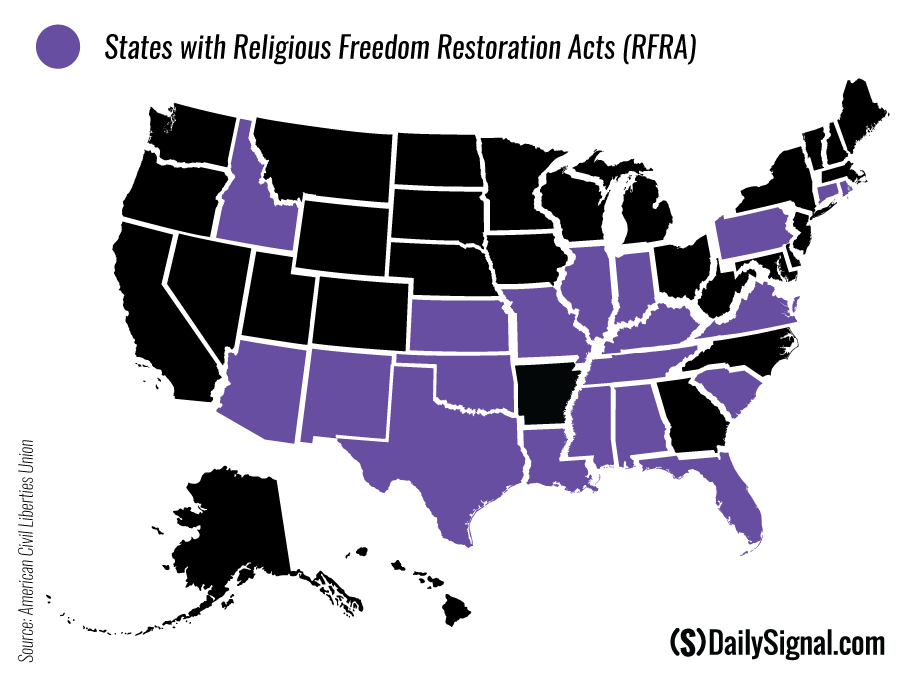
Nineteen states have RFRAs. Of these, eleven have non-discrimination laws at the city or township level, and two (Illinois and New Mexico) have state laws protecting gays, lesbians, and bisexuals. Another eleven have RFRA-like restrictions based on SCOTUS decisions. (Source: Daily Signal.) On the surface, the problem with Indiana’s RFRA is that it’s loosely written; critics claim that businesses can refuse gay people’s business, and that the civil-rights legislation and decisions of the last sixty years have determined that “you don’t have the right to choose who gets to sit at the counter.”

The truth of the matter, though, is that the other states all caught the RFRA wave at the right time, before SCOTUS’ decision in Lawrence v. Texas (539 US 558, 2003) made it “okay to be gay”. Now that wave has long passed; the LGBT lobby has command of a sizeable chunk of the culture factories, as well as the allegiance of the majority of our celebrities and politicians.

This makes the conditions most favorable for anti-RFRA moral posturing, along with its attendant obliviousness. For instance, the Daily Caller reports, “Connecticut Gov. Dannell Malloy will issue an executive order on Monday calling for a ban on state-funded travel to Indiana” … conveniently forgetting that Connecticut has an arguably more restrictive RFRA. Oops.

Friday, January 16, 2015

Talking smack about the Pope

It’s been over a week now, and certain people still haven’t gotten over the spanking Maureen Mullarkey received for her rather slanderous attack on Pope Francis. And a spanking it was; R. R. Reno, the editor-in-chief of First Things, not only washed his hands of her post but offered his own rebuttal to it, calling her criticisms and caricatures of Francis “overdrawn and ill-tempered”.

Oh, wait a minute — that’s not the spanking they’re not over. Rather, they’re not over the explosion from the Patheos blog, Catholic and Enjoying It, written by The Blogger Whom I’m Damn Well Going to Name for Just This Once, Mark Shea.

You see, Shea had just written the day before about the Catholic right’s pre-dismissal of Francis’ yet-to-be-completed encyclical on climate change; and lo and behold, out comes Mullarkey’s hit piece. (You could almost hear him yelling at the clay pigeon launcher, “Pull!”) So he unloaded on Mullarkey, as well as her First Things combox followers, calling it a “festival of crazy contempt for Francis” and a “revolting (in every sense) smear job”.

Christopher Ferrara at The Remnant promptly got upset on Mullarkey’s behalf, deploying even more right-wing buzzwords and straw men, along with a healthy dollop of radical-traditionalist contempt for “neo-Catholics”. (Apparently, Francis “kissed the Koran” when he posed for that shot holding the anti-fracking T-shirt.) Nevertheless, we might have been able to walk away from the shindy — certainly it doesn’t appear Shea’s given the matter any further attention — had not my Catholic Stand colleague Donald R. McClarey weighed in with further acid, preceded with the biggest straw man of them all:

“…[C]riticism of this Pope is verboten in the eyes of some bloggers.”

Thursday, December 4, 2014

The Battle at the Communion Rail

Communion rail, Church of the Holy Ghost, Tiverton, RI
(© 2012 Fr. Jay Finelli)
The new pastor of the Windy City, my fellow Omahan the Most Rev. Blase Cupich, didn’t wait too long to start the usual suspects huffing about the “Francis Effect”. In an interview with CBS News’ Norah O’Donnell, Abp. Cupich stated — or rather implied — that he wouldn’t deny participation in the Eucharist to Catholic politicians who hold positions contrary to Church teaching.

I say “implied” because, in context, +Cupich seems to be talking about an ad hoc decision during a Mass to withhold Communion: “I would not use the Eucharist, or as they call it ‘the communion rail,’ as a place to have those discussions or a way in which people would be either excluded from the life of the church.

“The Eucharist is an opportunity of grace and conversion,” he told [O’Donnell] in an interview that aired on “Face the Nation” Sunday. “It’s also a time of forgiveness of sins, so my hope would be that grace would be instrumental in bringing people to the truth.”

Naturally, this is the kind of thing that leads Huffington Post’s Carol Kuruvilla, playing the classic “good Church/bad Church” game, to gush, “Cupich’s softened approach stands in stark contrast to the position held by Cardinal Raymond Burke, a prominent conservative Catholic archbishop who has led campaigns to ban Catholic politicians who support abortions from receiving communion.” Just as naturally, it leads many in the Catholic commentariat, such as Brian Williams of One Peter Five, to wail and harrumph:

Let us hope and pray that Our Lord is not subjected to further sacrilege, and His Church to further scandal, by an outright refusal to enforce Canon 915 in Chicago. The Church loses credibility when she rightly advocates for protecting the unborn, but then gives Holy Communion to high profile, unrepentant, Catholic politicians who support the “right” to an abortion.

Wednesday, October 29, 2014

To a friend who is leaving the Catholic Church


A Hard Saying

I so totally admire your love of the Catholic Church Tony. I am saddened that some of the rules I can not live with and will be joining a Lutheran one that will accept me.
What could I say? Facebook is where I keep in touch with my family and friends; I don’t go there to engage in verbal fisticuffs or stand on my soapbox. And yet, I can’t help feeling the answer I gave — “Forget it, lady. You gotta do a lot worse than that to lose my friendship” — was well-meaning but unsatisfactory.

I suppose I could have been a smartass and built some quibbles based on the precepts of the Church or on canon law. But either of those sallies would have ended in an exasperated “You know what I mean!”

In fact, I do know what you meant, my friend. It’s not really the rules you can’t live with, but rather some of the teachings. It isn’t a question of whether the Catholic Church accepts you: she does, and always has. Rather, it’s a question of what you accept — or, rather, what you reject.

You’re not the first person to abandon the Church over a teaching that sticks in the craw. Read the “Bread of Life” discourse (John 6:22-66): as Jesus insists that “unless you eat the flesh of the Son of man and drink his blood, you have no life in you” (v. 53), his verbs in the Greek become more graphic, switching from phagō (to eat) to trōgō (to chew, or gnaw like an animal). At the end of it, many of his disciples leave him, telling themselves and each other, “This is a hard saying; who can listen to it?” (vv. 60, 66)

Monday, October 13, 2014

What’s procreation got to do with sex?

Have you seen this child lately?

Ask a Stupid Question

I wouldn’t blame you if you don’t believe me. I neglected to save the link, so I can’t prove it happened; I can’t even remember which blog it happened on (either Creative Minority Report or The American Conservative … I think). But, in the midst of a discussion a few years ago — was it about gay marriage? abortion? — an apparently intelligent and educated woman asked, in all seriousness, “Who said reproduction has anything to do with sex?”

I know — “You honestly expect us to believe that? Seriously? No one’s that dumb!”

Truly, most people, when they’re thinking about it, know that you don’t get pregnant from germs spread around the office, or from a bad batch of chicken or kale you bought at Walmart. Parents who don’t stop having children, like Damien and Simcha Fisher, can testify to this common knowledge from the many stale repetitions they get of the fake-hearty jab whenever a new baby is on the way: “You do know what causes that, don’t you?”. And God knows how many times I’ve heard other people jovially refer to the act as “making babies”, even when creation of a newborn was the last thing the participants wanted.

And yet ….

If you really pay attention to arguments concerning abortion, contraception, gay marriage and other pelvic issues, you do get the sense that many people believe reproduction to be incidental to sex, even accidental, rather than its biological raison d’être. You ever notice how many times they refer to penises and vaginas as if they were the only sexually distinct organs, as if testes and uteri had no known function to fill? And that they mention ovaries only to rhyme with “rosaries”?

In less than one hundred years, we have gone from accepting pregnancy as the natural consequence of sex to regarding ourselves entitled to sex without consequences … at least, those we don’t want just right now. So powerful is this sense of entitlement that we’re driven to treat reproduction as an unnatural “occasional side effect” of sex, or even as a disease. Reality must not be allowed to intrude upon our human right to get our freak on.

Thursday, August 7, 2014

Praying for Obama

Is he really praying? Does it really matter?

Respecting the President’s Name

Living in Texas, I often have occasion to reflect on Elton John’s satirical “Texas Love Song”. The link takes you to a live version of it performed in Austin, possibly the bluest city in Texas, in 1998, with Sir Elton’s pre-performance caution, “Don’t be offended.” Probably they weren’t; many square miles of Texas hold people who still wouldn’t recognize the song as satire, and the people of Austin most likely hold them in as much contempt as did lyricist Bernie Taupin.

One line especially stands out to me right now: “And kids still respected the President’s name.” Personally, I can’t think of a single POTUS whose name was universally respected in his lifetime; even ol’ George Washington came in for some calumny during his second term, and didn’t achieve veneration second only to the Blessed Virgin Mother until some years after he passed. When Taupin wrote the song, the President was Richard M. Nixon, who had succeeded Lyndon B. Johnson — ’nuf ced; hippies weren’t totally to blame.

Still ….

Father Erik Richtsteig at Orthometer and I have a couple of things in common: 1) We’re both friends of Katrina Fernandez (and, I believe, Frank Weathers); 2) We’re both Knights of Columbus. Yesterday, attending the Knights’ annual convention in Orlando, he posted on his status:


The cold silence didn’t bother me; that was possibly the least disrespectful thing the Knights could have done in response to Pres. Obama’s message. Nor did the reactions of Fr. Erik’s followers, which all told wasn’t a Facebook “two-minutes’ hate” so much as an all-day grump, bother me … except for one:


“Let his days be few; and let another take his office.” Brrr, yikes.

Friday, July 18, 2014

“The Mass of All Time”: Epilogue

No accounting for taste

De gustibus non est disputandum has been loosely translated as, “There’s no accounting for taste.” But when we say it like that, we imply flippantly that someone has chosen to pursue a godawful aesthetic choice despite our best efforts to point them in the right direction.

Unless there’s some objective criteria to which both sides agree, then no dispute over tastes can ever be resolved — you like what you like, and there’s an end of the matter. No matter how detailed your technical analysis, you’re not going to make a Billy Joel fan give up “the Piano Man” in favor of Elvis Costello, or force a person to get more pleasure out of listening to Metallica than to Barry Manilow. Concerning tastes there are no common grounds for disputation, and therefore no hope for resolution: you’re arguing for the sake of being ornery, that’s all.

Now, I’m not such a naïf as to believe that Anthony J. J. Mathison’s essay, which I’ve posted over the last four days, is The Last Word on the Novus Ordo Mass. People have been writing Last Words on topical issues since people have had writing, and the disputes have gone merrily on despite such thunder from the rostrum. The same is true for Catholics; we never resemble sheep so much as when we go astray, each of us turning to his own way (Isaiah 53:6). Rome may have spoken, but not everybody gets the memo that the case is now closed.[*]

What Mathison has done is clear the field of some errors, both historical and liturgical. This gives us room to consider the debate between traditionalists and “neo-Catholics” on grounds other than that of aesthetic “taste”, if you will.

Thursday, July 17, 2014

"The Mass of All Time": Part IV

[This is the last installment of a Facebook post by a Dominican novice, Anthony J. J. Mathison. I’ve done some minor detail work, such as replacing straight quotes with “smart quotes”, justification of the margins, inclusion of links, and so forth. I’ve also broken down long paragraphs into two or three smaller paragraphs for easier reading. Otherwise, I've left it pretty much as it appeared in Facebook. For this last installment, the combox will be open; I'll have my own final observations posted tomorrow.—ASL]

Part IV

“Organic Development” Reconsidered

Perhaps now it would be best to leave the weeds of this issue of “organic development” and revisit the larger paradigm; especially considering how fundamental it is to criticisms of the liturgical reforms.

I contend that the “organic development” of the Sacred Liturgy is better understood as a garden than a forest. I grew up in the country, so I ask that the reader please humor me. A forest grows wild and the changes that occur in its environment are due to natural events (storms, wildfires, animal life, etc.) which lack any human design or interference (generally speaking). A garden however is often changed due to the decisions of the gardener. Of course the gardener cannot change the nature of what he is growing or alter the substance of the herbage(!); he can and should however intervene (sometimes rather violently) in moving plants, pruning them, or even rooting them up entirely.

So it is with the Sacred Liturgy. The Pope and the Bishops alone are the stewards of the liturgical practice of the Church. Period. Like gardeners, they watch over and intervene in the liturgical life of God’s People to better allow the Sacred Liturgy to perform its intended action. If things arise in it that are detrimental to this goal, or are even simply seen as detrimental by the Magisterium, she will remove or change them as she sees fit. A Coptic Catholic helped to teach me that, so it’s not just a “Roman” thing.

Many reject this view however as giving too much authority to the Pope, but this not the case at all. To support their opinion, the critics quote Joseph Ratzinger before his election to the Papacy, but I hesitate to remind these same critics that a Cardinal’s words are not immediately given authority at the election of that hierarch to the Papacy. This especially goes for the previously mentioned and famous “banal, fabricated” quote that is used both out of context and endlessly. In any case, the quotes cited do not say what critics appear to think they are saying; but even if they did, it does not really help them. Why? Because Pope Benedict XVI said this about the OF in relation to the EF:

“There is no contradiction between the two editions of the Roman Missal. In the history of the liturgy there is growth and progress, but no rupture.” (Letter to the Bishops w/ SP)


Wednesday, July 16, 2014

"The Mass of All Time": Part III

[For the next four days, I will be reprinting in its full length a Facebook post from a Dominican novice, Anthony J. J. Mathison. I’ve done some minor detail work — replacing straight quotation marks with “smart quotes”, justification of the margins, inclusion of links, etc. — broken it into four subtitled sections because of the length (over 5,300 words), and broken long paragraphs into two or three for easier reading. In all other respects, the essay is just as it appeared in Facebook. I’ll reserve my own comments until Friday; I’ll also turn the combox off until the final post.]

Part III

The “Organic Development”

More sophisticated critics of the reform rest most of their arguments on the question of the “organic development” of the Roman Liturgy. Their contention, more or less, is that the changes made by Ven. Paul VI were too abrupt, drastic, and different from the EF to be justified. They quote both Ven. Pius XII in this matter (see above) as well as Vatican II itself, which mandated that no changes be made unless it is for the good of the Church and that such changes come organically from forms that already exist.

While it is quite true that liturgy is an organic thing (in that it grows under the guidance of the Church), there is false understanding running around lately that suggests that the organic development aspect is far more “powerful” or authoritative than it really is. Let us remember that not everything that develops organically is good. Barnacles, parasites, pathogen-borne illnesses, and genetic deviations are all natural organic developments; yet they often cause malaise or even death in the organisms to whom they attach themselves.

Vatican II understood this and openly noted that many things that had “organically developed” in the Roman Rite were simply unnecessary and even detrimental. That was a decision of the Church solemnly convened in Ecumenical Council; we must remind ourselves of this. We must also remember that the judge of what is “organic” (not to mention the interpretation and implementation of Ecumenical Councils in general) is the Magisterium: the Pope and the Bishops. Theologians and liturgists can assist the Magisterium in its work, but the latter alone has both the authority and prerogative to determine how the reforms are carried out.

Despite this, these same critics (many of them theologians and liturgists, sadly) continue their objections by pointing out what appear to be two glaring “inorganic” developments: more than one anaphora, and the new offertory prayers. Indeed, these two changes are the only ones that lacked prior Roman liturgical antecedents. In the Church’s wisdom however, she decided that their addition was both needed and laudatory. I will begin showing this by talking a little about the original Roman Canon and the new Eucharistic Prayers.

Tuesday, July 15, 2014

"The Mass of All Time": Part II

[For the next four days, I will be reprinting in its full length a Facebook post from a Dominican novice, Anthony J. J. Mathison. I’ve done some minor detail work — replacing straight quotation marks with “smart quotes”, justification of the margins, inclusion of links, etc. — broken it into four subtitled sections because of the length (over 5,300 words), and broken long paragraphs into two or three for easier reading. In all other respects, the essay is just as it appeared in Facebook. I’ll reserve my own comments until Friday; I’ll also turn the combox off until the final post.]

Part II

How “old” is the “Old Use” really?

To continue to speak as though there is some intrinsically aesthetic inequality between the two uses of the Roman Rite is disturbing. It denotes the very false comparison practices that lead to misconceptions about what exactly the Roman Rite is in its most authentic character (we will revisit that soon). The long and the short of it is that we must abjure such comparisons because they are both needless and grievously misleading. Aesthetics are, in many cases, merely in the eye of the beholder. I cherish the EF (I truly do!), but I do not find in it the same grandiose reverence that devotees of it find. Yes, it is beautiful in a general sense but, for me, it is nowhere near as mystically edifying as a well celebrated OF. Of course, I don’t criticize those who find the EF spiritually more nourishing than the OF ... but I also do not brook those who make their personal preferences (anymore than I my own) quasi-equivalent to “proper” liturgy.

I believe that I can demonstrate the errors these false comparisons cause by pointing out another common objection to the OF: one that characterizes some of the older prayers in the usus antiquior as “ancient”. The reality is that only about a handful or so of the rich, layered text of the old use are really ancient (that is, pre-medieval). Many things from the old offertory prayers, to the prayers accompanying liturgical actions, to the very symbolic rituals themselves are incredibly late in their origin. Some do not even out-date Protestantism!

To use unnecessarily caustic language like “trashing”, as is often done, to refer to the removal of these prayers is a characterization that is both uncharitable and false. The Second Vatican Ecumenical Council mandated (not suggested, not speculated about — mandated) that many of the late additions that had crept in to the Roman Rite were to be removed (cf. Sacrosanctum Concilium II:50). That was the word of an Ecumenical Council — the highest expression of the Church’s magisterial authority. Ven. Paul VI and his Consilium did exactly as the Ecumenical Council asked of them and removed many of these things, while (as I showed above) keeping some of the more demonstrably valuable practices. Now, one can respectfully disagree with some of what they did to a certain extent, but, in the end, the complaints may(!) have more to do with what Vatican II asked of the Pope rather than what he actually did. One should take note of this; I had to and it was helpful.

Monday, July 14, 2014

“The Mass of All Time”: Part I


[For the next four days, I will be reprinting in its full length a Facebook post from a Dominican novice, Anthony J. J. Mathison. I’ve done some minor detail work — replacing straight quotation marks with “smart quotes”, justification of the margins, inclusion of links, etc. — broken it into four subtitled sections because of the length (over 5,300 words), and broken long paragraphs into two or three for easier reading. In all other respects, the essay is just as it appeared in Facebook. I’ll reserve my own comments until Friday; I’ll also turn the combox off until the final post.]


Part I

Introduction

One of the greatest and most salutary aspects of the liturgical reforms carried out by Ven. Pope Paul VI at the behest of the Second Vatican Ecumenical Council was the restoration of numerous elements of the ancient Roman liturgical rite and character that were lost over the centuries. The unique genius of the Roman Rite was recaptured and accentuated, while non-Roman elements (e.g. Gallican, Celtic, Sarum, etc.) were reduced greatly. The Holy Mass that we have today is almost a complete recovery of that used by Pope St. Gregory the Great in the seventh century A.D. It would be an error however to think that the restorations of the ancient Roman Rite consisted of a complete rejection of all post-Gallican Rite and medieval influences. Such a thing would be the very false archealogism condemned by Ven. Pope Pius XII in his encyclical, Mediator Dei (cf. no. 61-63).  

While the reformed Roman Rite of today does marvelously make visible the pure Latin liturgical character of the Western Fathers, it also maintains many of the salutary and beautiful practices gained from non-Roman Western rites, and, especially, medieval piety. For example: In the Holy Mass alone we have the “Orate Fratres” prayer;[1] the Offertory secret; the practice of genuflection; the opening sign of the Cross; the Penitential Rite; the Niceno-Constantinopolitan Creed; the post-consecration elevation of the Host and Chalice; the swinging of the thurible; the blessings of various objects; the priest’s private pre-communion prayers; and many more elements of the Roman Eucharist can be shown to have, often quite late, medieval or renaissance origins. Thus, not only did the Roman Rite of Ven. Pope Paul VI restore the pre-medieval character of the Roman Liturgy, it also continued the medieval piety that so richly adorned our ancestors; as well as the Gallican elements that make our liturgical heritage rightly “Romano-Frankish” (much as how the modern Byzantine Rite is “Greco-Slavic” in character).

Put more simply, the so-called “new” Roman Rite is not really “new” at all. In fact, it restores ancient, Patristic practices lost from the Western liturgy by accidents of history, but it also continues the Gallican and medieval elements that made the Roman Rite so beautiful and rich. Celebrants who utilize the modern Roman Rite alongside the pre-conciliar Roman Rite and other older liturgical uses (e.g. the Dominican Rite) will be able to see this quite clearly; hence the immense wisdom of Pope Benedict XVI in his now famous motu proprio, Summorum Pontificum.


Wednesday, July 9, 2014

Two lists; or, “YOLO” vs. commitment


A few months ago, Katrina Fernandez posted a list written by one of HuffPo’s “limitless supply of young narcissists”, Vanessa Elizabeth, under the title “23 Things to Do Instead of Getting Married”. After skewering Ms. Elizabeth six ways from Sunday for her “verbose, self-appeasing litany of how ‘f**king awesome’ she is,” Kat posted her own list of things young women should accomplish by the time they’re twenty-three. Let’s compare:

VANESSA’S ADVICE TO YOUNG WOMEN:
KATRINA’S ADVICE TO YOUNG WOMEN:
1. Get a passport.
1. Join the military or a volunteer organization.
2. Find your “thing.”
2. Regularly donate to a charitable organization.
3. Make out with a stranger.
3. Graduate college with a useful degree, learn a trade, or acquire a marketable skill.
4. Adopt a pet.
4. Have a job and keep it for at least a year.
5. Start a band.
5. Get at least one raise, one promotion, or some workplace accolade.
6. Make a cake. Make a second cake. Have your cake and eat it too.
6. Own grown up clothes and dress like an adult, not a perpetual adolescent.
7. Get a tattoo. It’s more permanent than a marriage.
7. Become an active member of a church.
8. Explore a new religion.
8. Stop taking money from your parents. Don’t ask for loans or bail. You’re an adult now.
9. Start a small business.
9. Move out of your parent’s house.
10. Cut your hair.
10. Have a lease in your name and fulfill your contractual obligations.
11. Date two people at once and see how long it takes to blow up in your face.
11. Purchase and maintain your own vehicle and vehicle insurance without the aid of a co-signer.
12. Build something with your hands.
12. Balance your checkbook and create a budget.
13. Accomplish a Pinterest project.
13. Open a savings account.
14. Join the Peace Corps.
14. Put aside money from every paycheck, even if it’s just $10 to start.
15. Disappoint your parents.
15. Check out your credit score.
16. Watch Girls, over and over again.
16. Donate blood often.
17. Eat a jar of Nutella in one sitting.
17. Every day tell your friends and family you love them.
18. Make strangers feel uncomfortable in public places.
18. Babysit your friend’s children … for free.
19. Sign up for CrossFit.
19. Keep a private journal.
20. Hang out naked in front of a window.
20. Learn a hobby or try out new ones till you find your passion.
21. Write your feelings down in a blog.
21. Cancel a date to spend time with a grieving friend or family member.
22. Be selfish.
22. Seek and listen to advice from your elders.
23. Come with me to the Philippines for Chinese New Year.
23. Make a habit of thanking God daily.

Monday, June 16, 2014

This post is for MEN ONLY!

It started life as a hashtag hoax, but
picked up some real agreement.
That’s right, ladies: I’m going to talk directly to men about man stuff. So I suggest you go read one of my friends (see my blogroll down in the right-hand column near the bottom). Or read Catholic Stand, or New Evangelist Monthly. If you do read this post, and you’re offended by anything I say — well, like the Piano Man said in the song "Big Shot", “Go and cry in your coffee, but don’t come b****in’ to me.”

*          *          *

Okay, gents, listen up: We have a problem, and it’s mostly a problem of our making. What’s the problem? Let me work up to it slowly:

I know some of you call yourselves “dogs”. Why? Because dogs can’t say “no” to sex. Dogs don’t want to say “no” to sex. A dog doesn’t care how he gets laid, when he gets laid, by whom he gets laid, or what happens after he gets laid. He gets a whiff of pheromones, and he’s going for it. A dog thinks with his gonads … if he thinks at all.

A man can say “no” to sex. In fact, there are times when he says “Hell, no!” to sex. He cares about the how and the when and the by whom and the what happens after; he thinks about these things; he thinks about what’s right, about whether the rewards are worth the risks, and what the consequences may be.

A dog is not a man. If you’re a man, you can’t be a dog about sex. If you’re gonna be a dog, don’t pretend you’re a man. Sex doesn’t make you a man. You can f**k? Congratulations; you’ve got something in common with every mammal on the planet.