Showing posts with label Theology 101. Show all posts

Saturday, May 27, 2017

The Day Melania Trump Became a Real Person

First Lady Melania Trump, just before meeting Pope Francis.
(Photo credit: Gregorio Borgia, AP)
I’ve felt some pity for Melania Trump for some time now. It’s hard not to.

In the Shadow

For one thing, for all the money they make — and it’s not necessarily as much as you’d think — supermodels don’t get much more respect than ordinary models, who rate more respect than fast-food workers but less than nursing assistants. To the average person, being a model requires only three attributes: height, skinniness, and photogenic looks. No one expects you to have a brain, let alone opinions worth listening to; after all, if you had a brain, you’d have pursued some socially useful career, like (fill in the blank), instead of trading on such an ephemeral quality as beauty.

For another thing, Melania’s married to the shamelessly self-promoting Donald Trump. As such, to the public eye, she’s been little more than an accessory to The Donald, a gold-electroplated accouterment. Nobody actually knows the dynamic of their relationship, which has never stopped anyone from treating speculation as fact (“trophy wife!”). Being Trump’s wife has made her a target of spite. Melania recently settled a libel lawsuit with the British tabloid the Daily Mail, who had asserted that at one point she supplemented her modeling income with prostitution. And her delivery of the Lord’s Prayer at a rally in Melbourne, Florida garnered both howls of outrage from secularists and sneers from bigots who made fun of her accented English.

All told, however, most of Melania’s time is spent in the shadow of the lurching, bellowing PR ogre that is Pres. Donald Trump. For the press and for a large proportion of the Trump-hating public, she is little more than a cardboard cutout, or a pretty face posted on a punching bag — the First Bimbo. Even her son Barron gets more positive attention than she does.

Wednesday, May 25, 2016

I Believe … But I Don’t Understand

Image source: gospelcoalition.org.
On Monday, May 23, Patheos published an article by Rebecca Bratten Weiss on suffering and “the clamor of insufficient explanations”. By “insufficient explanations”, Weiss means not only the myriad of clichés we Christians inflict on the suffering and despairing (“If God brings you to it, He will bring you through it;” “God shapes the back to fit the burden”), but also the assertion, “It must be God’s will.”

The Challenge of Suffering

The problem of suffering is the single most potent argument against Christian theology and cosmology, because it cuts past the dry hairsplitting of philosophy to pose a direct challenge to the heart. As Weiss puts it, “The fact that we need to suffer to be well is a symptom of a fallen world, but to suggest that the suffering itself comes not from the darkness of nature but from God on high is horrifying, sadistic.”

In Dostoevsky’s The Brothers Karamazov, the atheist brother Ivan refuses to believe in a God who allows the suffering of children, and says that even if there is some inexplicable benefit to be derived from this, he will not have it. “I respectfully return the ticket” he says. I sympathize. I respectfully return the ticket to whatever fun-house or extravaganza somehow necessitates this terrible suffering. I would rather join Ivan and deny God outright, than believe in a God who is up there pulling all the strings that lead us to torment and loss, because this was the only way, the best of all possible worlds. [N.B.: Weiss has not abandoned the Faith, either formally or informally.]

We can’t escape the challenge by blaming the darkness of nature; for if Nature is dark, it can only be by God’s Will. And it’s not even the best of all possible worlds (cf. St. Thomas Aquinas, Summa Theologiae I:25:6 ad 3). Whether God manipulates all events directly, or simply sits back and watches everything play out by itself, or some combination of the two, the buck stops at His desk.

Saturday, March 12, 2016

God, Galileo, and the Transgendered

On February 27, Melinda Selmys, a self-described “queer convert to Catholicism”, wrote a post for her blog on Patheos titled, “Does God Make Mistakes? (And are Trans People One of Them?)” There are two ways, Selmys asserts, that trans identities could be “real and valid” without using a fallible God as an explanation. The first is the fallen nature of man; the second is that the binary model of sexuality is too simplistic.

Here Comes Galileo (Again!?)

I have a lot of respect for Selmys. C. S. Lewis said once that he didn’t talk about homosexuality as a rule because it wasn’t a problem in his life; he wouldn’t tell someone how to fight a battle he’d never fought. Likewise, never having thought of myself as anything but a male, I’m in no position to tell people with gender-identity disorder how to overcome it, nor can I fault them if they fail. In fact, as I understand it, GID is an almost intractable problem; even sexual-reassignment surgery is unreliable as a palliative. (See my post in The Impractical Catholic on sex changes.)

As I say, I respect Selmys, and don’t wish to impugn her fidelity to the Church. However, in defending her second postulate, instead of stepping through the common arguments in support of Church teaching and calling them into question, she drags Galileo into the argument to serve once more as the sine qua non of magisterial error. Poor, abused Galileo! Never simply allowed to rest vindicated, his shade must be constantly conjured up to bolster weak arguments: “Well, the Church has been wrong before. Just look at Galileo!”

Why, O why does Selmys, who is capable of so much better, reach for such a hackneyed and intellectually lazy comparison? Well, because apparently the Church hasn’t formally instituted the “binary model” as dogma:

How does this relate to the transgender question? Well, today we know that various bodies with lower levels of authority (lower, in many cases than the Inquisition of 1616) have condemned transgender identities. We know that Popes have offered indirect criticism (though Christmas greetings and Papal homilies are not official dogmatic pronouncements any more than airplane interviews are.) We know that the weight of theological tradition falls on the side of a strict male-female binary, and we know that Genesis 1:27 and Matthew 19:4 are traditionally interpreted as excluding legitimate variation from this scheme.
We also know that nothing about transgender or intersex conditions has been promulgated at a level of authority that meets Vatican I’s criteria for infallibility. This means that there remains open the possibility of developments in doctrine that will reveal a space within the order of creation for those who do not fit neatly into binary categories [bold type mine.—ASL]. The basic teaching — that we are created male and female in the image and likeness of God — could be compatible with the idea that there is some admixture of both the male and the female in certain individuals (an idea which, in fact, has roots in some ancient Jewish interpretive traditions.)

Saturday, July 18, 2015

Apologetics Toolbox: Sin, forgiveness, and reconciliation


Pope Francis hearing a confession.
(Image source: catholic.com.)
The Catholic doctrines surrounding the Sacrament of Reconciliation (aka Confession, aka Penance) present a challenge to many Protestants, especially those of the free-church/Evangelical lineage. “Why,” the Protestant asks, “must I go to a priest to have my sins forgiven? Why can’t I just pray to Jesus directly? After all, my sins are between me and God!” If the Protestant is an Evangelical of the “once saved, always saved” stripe, he may even say, “Jesus has already taken away all of my sins, past, present, and future! Why would I need to ask?”

Sin is not a private matter

I’ve already discussed the assurance of salvation elsewhere; if you need to, please consult that post first. The rest of the discussion will assume that a mere assertion of faith in Christ is not sufficient in itself to achieve salvation, that we can lose our salvation through our own fault.

Sins don’t occur in a vacuum or a void space. In all cases, there is at least one person other than God who is offended by a particular sin — namely, the sinner himself, even if he fails to recognize it. Most of the time, there is at least one direct victim of the sin; there are often witnesses. Many sins hurt the community, even when they’re not illegal. And sins done in public cause scandal in the classic sense: they testify against the Church and the Faith to non-Christians. Moreover, we know just from watching the news that many sins done in secret become public knowledge due to circumstances beyond the sinners’ control, becoming scandals in the common sense. How could you ever think that your sins are “just between you and God”?

So we’ve assumed that an assertion of faith, even a “conviction of salvation”, doesn’t of itself secure salvation, because “if we go on sinning willfully after receiving the knowledge of the truth, there no longer remains a sacrifice for sins, but a terrifying expectation of judgment and the fury of a fire which will consume the adversaries.” (Hebrews 10:26-27 NASB)[*] Only those who “persevere to the end” (Matthew 24:13), who “[do] the will of My Father who is in heaven” (Matthew 7:21), will be saved. How then, does a Christian repair the damage and put himself back on the path?

Thursday, July 16, 2015

Apologetics Toolbox: Catholic Answers for Slick Questions


A Facebook source led me to a page titled “Questions for Roman Catholics”, by Matt Slick of the Christian Apologetics & Research Ministry. “The responses [I get],” Slick states, “vary from defensive tradition to ignoring them and hoping to go away. Some of the questions are easier for Roman Catholics to respond to, and others are not. I hope that these might be helpful in your dialogs with the Roman Catholics as you try to present to them the true and saving gospel of Jesus Christ.”

Well, it depends on the context in which Slick presents the questions; some are pretty intrusive. But overall, some of the questions are no-brainers, some misrepresent Catholic doctrine to some extent, and some just show how little Slick himself understands what he’s attacking. The overall presentation is supposed to lead the Catholic to question his faith and the Church. But it’s by no means an infallible (*ahem!*) wrecking ball. Here I present it with fearful fidelity, including Slick’s misspellings, along with the answers. (Note: Questions rendered irrelevant by the answer to a previous question — or, in the case of the oral tradition questions, based on a fallacious notion — are presented in strikeouts.)


Friday, April 10, 2015

Murphy’s Law and Jesus in Hell

Okay, if we’re all done laughing about #SalonChristianitySecrets ….

The problem with clickbait headlines is that, all too often, they don’t entice you to read the story. Rather, they become the story. More often than not, the link is shared with other people, to be ridiculed or praised whether anyone actually reads the copy or not; their joy and outrage is sparked solely by the one or two deliberately misleading lines at the top of the page. Not even the lede gets a glance. Moreover, if someone does read the copy, their understanding is front-loaded by the headline, giving false strength to weak evidence and arguments.

Such was the case with Ed Simon’s “Jesus went to hell: The Christian history churches would rather not acknowledge”. Contrary to Simcha Fisher’s impatient dismissal in her National Catholic Register blog, Simon did do some research on Jesus’ descent to Sheol, and showed some understanding of the teaching. Knowing the teaching, however, isn’t the same as knowing the divisions in modern Christian culture. It’s here that Simon trips up in his analysis, leading himself to the theme from which someone at Salon derived the title, in all its conspiracy-theorist awkwardness … and to all the hoo-hahs of the Twitterverse.

(My two favorites: “BREAKING: Jesus flipped tables in a fit of rage one time. IS THIS YOUR CHRIST?” and “‘I have not come to call the righteous, but sinners to repentance.’ #JesusMicroaggressions”)

For my own part, I suspect Simon is a Christian, even possibly one of an Eastern Orthodox communion. However, I suspect that he was raised in the West, and therefore infected by the materialism and reductionism in our culture. Certain aspects of Christianity strike him as weird because he expects everything to be rational, which no reasonable person would expect. The simplest, most readily-available cure for such an odd view of the world is to consult the many permutations of Murphy’s Law.

Sunday, March 15, 2015

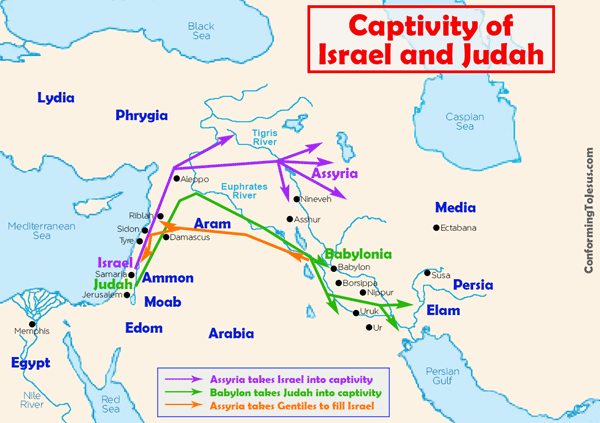
Fourth Sunday in Lent: The Babylonian Exile

Image source: conformingtojesus.com.
Responsorial: Psalm 137:1-6
Second Reading: Ephesians 2:4-10
Gospel: John 3:14-21

The first reading recalls the fall of the kingdom of Judah, the southern half of the Davidic Kingdom of Israel, in 586 BC. The northern half, which had retained the name of Israel, had fallen to Sargon II in 722 BC, and had been redesignated an Assyrian province with the name Samaria. Now, with the twin invasions of the Chaldeans and Idumeans, the original Kingdom of David and Solomon was no more.

Moses had given the Hebrew people God and His Law. Nebuchadnezzar gave them their identity as Jews. The seventy years of the Babylonian Exile[*] had done more to make the Jewish people monotheists than had over four centuries of self-rule. The Hebrews had had an alphabet and a written language since at least David’s time; now they began to gather such records as they had and compile their oral traditions, to redact the beginning of what would eventually become the Tanakh — the Hebrew Bible.

This period, in which Jewish identity was being crystallized, also gave us Psalm 137 [136], a song of heartbreak and loss: “How could we sing a song of the Lord in a foreign land?” Not included in the reading of the psalm is the anger:

Remember, Lord, against Edom
    that day at Jerusalem.
They said: “Level it, level it
    down to its foundations!”
Desolate Daughter Babylon, you shall be destroyed,
    blessed the one who pays you back
    what you have done us!
Blessed the one who seizes your children
    and smashes them against the rock.
Thus was forged in the minds and hearts of the Jewish people the iron triad of God, the Law, and Zion, to which they have clung with stubborn fidelity for over 2,500 years.

Sunday, March 1, 2015

Second Sunday in Lent: Generosity and Sacrifice

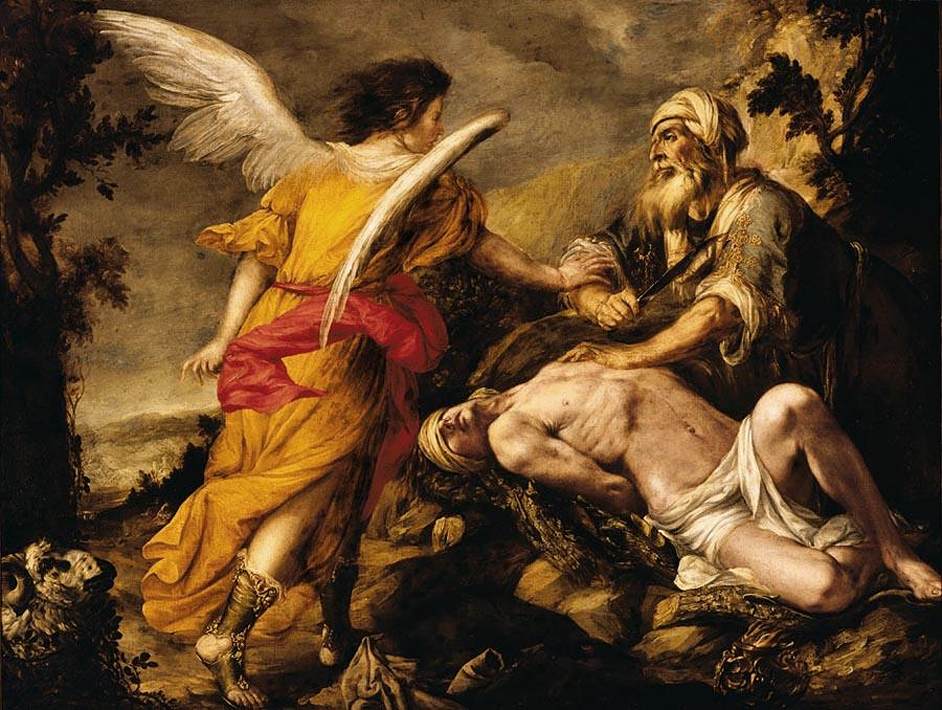
The Sacrifice of Isaac, by Juan de Valdes Leal (1659).
Responsorial: Psalm 116:10,15-19
Second Reading: Romans 8:31-34
Gospel: Mark 9:2-10

In today’s Gospel reading, Mark gives us an account of Jesus’ transfiguration in the presence of Ss. Peter, John and James. A lot is packed into this theophanic moment: Moses, the Teacher and Lawgiver, sitting with Elijah, the greatest of the Prophets, both in conversation with the Word of God Revealed — not quite in his fullness of power and glory, but in a manner (somewhat) comprehensible to the three disciples. Moreover, they are conversing: neither Moses nor Elijah is a mindless shade, as many Mediterranean cultures conceived of the dead:


Who will sing praises to the Most High in Hades,
      as do those who are alive and give thanks?
From the dead, as from one who does not exist, thanksgiving has ceased;
      he who is alive and well sings the Lord’s praises.


So wondrous is this revelation that Peter, speaking from his heart, offers to build sukkoth for them. Sukkoth, on the one hand, were temporary shelters, walled with leather and roofed with palm fronds, such as field workers and religious pilgrims used; on the other hand, just such a tabernacle had been the temple of the Hebrews as they sojourned in the desert with Moses — a holy place that was wholly portable. God had “tented” with His people in the desert, in the Ark of the Covenant, just as His Word “tabernacled” among humanity in the flesh of Christ (cf. John 1:14 LXX, eskēnōsen).

Sunday, February 22, 2015

First Sunday in Lent 2015: Spring Cleaning the Conscience

First Reading: Genesis 9:8-15
Psalm 25:4-6,7-9
Second Reading: 1 Peter 3:18-22
Gospel: Mark 1:12-15

In the first reading, God makes a covenant with every mortal being on earth through Noah: “Never again shall all creatures be destroyed by the waters of a flood.” (Genesis 9:11) In the second reading, St. Peter tells us this flood “prefigured” the sacrament of Baptism, “not as a cleansing of dirt from the body, but as an eperōtēma of a good conscience to God, through the resurrection of Jesus Christ.” (1 Peter 3:21)

The meaning of eperōtēma is uncertain. The Vulgate, following St. Jerome, translates it as interrogatio — a question, an interrogation, a cross-examination, perhaps even an argument or syllogism. The New American Bible, Revised Edition notes that it could also be rendered as pledge; “that is, a promise on the part of Christians to live with a good conscience before God, or a pledge from God of forgiveness and therefore a good conscience for us.” And Thayer’s Lexicon argues that “As the terms of inquiry and demand often include the idea of desire, the word thus gets the signification of earnest seeking, i.e. a craving, an intense desire ….”

So what did St. Peter mean by calling Baptism an eperōtēma? It helps us to step backwards, not only in the epistle, but also in Genesis.


Monday, December 22, 2014

Virginity is Not Purity

Purity ring. (Photo source: JamesMarner.com)
There are three posts you should read: “Christians, Stop Staying Pure Till [sic] Marriage” by Sarah (last name unknown), “I Didn’t Wait For My Future Spouse, and You Shouldn’t Either” by Daniel Wilde, and “I Kept My Virginity, But Not My Purity” by Danielle Renfrow. By no means do these young Christian writers — two single, one married — suggest that other Christians engage in premarital sex. Rather, all three are critics of the Evangelical “purity movement” and the language with which it’s been taught.

Until recently, there’s never really been an explicit Christian theology of sexuality to tie the various prescriptions and proscriptions of sexual behavior together. You could even say, with some justice, that Christianity has always been ambivalent about sex.

On the one hand, the Church long ago rejected the Gnostic position that even sex for the sake of reproduction was sinful; on the contrary, she taught that marriage, childbearing and childrearing were positive goods. On the other hand, passages from both Christ and St. Paul suggest that people could pursue celibacy “for the sake of the kingdom of heaven” (Matthew 19:12), that there is something of value to celibacy that doesn’t obtain to marriage (vide 1 Corinthians 7:32-34).

This ambivalence persists about fornication. Considered strictly as sex between two unmarried people, with the implication that neither one intends or is committed to marry the other, it has always been considered a sin (e.g., St. Thomas Aquinas, Summa Theologica II-II:154:2 SC); however, as a pastoral matter, its gravity was (and still is) often underplayed. And premarital sex — that is, sex between people who do intend to marry — hasn’t always been considered a grave matter in every time by every communion.

So marriage has always been good — but not better than celibacy, while fornication has always been bad — but not always as bad as other sexual sins. Nevertheless, the idea that sex is an unclean necessity isn’t authentic to the Christian tradition. That fact, however, hasn’t stopped some Christian idiots from teaching it as a “biblical” principle. (Exhibit #2,623 in the case against sola scriptura.)

Thursday, December 4, 2014

The Battle at the Communion Rail

Communion rail, Church of the Holy Ghost, Tiverton, RI
(© 2012 Fr. Jay Finelli)
The new pastor of the Windy City, my fellow Omahan the Most Rev. Blase Cupich, didn’t wait too long to start the usual suspects huffing about the “Francis Effect”. In an interview with CBS News’ Norah O’Donnell, Abp. Cupich stated — or rather implied — that he wouldn’t deny participation in the Eucharist to Catholic politicians who hold positions contrary to Church teaching.

I say “implied” because, in context, +Cupich seems to be talking about an ad hoc decision during a Mass to withhold Communion: “I would not use the Eucharist, or as they call it ‘the communion rail,’ as a place to have those discussions or a way in which people would be either excluded from the life of the church.

“The Eucharist is an opportunity of grace and conversion,” he told [O’Donnell] in an interview that aired on “Face the Nation” Sunday. “It’s also a time of forgiveness of sins, so my hope would be that grace would be instrumental in bringing people to the truth.”

Naturally, this is the kind of thing that leads Huffington Post’s Carol Kuruvilla, playing the classic “good Church/bad Church” game, to gush, “Cupich’s softened approach stands in stark contrast to the position held by Cardinal Raymond Burke, a prominent conservative Catholic archbishop who has led campaigns to ban Catholic politicians who support abortions from receiving communion.” Just as naturally, it leads many in the Catholic commentariat, such as Brian Williams of One Peter Five, to wail and harrumph:

Let us hope and pray that Our Lord is not subjected to further sacrilege, and His Church to further scandal, by an outright refusal to enforce Canon 915 in Chicago. The Church loses credibility when she rightly advocates for protecting the unborn, but then gives Holy Communion to high profile, unrepentant, Catholic politicians who support the “right” to an abortion.

Tuesday, August 12, 2014

Free-market economics and bad philosophy

Reading doctrine through ideological glasses

The most pervasive problem facing the Catholic Church in America today is our predilection for reading both Scripture and Tradition through ideological glasses. If bad philosophy leads inevitably to bad science, it leads even more quickly to bad theology.

The left has a history of trying to reconcile Catholicism with socialism, even Marxism, despite the explicit condemnations of various popes beginning with Bl. Pius IX (cf. Syllabus of Errors). The right’s version sometimes goes so far as to baptize Randian objectivism — to which Ayn Rand herself would  have objected — but more often settles for its own version of the “health and wealth gospel”; i.e., invocation of free-market capitalism.

As I’ve outlined before, “cafeteria Catholicism” on the right tends to play a game I call the “appeal to theological weight”. If a citation of pope or dicastery runs counter to a free-market position, the tactic is to claim it sits on a level of theological certainty low enough that a Catholic of good conscience can dispute or ignore it.

Even when the authority of a document, such as Leo XIII’s Rerum Novarum, is treated as authoritative, it’s creatively interpreted so that all the troublesome bits get ignored. For example, read this post in Ethika Politika, in which Gabriel S. Sanchez takes Joe Hargreaves to task for his sins of omission.

Thursday, August 7, 2014

Praying for Obama

Is he really praying? Does it really matter?

Respecting the President’s Name

Living in Texas, I often have occasion to reflect on Elton John’s satirical “Texas Love Song”. The link takes you to a live version of it performed in Austin, possibly the bluest city in Texas, in 1998, with Sir Elton’s pre-performance caution, “Don’t be offended.” Probably they weren’t; many square miles of Texas hold people who still wouldn’t recognize the song as satire, and the people of Austin most likely hold them in as much contempt as did lyricist Bernie Taupin.

One line especially stands out to me right now: “And kids still respected the President’s name.” Personally, I can’t think of a single POTUS whose name was universally respected in his lifetime; even ol’ George Washington came in for some calumny during his second term, and didn’t achieve veneration second only to the Blessed Virgin Mother until some years after he passed. When Taupin wrote the song, the President was Richard M. Nixon, who had succeeded Lyndon B. Johnson — ’nuf ced; hippies weren’t totally to blame.

Still ….

Father Erik Richtsteig at Orthometer and I have a couple of things in common: 1) We’re both friends of Katrina Fernandez (and, I believe, Frank Weathers); 2) We’re both Knights of Columbus. Yesterday, attending the Knights’ annual convention in Orlando, he posted on his status:


The cold silence didn’t bother me; that was possibly the least disrespectful thing the Knights could have done in response to Pres. Obama’s message. Nor did the reactions of Fr. Erik’s followers, which all told wasn’t a Facebook “two-minutes’ hate” so much as an all-day grump, bother me … except for one:


“Let his days be few; and let another take his office.” Brrr, yikes.

Sunday, June 1, 2014

“Mere Catholicism” vs. Real Catholicism™

Which one is the Real Catholic™?
The Circular Catholic Firing Squad found more bullets this last week. *sigh*

It appears that a Popular Catholic Blogger (whom I will not identify) called BS in the combox of another Not-So-Popular Catholic Blogger (ditto). After some vicious squabbling in NSPCB’s combox and on PCB’s Facebook page, joined in by other Well-Known Catholic Bloggers, NSPCB left the field of bloggery in a huff — or, per Groucho, in a minute and a huff — calling down divine retribution on all those who had the gall to correct him for their lack of charity.

In reference to this shindy, Scott Eric Alt commented on Facebook, “Pride is the most dangerous of sins because it is the least correctible — the very nature of the sin makes its victim feel himself to be above correction. The adulteress wept, and the Pharisee sneered.” Whether because of pride or narcissism or a particularly nasty combination of both, it’s very tempting for a Catholic blogger (Your Humble Blogger included) to make him/herself and his tribe the point of reference for Real Catholicism™.

The problem isn’t that there’s no normative or “mere” Catholicism, with distinct borders that define it as well as distinguish it from not-Catholicism. The first problem is that, while the Greek root katholikos means “universal”, Real Catholicism™ tries to make that universe smaller; it becomes more concerned with kicking “fake Catholics” to the curb than with correcting error or instructing the unknowing. The second problem is that, because Catholics are split politically by our god-awful culture wars, political language confuses and pollutes the competing monologues (very little real dialogue takes place). For example, see Hilary White’s diatribe in The Remnant  of a couple years ago, in which she condescendingly equates “neo-Catholicism” (almost-but-not-quite Real Catholicism™) with political progressivism. (EEK! RUN AWAY!)


Sunday, March 23, 2014

Apologetics toolbox: Sunday worship II — St. Paul and the Law of Moses

Part I concerned itself with the basic case for Sunday worship against those communions which argue that we ought to worship on Saturdays, that Sabbath worship is mandated by “God's law” (i.e., the Law of Moses). Part II looks at a particular argument, which tries to reintroduce the Law of Moses via St. Paul.

Yesterday (3/22/14), I engaged in a Facebook argument in which a Seventh-Day Adventist attempted to lecture The Blogger Who Must Not Be Named on St. Paul and Sabbath worship. Apparently it carried over from someplace else, for when she posted to The Blogger’s wall a link to a video that asked, “Can the Majority Ever Be Wrong?”, he replied (quite lucidly), “Of course the majority can be wrong. But that is useless for demonstrating that you are right.” He then asked SAD why Christians are bound to observe the Jewish Sabbath when we’re not bound to observe anything else the Law of Moses mandates (i.e., phylacteries, kashrus, etc.).

Someone else noted that the Israelites were never bound to observe all 613 mitzvoth, a contention on which I held my piece though I felt it didn’t really answer the question. So I cited Colossians 2:16-17, with the punctuation, “Saint Paul FTW.” The Blogger, probably after heaving a mental sigh, advised me, “I’ve cited that previously. [SDA] shrugs it off with ‘you don’t understand Paul’ and then supplies no explanation of what he ‘really’ means.”

To her credit, SDA tried to enlighten The Blogger and me. However, within two sentences, her analysis went off the rails: “When the NT was written it had to line up in agreement with the OT.”

This is a problem we encounter quite frequently in combox controversies with less sophisticated sola scriptura types: Although we all acknowledge Scripture to be “inspired by God” (2 Timothy 3:16) — literally, Theopneustos, “God-breathed” — and thus to have a unity in the Holy Spirit, some Protestants treat the New Testament as if the books and letters were intended to be treated the same way they treated Old Testament Scripture. In fact, though, the NT works, especially the letters, were “occasional” in nature, written ad hoc to address contemporary issues and needs, without any obvious consciousness that they would one day be gathered together in a single codex.[*]

This makes a difference, because SDA continues, “The OT was the reference guide for Paul used [sic]. Paul had to learn and memorize the entire OT and not only that he was taught by the top notch Rabbi [Gamaliel]. Who is better at understanding and writing the NT. Obviously the NT had to be in agreement with the OT.”

Saturday, March 22, 2014

Apologetics toolbox: Sunday worship I — the basic case

As a result of a Facebook argument, I decided to repost this as the first part of a two-part series. Part II was posted March 23, 2013, and concerns itself with an attempt to sneak the Law of Moses into Christianity through a back door; this is the basic case.

*          *          *

“The Sabbath was made for man, not man for the Sabbath. So the Son of Man is Lord even of the Sabbath” (Mk 2:27-28 NIV).

With these words, Jesus reminded the Pharisees that the Sabbath, the Jewish day of rest, was commanded not for the benefit of God, who can be — and ought to be — worshipped any and every day of the week, but for the benefit of his creatures doomed to eat their bread in the sweat of their face (Gen 3:17-19), to give them a day of rest (Ex 20:10; cf. Ex 23:12, 31:15, Dt 5:14). Indeed, the English word holiday is a contraction of “holy day”, a fact G. K. Chesterton played on when he said of the ancients, “And only when they made a holy day for God did they find they had made a holiday for men.”[*]

But Jesus doesn’t simply remind the Pharisees that the Sabbath is for man’s sake … he also associates the Sabbath to himself: “The Son of Man is Lord of the Sabbath” (Mk 2:28; cf. Lk 6:5). Tertullian argued from the relevant passages, the plucking of grain from the fields (Mk2:23-28; Lk 6:1-5) and the curing of the withered hand (Lk 6:6-10), that Jesus as Son of Man and Son of God had the power to transfer the Sabbath to another day:


Now, even if He had annulled the Sabbath, He would have had the right to do so, as being its Lord, (and) still more as He who instituted it. But He did not utterly destroy it, although its Lord, in order that it might henceforth be plain that the Sabbath was not broken by the Creator, even at the time when the ark was carried around Jericho. … Now, although He has in a certain place expressed an aversion of Sabbaths, by calling them your Sabbaths (Is 1:13-14), reckoning them as men’s Sabbaths, not His own, … He has yet put His own Sabbaths (those, that is, which were kept according to His prescription) in a different position. Thus Christ did not at all rescind the Sabbath: He kept the law thereof, and both in the former case did a work which was beneficial to the life of His disciples, for He indulged them with the relief of food when they were hungry, and in the present instance cured the withered hand; in each case intimating by facts, I came not to destroy, the law, but to fulfill it (Mt 5:17), although Marcion has gagged His mouth by this word (Against Marcion 4:12).


Friday, February 14, 2014

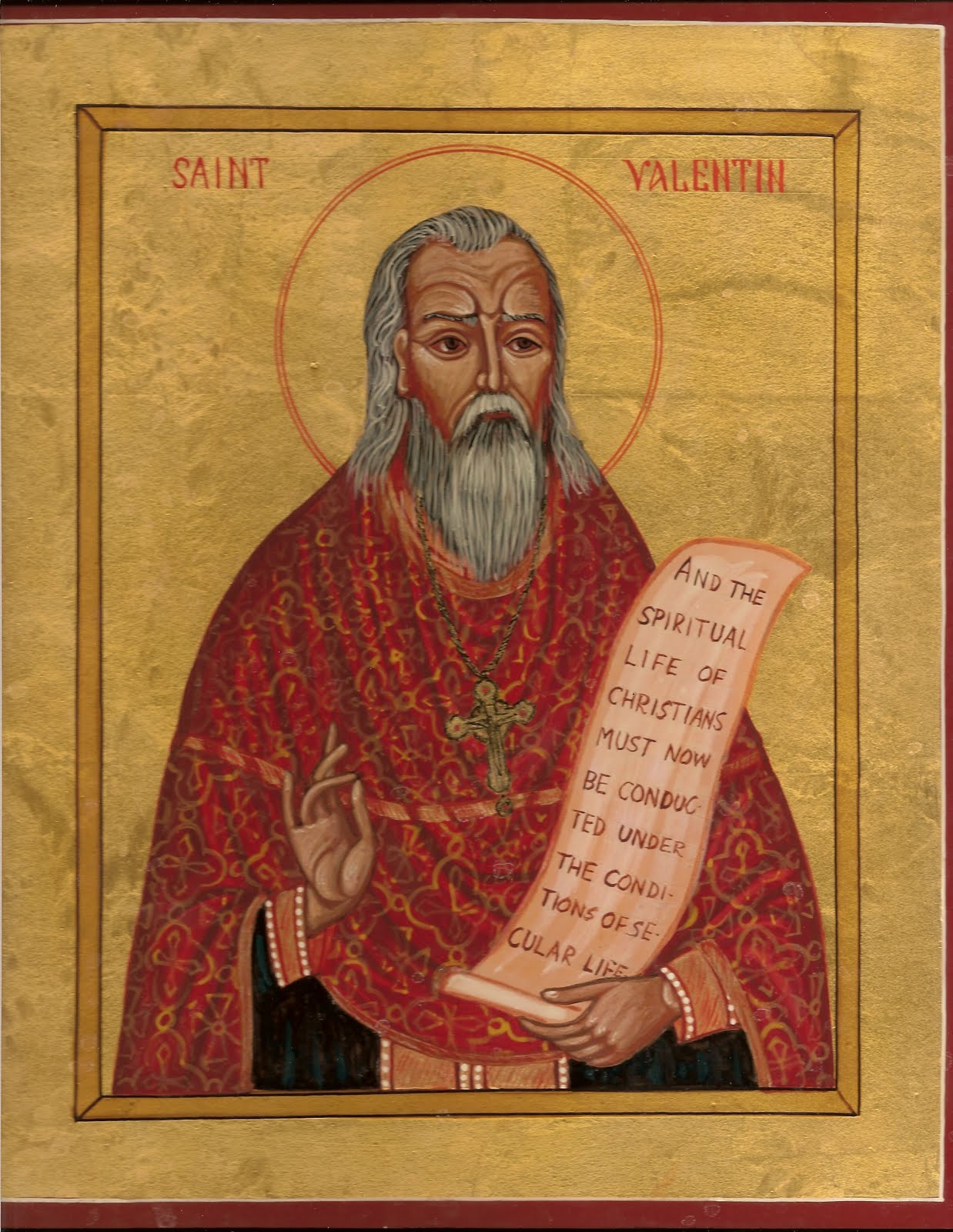
Romance, self-sacrifice and St. Valentine

Sancte Valentine, ora pro nobis.
Post originally published February 14, 2012.

I fail miserably at romance. I’m like the guy in Billy Joel’s song, “Leave a Tender Moment Alone”: sometimes I get so tense, I’ll say or do something that completely spoils the moment … usually, it’s a joke. 

So if I were to write a post telling men how to win women’s hearts, I would be putting myself in a false position. I don’t even have the excuse of being a priest; a priest could at least form some conclusions from what he hears in confessions and spiritual counseling. In fact, I’m convinced that even Dr. Phil is making educated guesses when it comes to women. 

(“What do women want?” asked Freud in despair … to which cartoonist Mimi Pond replied, “Shoes.” Thanks, Mimi. Big help.)

It’s especially difficult to write about romantic love when, in one sense, both “love” and “romance” have lost meaning in the post-modern world. Saint Valentine, his day stripped of its sanctity in the name of secular commerce, now presides over a semi-ritualized gift-giving that drips the same sappy sentimentality with which American marketing saturates every major holiday. Where is the passion, the adventure, the hypergolic mix of eros and agapē? At the same time, why bother with the jewelry and the chocolates when you can just as easily get laid on Groundhog’s Day as Valentine’s Day?

Sunday, December 1, 2013

First Sunday in Advent

From Isaiah 2:1-5 NAB:

This is what Isaiah, son of Amoz, saw concerning Judah and Jerusalem. In days to come,
The mountain of the Lord’s house shall be established as the highest mountain and raised above the hills.
All nations shall stream toward it; many peoples shall come and say:
“Come, let us climb the Lord’s mountain, to the house of the God of Jacob,
That he may instruct us in his ways, and we may walk in his paths.”
For from Zion shall go forth instruction, and the word of the Lord from Jerusalem.
He shall judge between the nations, and impose terms on many peoples.
They shall beat their swords into plowshares and their spears into pruning hooks;
One nation shall not raise the sword against another, nor shall they train for war again.
O house of Jacob, come, let us walk in the light of the Lord!

What is Advent? Advent is the beginning of the Christian liturgical year. It’s a season of preparation for the Feast of the Nativity of the Lord. “Advent has a twofold character, for it is a time of preparation for the Solemnities of Christmas, in which the First Coming of the Son of God to humanity is remembered, and likewise a time when, by remembrance of this, minds and hearts are led to look forward to Christ’s Second Coming at the end of time. For these two reasons, Advent is a period of devout and expectant delight” (Roman Missal, p. 114, §39). In the words of the Catechism, “When the Church celebrates the liturgy of Advent each year, she makes present this ancient expectancy of the Messiah, for by sharing in the long preparation for the Savior’s first coming, the faithful renew their ardent desire for his second coming” (CCC 524; cf. Revelation 22:17).

Monday, May 27, 2013

Apologetics toolbox: Redemption and heaven


As unreliable as the MSM is in reporting on matters religious, religious bloggers and non-mainstream news outlets are almost as bad at reporting on what the MSM says about religion. Has anyone actually read an article or post which declares, without any weasel words or equivocal phrasing, “Pope Francis said Thursday that atheists can go to heaven by doing good works”? If you know where such posts can be found, please send me the links and I’ll post them here.

Of course, that’s not what the Pope said, as Jimmy Akin takes some time to explain. Pace Terry Mattingly, HuffPo’s headline (“Atheists Who Do Good Are Redeemed By Jesus As Well As Catholics, Pope Francis Says”) is only as dramatic as the fact is — all mankind has been redeemed by Christ’s sacrifice. If there’s any problem with the anonymous author’s piece, it’s that s/he confuses redemption with justification: “…the Pope’s words may spark memories of the deep divisions from the Protestant reformation over the belief in redemption through grace versus redemption through works” [bold font mine.—TL].

Why would such an assertion be controversial? In strict justice, atheists can’t be wholly blamed for getting Christian concepts mixed up. For one thing, Catholic catechesis and religious formation have degraded considerably since 1965; for another, common Christian consensus understanding of such basic concepts has also fallen apart, as a natural consequence of sola scriptura and the rejection of human religious authority. If we don’t get these things right, how do we convince the non-believer?

The assertion is only controversial if we believe that redemption is a guarantee of heaven — that, because of Christ’s sacrifice on the cross, you don’t really need to do anything other than be “good enough” to go to heaven. This is the error that needs correction. So what is redemption?

Sunday, May 12, 2013

To a very special Mother

Originally posted May 8, 2011

Fundamentalists and Evangelicals sing in truth, "What a friend we have in Jesus!" But I wonder what their Friend thinks about the way they talk about His Mother.

You may read the Bible. You may read it so much that you can rattle off whole chapters from memory without missing a word. But if you don't have a proper love and reverence for the Blessed Virgin Mother, then either you don't truly understand what you read, or your relationship with Jesus is way off. Or both.

Yes, Marian devotion can be overdone, just as you can have an inordinate or improper love for your own mother. But the opposite is just as true. "As a protestant," Randy at Speak the Truth in Love writes, "I looked at Mary and saw a concubine. Someone who performed a biological function. A surrogate mother. I was told to look at her and marvel at how amazing a thing she did. God using her body to bring Jesus to the world. That contemplating that was dangerous. It might lead me to worship Mary."

Yes, Randy has come past that point. And to be fair, there are Protestants who love Mary as well. "You Catholics don't have sole claim on her," one woman said, and I for one am willing to share. But to regard Mary as important only for her uterus? That wrongs not just Mary — and all women should take umbrage at it — but God as well.