Showing posts with label Meditations and Reflections. Show all posts

Friday, November 11, 2016

Message to the Elite: “You’re Running the Country Wrong”

© 2016 A. F. Branco, Liberty Alliance.
As I watched ABC’s George Stephanopoulos and his crew of talking heads begin the autopsy on the election late Tuesday night, I felt some dark satisfaction. I hadn’t been the only self-appointed expert caught flat-footed by Donald Trump’s and the Republicans’ victory. Most of the elite, the Only People Whose Opinions Count, were humiliated by an over-glorified carnival huckster who (in our wise estimation) did just about everything wrong that could be done wrong and still pulled the upset of the century.

Andrew Sullivan Throws a Nutty

And the funny thing is, having been so spectacularly wrong about this election, we, the chatterati of America who have been polluting your television screens and social media feeds for months with our hive-mind wisdom, still think you should take our social forecasts seriously. Case in point: Andrew Sullivan, who threw a classic spittle-flecked nutty on the Daily Intelligencer.

This is now Trump’s America. He controls everything from here on forward. He has won this campaign in such a decisive fashion that he owes no one anything. He has destroyed the GOP and remade it in his image. He has humiliated the elites and the elite media. He has embarrassed every pollster and naysayer. He has avenged Obama. And in the coming weeks, Trump will not likely be content to bask in vindication. He will seek unforgiving revenge on those who dared to oppose him. The party apparatus will be remade in his image. The House and Senate will fail to resist anything he proposes — and those who speak up will be primaried into oblivion. The Supreme Court may well be shifted to the far right for more than a generation to come — with this massive victory, he can pick a new Supreme Court justice who will make Antonin Scalia seem like a milquetoast. He will have a docile, fawning Congress for at least four years. We will not have an administration so much as a court.

You should read it. Sullivan is so hysterical over Trump’s forthcoming fascist state that he didn’t pay attention to what he himself wrote: Trump can’t keep all his promises. In fact, we ought to be wondering which promises, if any, he really meant. For instance, his website’s policies page doesn’t have a link to pro-life policies. Various press releases had mentioned his pro-life position; but hey! those press releases are gone now. And frankly, I don’t trust the GOP to hold his feet to the fire on the matter.

Sunday, September 11, 2016

The Twin Towers of Siloam

The one memory that will stay with me, when all other memories of September 11, 2001 have faded, is how obscenely beautiful the weather was. There really should have been more portents. Fierce, fiery warriors battling in the clouds. Graves yawning and yielding up their dead. At least a two-headed cow, or the ghost of William McKinley.

But no, the New York sky was barely touched with clouds when the Twin Towers  crumbled to the ground. Just as clear was the Arlington, Virginia sky as American Airlines flight 77 slammed into the western side of the Pentagon, and over Stoney Creek Township, Pennsylvania, as the hijackers of United 93 plowed their Boeing 757 into the ground to prevent the passengers from taking over. And it was just as beautiful in Omaha, Nebraska, where I listened to my cab’s FM radio in horror, knowing exactly why Peter Jennings quietly said, “Oh, my God,” as soon as he said it. Satan had apparently decided not to overdo it.

The Loss of Faith

Inevitably, anniversaries such as this will produce analyses in gross lots, rewriting as growing out of the evil stem of the 9/11 attacks trends that were already in place the day before. We need no “truther” conspiracy theories to explain the nadir of our trust in our government; it had been declining for three decades and more. Anti-Moslem sentiment didn’t begin with the collapse of the World Trade Center; it was present during the OPEC oil crisis in the late 1970s, a natural outgrowth of American nativism. We don’t need al-Qaida to explain our interventionism; it was already implicit in complaints that Operation Desert Storm didn’t “finish the job” by going to Baghdad and ousting Saddam Hussein.

Of course we became more afraid. For the sake of security, we permitted the federal government unprecedented powers of investigation and almost casually dispensed with habeas corpus rights for suspected terrorists. In the meantime, we created a new Cabinet-level department whose name carries perhaps-unintended echoes of totalitarian police states. And we also built a cheap, absurd wall along our border with Mexico, as we flailed around to find solutions that would keep terrorists out without going so far as to completely imprison ourselves or stop tourists and imports from coming.

I can’t help but think, though, that in the last fifteen years we became more aware of the fact that America is rotting from within, that both the dream and the reality of America have been corrupted. That’s a broad and vague charge, one not easily specified or documented. However, as much as has been written about the loss of faith in God, I believe that we’ve lost faith in everything — faith in ourselves, in each other, in our social institutions, in our government, in our founding principles.

Wednesday, May 25, 2016

I Believe … But I Don’t Understand

Image source: gospelcoalition.org.
On Monday, May 23, Patheos published an article by Rebecca Bratten Weiss on suffering and “the clamor of insufficient explanations”. By “insufficient explanations”, Weiss means not only the myriad of clichés we Christians inflict on the suffering and despairing (“If God brings you to it, He will bring you through it;” “God shapes the back to fit the burden”), but also the assertion, “It must be God’s will.”

The Challenge of Suffering

The problem of suffering is the single most potent argument against Christian theology and cosmology, because it cuts past the dry hairsplitting of philosophy to pose a direct challenge to the heart. As Weiss puts it, “The fact that we need to suffer to be well is a symptom of a fallen world, but to suggest that the suffering itself comes not from the darkness of nature but from God on high is horrifying, sadistic.”

In Dostoevsky’s The Brothers Karamazov, the atheist brother Ivan refuses to believe in a God who allows the suffering of children, and says that even if there is some inexplicable benefit to be derived from this, he will not have it. “I respectfully return the ticket” he says. I sympathize. I respectfully return the ticket to whatever fun-house or extravaganza somehow necessitates this terrible suffering. I would rather join Ivan and deny God outright, than believe in a God who is up there pulling all the strings that lead us to torment and loss, because this was the only way, the best of all possible worlds. [N.B.: Weiss has not abandoned the Faith, either formally or informally.]

We can’t escape the challenge by blaming the darkness of nature; for if Nature is dark, it can only be by God’s Will. And it’s not even the best of all possible worlds (cf. St. Thomas Aquinas, Summa Theologiae I:25:6 ad 3). Whether God manipulates all events directly, or simply sits back and watches everything play out by itself, or some combination of the two, the buck stops at His desk.

Sunday, February 14, 2016

Requiescat in pacem, Antonin Scalia

Oddly enough, according to a couple of sources, Associate Justice Antonin G. Scalia’s best friend was AJ Ruth Bader Ginsburg. Said Marcia Coyle on PBS NewsHour Weekend, Scalia, who passed away Saturday at the age of 79, “was widely liked ... a very colorful writer, and in person ... a consummate gentleman, ... could be very funny. He is going to be missed ... especially by Justice Ginsburg, with whom he had a special friendship — they called each other best friends — and with whom he went to opera and ... to India.

“He does not write like a happy man”

To hear Scalia described as “widely liked” and a “consummate gentleman” may sound improbable to people who only knew of him through his strident, hectoring argumentation on the bench, especially to liberals and progressives who came to hate him as a conservative obstructionist. (One gay man of my acquaintance sneered, “My condolences to the Koch brothers for their loss.”)

Because Scalia’s opinions coincided often with conservative interests, it was all too easy to claim his originalism was merely intellectual cover for his political views — in fact, so easy that more substantive legal criticism often went lacking. His dissents — and he wrote plenty of dissents in his nearly thirty years’ tenure on the SCOTUS bench — often sacrificed detailed analysis of the legal principles involved in favor of sarcastic fiskings of the majority opinion and fervent homilies on the wider implications of the decision; e.g., his dissent in Obergefell v. Hodges (513 U.S. ___ [2015]; pp. 69 ff.). So acidic were his opinions that, as Conor Clarke observed in Slate, “Scalia’s opinions read like they’re about to catch fire for pure outrage. He does not, in short, write like a happy man.”

Thursday, December 24, 2015

Book Review: To the Martyrs, by Cdl. Donald Wuerl

Cdl. Donald Wuerl
Emmaus Road Publishing
Cover Price: $22.95
Recommended

 Anti-Christians condemn Christians for their hypocrisy. However, not a single Christian martyr has ever suffered persecution by non-Christians for failing to live the gospel message perfectly. Rather, Christians were and are persecuted just for associating themselves with the gospel message in the first place. Imperfection of religious practice has hardly been a barrier to execution, imprisonment, maiming, rape, or torture by those who hate Christianity and that for which they think it stands.

This is the first thought that occurs to me after reading To the Martyrs: A Reflection on the Supreme Christian Witness by Cdl. Donald Wuerl. The title reflects both the title of a letter by the Church Father Tertullian and Wuerl’s own personal fascination with, and dedication to, the millions of martyrs and confessors who have been “the seeds of the Church” over the last two millennia. It’s a “reflection” as well in that it’s obviously not an exhaustive treatment of martyrdom intended for scholars and Church historians, but rather a brief overview for the ordinary layman. Written in a very accessible style, it has just enough footnotes to show that the good archbishop didn’t rely on his own memory or make things up as he went along.

As one reads To the Martyrs, though, a theme recurs. G. K. Chesterton famously noted that the Christian ideal hadn’t been “tried hard, and found wanting,” but rather had been “found difficult; and left untried.” However, as Cdl. Wuerl shows, the centuries of persecution didn’t come from people who found the Christian ideal too difficult to live up to, but rather from people who found that ideal too challenging, too uncomfortable to live with.

Sunday, March 15, 2015

Fourth Sunday in Lent: The Babylonian Exile

Image source: conformingtojesus.com.
Responsorial: Psalm 137:1-6
Second Reading: Ephesians 2:4-10
Gospel: John 3:14-21

The first reading recalls the fall of the kingdom of Judah, the southern half of the Davidic Kingdom of Israel, in 586 BC. The northern half, which had retained the name of Israel, had fallen to Sargon II in 722 BC, and had been redesignated an Assyrian province with the name Samaria. Now, with the twin invasions of the Chaldeans and Idumeans, the original Kingdom of David and Solomon was no more.

Moses had given the Hebrew people God and His Law. Nebuchadnezzar gave them their identity as Jews. The seventy years of the Babylonian Exile[*] had done more to make the Jewish people monotheists than had over four centuries of self-rule. The Hebrews had had an alphabet and a written language since at least David’s time; now they began to gather such records as they had and compile their oral traditions, to redact the beginning of what would eventually become the Tanakh — the Hebrew Bible.

This period, in which Jewish identity was being crystallized, also gave us Psalm 137 [136], a song of heartbreak and loss: “How could we sing a song of the Lord in a foreign land?” Not included in the reading of the psalm is the anger:

Remember, Lord, against Edom
    that day at Jerusalem.
They said: “Level it, level it
    down to its foundations!”
Desolate Daughter Babylon, you shall be destroyed,
    blessed the one who pays you back
    what you have done us!
Blessed the one who seizes your children
    and smashes them against the rock.
Thus was forged in the minds and hearts of the Jewish people the iron triad of God, the Law, and Zion, to which they have clung with stubborn fidelity for over 2,500 years.

Wednesday, October 29, 2014

To a friend who is leaving the Catholic Church


A Hard Saying

I so totally admire your love of the Catholic Church Tony. I am saddened that some of the rules I can not live with and will be joining a Lutheran one that will accept me.
What could I say? Facebook is where I keep in touch with my family and friends; I don’t go there to engage in verbal fisticuffs or stand on my soapbox. And yet, I can’t help feeling the answer I gave — “Forget it, lady. You gotta do a lot worse than that to lose my friendship” — was well-meaning but unsatisfactory.

I suppose I could have been a smartass and built some quibbles based on the precepts of the Church or on canon law. But either of those sallies would have ended in an exasperated “You know what I mean!”

In fact, I do know what you meant, my friend. It’s not really the rules you can’t live with, but rather some of the teachings. It isn’t a question of whether the Catholic Church accepts you: she does, and always has. Rather, it’s a question of what you accept — or, rather, what you reject.

You’re not the first person to abandon the Church over a teaching that sticks in the craw. Read the “Bread of Life” discourse (John 6:22-66): as Jesus insists that “unless you eat the flesh of the Son of man and drink his blood, you have no life in you” (v. 53), his verbs in the Greek become more graphic, switching from phagō (to eat) to trōgō (to chew, or gnaw like an animal). At the end of it, many of his disciples leave him, telling themselves and each other, “This is a hard saying; who can listen to it?” (vv. 60, 66)

Monday, May 19, 2014

One hundred eighty seconds

° 2001 United Press Syndicate.

I’d seen the interview scenario before: Two team leaders, neither of whom had the power to hire me, asking boilerplate questions that the real decision-maker would use to determine whether I would have a future with the company. This pair were almost twins, nearly identical down to facial features, except that one positively brightened in response to my warmth and self-effacing humor, while the other remained determinedly serious.

Smileyface asked the question I dread at these kinds of interviews: “What would your supervisors say are your greatest strength and greatest weakness?”

“Well,” I replied cautiously, “my greatest strength is my ability to build relationships with customers. The downside of my approach, however, is that it’s a little more time-intensive.”

Frowneyface, who had been silent up to that point, pounced. “Oh, you take too long?”

This is precisely why I dread that question. On the one hand, I’ve never felt comfortable shading the truth, let alone outright lying. Generally, people have a right to hear the truth and an obligation to tell the truth, leaving aside extreme cases and questions of national security. On the other hand, this interview setup is designed to find reasons to not hire candidates, and I’d just given one to Frowneyface.

To an accountant, the customer service department is an expense; to maximize efficiency, the cost per hour of a phone line must be divided out by as many calls as possible. The word queue is used very much in the British sense: behind the customer you’re talking to, other customers are tapping their feet, impatiently waiting to be served.

One hundred eighty seconds. Or less … preferably much less. That’s the average time you’re given to verify the customer, dope out the issue, resolve it, and get him/her off your line.

Monday, March 17, 2014

Of judgment, sheep and Fred Phelps' passing—UPDATED

Fred Phelps, Sr. preaching at Westboro Baptist.
Yesterday, I happened to remember a chorus from Part II of Händel’s Messiah, “All we like sheep”, which is taken from Isaiah 53:6 KJV: “All we like sheep have gone astray; we have turned every one to his own way; and the Lord hath laid on him the iniquity of us all.” And it occurred to me that people who use the image of sheep to illustrate people who blindly follow leaders know less of sheep than I do ... and I don’t know much at all, at all. (Sorry; on St. Patrick’s Day I tend to slip into a stage-Irish accent.)

Contrary to the image, sheep have minds of their own. They wander all over as they graze. The shepherd’s task is to keep the flock together, and to protect them from predators. The task is made easier by dogs who have been bred to chase livestock back into herds (they make really good pets for children, too). Nevertheless, the shepherd’s life is hardly that of Riley — er, one of ease and contentment; when they’re not on the move trying to get the sheep from one pasture to another, they’re on watch for wolves.

So it is with Catholic and Orthodox bishops: The true picture of Church history is neither the triumphalist Whig history of millions of devoted faithful marching shoulder-to-shoulder in the wake of inspired leaders nor the hideous dystopian myth of cruel tyrants tormenting anyone who showed signs of intellectual independence. Rather, it’s the story of mostly ordinary men — some saints, some knaves, some fools, all limited by the very fact of their humanity — trying not only to spread the Gospel message but also to protect to the best of their knowledge and ability its integrity against threats both real and imagined.

Friday, February 14, 2014

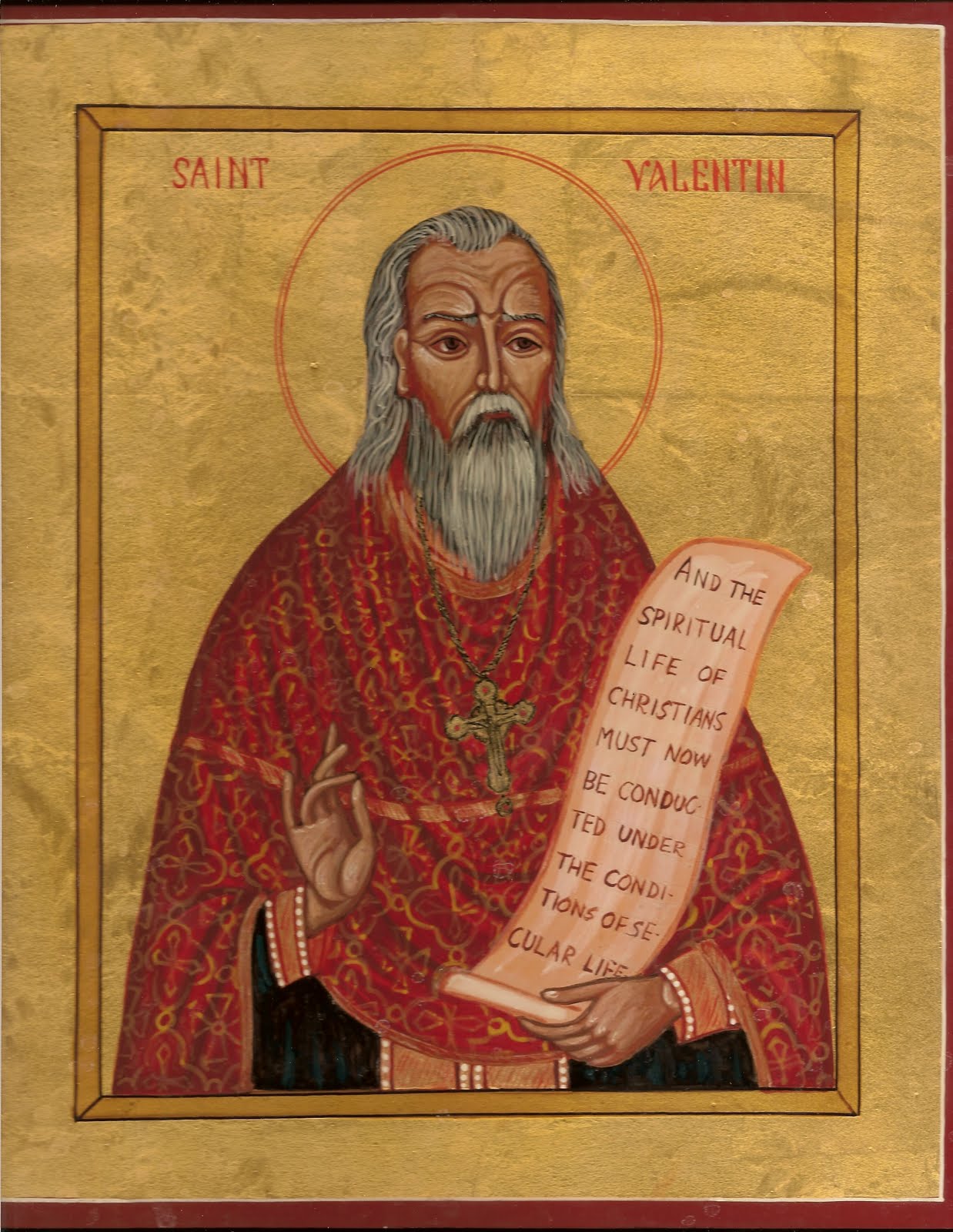
Romance, self-sacrifice and St. Valentine

Sancte Valentine, ora pro nobis.
Post originally published February 14, 2012.

I fail miserably at romance. I’m like the guy in Billy Joel’s song, “Leave a Tender Moment Alone”: sometimes I get so tense, I’ll say or do something that completely spoils the moment … usually, it’s a joke. 

So if I were to write a post telling men how to win women’s hearts, I would be putting myself in a false position. I don’t even have the excuse of being a priest; a priest could at least form some conclusions from what he hears in confessions and spiritual counseling. In fact, I’m convinced that even Dr. Phil is making educated guesses when it comes to women. 

(“What do women want?” asked Freud in despair … to which cartoonist Mimi Pond replied, “Shoes.” Thanks, Mimi. Big help.)

It’s especially difficult to write about romantic love when, in one sense, both “love” and “romance” have lost meaning in the post-modern world. Saint Valentine, his day stripped of its sanctity in the name of secular commerce, now presides over a semi-ritualized gift-giving that drips the same sappy sentimentality with which American marketing saturates every major holiday. Where is the passion, the adventure, the hypergolic mix of eros and agapē? At the same time, why bother with the jewelry and the chocolates when you can just as easily get laid on Groundhog’s Day as Valentine’s Day?

Sunday, December 8, 2013

“Ecce ancilla Domini …”

From Genesis 3:9-15, 20:

After the man, Adam, had eaten of the tree, the Lord God called to the man and asked him, “Where are you?” He answered, “I heard you in the garden; but I was afraid, because I was naked, so I hid myself.” Then he asked, “Who told you that you were naked? You have eaten, then, from the tree of which I had forbidden you to eat!” The man replied, “The woman whom you put here with me, she gave me fruit from the tree, and so I ate it.” The Lord God then asked the woman, “Why did you do such a thing?” The woman answered, “The serpent tricked me into it, so I ate it.”

Then the Lord God said to the serpent: “Because you have done this, you shall be banned from all the animals and from all the wild creatures; on your belly shall you crawl, and dirt shall you eat all the days of your life. I will put enmity between you and the woman, and between your offspring and hers; he will strike at your head, while you strike at his heel.”

The man called his wife Eve, because she became the mother of all the living.

Blessed John Paul tells us that the story of Genesis contains not only the story of the first sin and Man’s fall but also “the first foretelling of victory over evil, over sin” (Mulieris Dignitatem 11, emphasis in original). Our enmity with Satan stems not from our being children of Adam but rather from our being children of Eve, the Progenetrix; and it is her remote offspring, the Son of Man, who will crush the serpent in retribution for his deception.

Sunday, December 1, 2013

First Sunday in Advent

From Isaiah 2:1-5 NAB:

This is what Isaiah, son of Amoz, saw concerning Judah and Jerusalem. In days to come,
The mountain of the Lord’s house shall be established as the highest mountain and raised above the hills.
All nations shall stream toward it; many peoples shall come and say:
“Come, let us climb the Lord’s mountain, to the house of the God of Jacob,
That he may instruct us in his ways, and we may walk in his paths.”
For from Zion shall go forth instruction, and the word of the Lord from Jerusalem.
He shall judge between the nations, and impose terms on many peoples.
They shall beat their swords into plowshares and their spears into pruning hooks;
One nation shall not raise the sword against another, nor shall they train for war again.
O house of Jacob, come, let us walk in the light of the Lord!

What is Advent? Advent is the beginning of the Christian liturgical year. It’s a season of preparation for the Feast of the Nativity of the Lord. “Advent has a twofold character, for it is a time of preparation for the Solemnities of Christmas, in which the First Coming of the Son of God to humanity is remembered, and likewise a time when, by remembrance of this, minds and hearts are led to look forward to Christ’s Second Coming at the end of time. For these two reasons, Advent is a period of devout and expectant delight” (Roman Missal, p. 114, §39). In the words of the Catechism, “When the Church celebrates the liturgy of Advent each year, she makes present this ancient expectancy of the Messiah, for by sharing in the long preparation for the Savior’s first coming, the faithful renew their ardent desire for his second coming” (CCC 524; cf. Revelation 22:17).