Showing posts with label Lenten Reflections. Show all posts

Sunday, March 15, 2015

Fourth Sunday in Lent: The Babylonian Exile

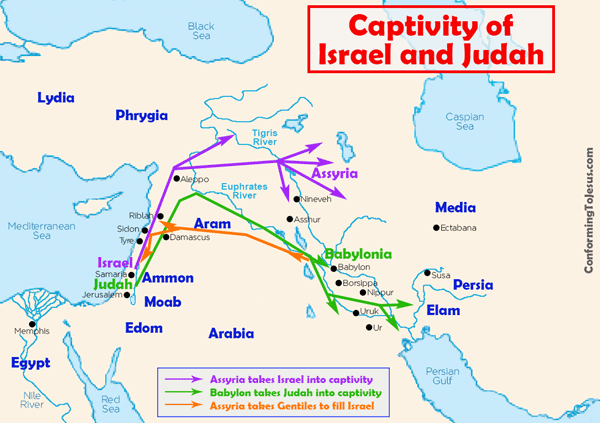
Image source: conformingtojesus.com.
Responsorial: Psalm 137:1-6
Second Reading: Ephesians 2:4-10
Gospel: John 3:14-21

The first reading recalls the fall of the kingdom of Judah, the southern half of the Davidic Kingdom of Israel, in 586 BC. The northern half, which had retained the name of Israel, had fallen to Sargon II in 722 BC, and had been redesignated an Assyrian province with the name Samaria. Now, with the twin invasions of the Chaldeans and Idumeans, the original Kingdom of David and Solomon was no more.

Moses had given the Hebrew people God and His Law. Nebuchadnezzar gave them their identity as Jews. The seventy years of the Babylonian Exile[*] had done more to make the Jewish people monotheists than had over four centuries of self-rule. The Hebrews had had an alphabet and a written language since at least David’s time; now they began to gather such records as they had and compile their oral traditions, to redact the beginning of what would eventually become the Tanakh — the Hebrew Bible.

This period, in which Jewish identity was being crystallized, also gave us Psalm 137 [136], a song of heartbreak and loss: “How could we sing a song of the Lord in a foreign land?” Not included in the reading of the psalm is the anger:

Remember, Lord, against Edom
    that day at Jerusalem.
They said: “Level it, level it
    down to its foundations!”
Desolate Daughter Babylon, you shall be destroyed,
    blessed the one who pays you back
    what you have done us!
Blessed the one who seizes your children
    and smashes them against the rock.
Thus was forged in the minds and hearts of the Jewish people the iron triad of God, the Law, and Zion, to which they have clung with stubborn fidelity for over 2,500 years.

Sunday, March 1, 2015

Second Sunday in Lent: Generosity and Sacrifice

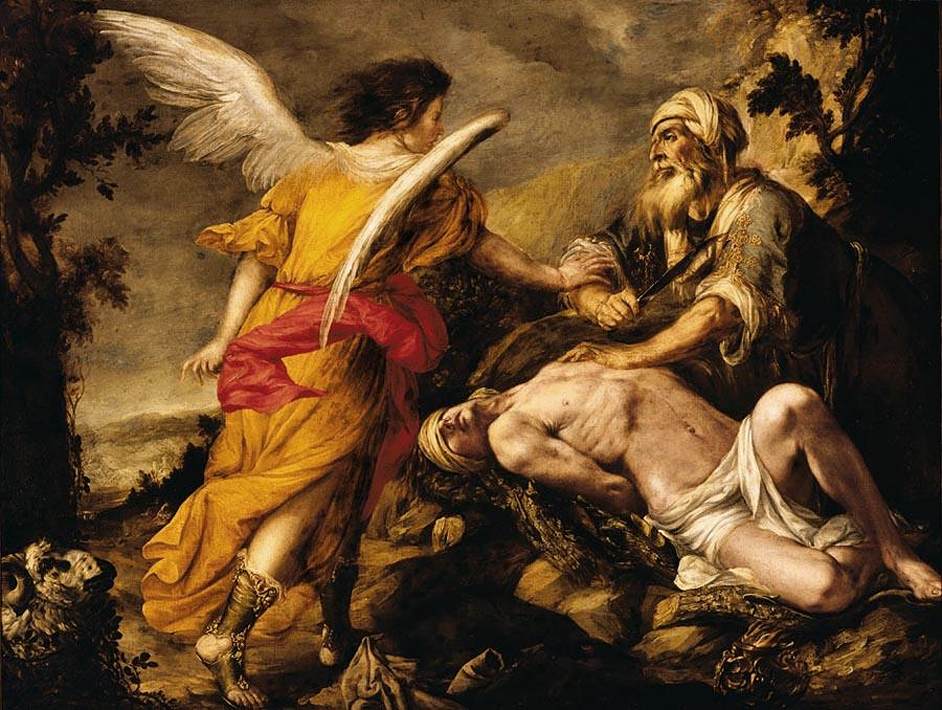
The Sacrifice of Isaac, by Juan de Valdes Leal (1659).
Responsorial: Psalm 116:10,15-19
Second Reading: Romans 8:31-34
Gospel: Mark 9:2-10

In today’s Gospel reading, Mark gives us an account of Jesus’ transfiguration in the presence of Ss. Peter, John and James. A lot is packed into this theophanic moment: Moses, the Teacher and Lawgiver, sitting with Elijah, the greatest of the Prophets, both in conversation with the Word of God Revealed — not quite in his fullness of power and glory, but in a manner (somewhat) comprehensible to the three disciples. Moreover, they are conversing: neither Moses nor Elijah is a mindless shade, as many Mediterranean cultures conceived of the dead:


Who will sing praises to the Most High in Hades,
      as do those who are alive and give thanks?
From the dead, as from one who does not exist, thanksgiving has ceased;
      he who is alive and well sings the Lord’s praises.


So wondrous is this revelation that Peter, speaking from his heart, offers to build sukkoth for them. Sukkoth, on the one hand, were temporary shelters, walled with leather and roofed with palm fronds, such as field workers and religious pilgrims used; on the other hand, just such a tabernacle had been the temple of the Hebrews as they sojourned in the desert with Moses — a holy place that was wholly portable. God had “tented” with His people in the desert, in the Ark of the Covenant, just as His Word “tabernacled” among humanity in the flesh of Christ (cf. John 1:14 LXX, eskēnōsen).

Sunday, February 22, 2015

First Sunday in Lent 2015: Spring Cleaning the Conscience

First Reading: Genesis 9:8-15
Psalm 25:4-6,7-9
Second Reading: 1 Peter 3:18-22
Gospel: Mark 1:12-15

In the first reading, God makes a covenant with every mortal being on earth through Noah: “Never again shall all creatures be destroyed by the waters of a flood.” (Genesis 9:11) In the second reading, St. Peter tells us this flood “prefigured” the sacrament of Baptism, “not as a cleansing of dirt from the body, but as an eperōtēma of a good conscience to God, through the resurrection of Jesus Christ.” (1 Peter 3:21)

The meaning of eperōtēma is uncertain. The Vulgate, following St. Jerome, translates it as interrogatio — a question, an interrogation, a cross-examination, perhaps even an argument or syllogism. The New American Bible, Revised Edition notes that it could also be rendered as pledge; “that is, a promise on the part of Christians to live with a good conscience before God, or a pledge from God of forgiveness and therefore a good conscience for us.” And Thayer’s Lexicon argues that “As the terms of inquiry and demand often include the idea of desire, the word thus gets the signification of earnest seeking, i.e. a craving, an intense desire ….”

So what did St. Peter mean by calling Baptism an eperōtēma? It helps us to step backwards, not only in the epistle, but also in Genesis.