
 |
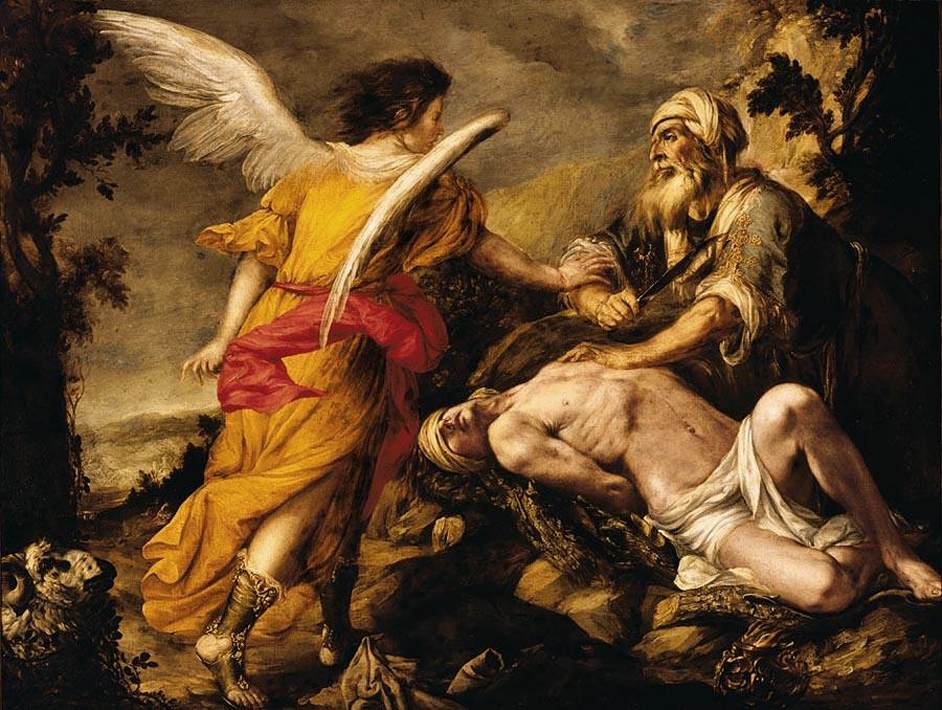
| The Sacrifice of Isaac, by Juan de Valdes Leal (1659). |
First Reading: Genesis
22:1-2,9-13,15-18
Responsorial: Psalm
116:10,15-19
Second Reading: Romans
8:31-34
Gospel:
Mark
9:2-10
In today’s Gospel reading, Mark gives us an account of
Jesus’ transfiguration in the presence of Ss. Peter, John and James. A lot is
packed into this theophanic moment: Moses, the Teacher and Lawgiver, sitting
with Elijah, the greatest of the Prophets, both in conversation with the Word
of God Revealed — not quite in his fullness of power and glory, but in a manner
(somewhat) comprehensible to the three disciples. Moreover, they are conversing: neither Moses nor Elijah is
a mindless shade, as many Mediterranean cultures conceived of the dead:
Who will sing praises to the Most High in Hades,as do those who are alive and give thanks?From the dead, as from one who does not exist, thanksgiving has ceased;he who is alive and well sings the Lord’s praises.
So wondrous is this revelation that Peter, speaking from his
heart, offers to build sukkoth for
them. Sukkoth, on the one hand, were
temporary shelters, walled with leather and roofed with palm fronds, such as
field workers and religious pilgrims used; on the other hand, just such a
tabernacle had been the temple of the Hebrews as they sojourned in the desert
with Moses — a holy place that was wholly portable. God had “tented” with His
people in the desert, in the Ark of the Covenant, just as His Word
“tabernacled” among humanity in the flesh of Christ (cf. John 1:14 LXX, eskēnōsen).
For we did not follow cleverly devised myths when we made known to you the power and coming of our Lord Jesus Christ, but we were eyewitnesses of his majesty. For when he received honor and glory from God the Father and the voice was borne to him by the Majestic Glory, “This is my beloved Son, with whom I am well pleased,” we heard this voice borne from heaven, for we were with him on the holy mountain. (2 Peter 1:16-18 RSVCE)
God’s beloved Son … who was soon to be put to death.
The first reading is somewhat troublesome to many people. I
heard one priest confess that, for many years, he wondered why God would ask
such a drastic act of trust from Abraham as to deliberately sacrifice his only
son to Him. Indeed, environed as the Hebrews were by lands and deities that
occasionally demanded child sacrifice, the God of the Hebrews would condemn
such holocausts and those who offered them.
Yet beyond the apparent horror of the request is an
unfailing fact: Our lives are not our own to spend as we like, but rather given
to us by God in trust, to be invested wisely, and returned to Him with interest
at some time in the future. Isaac, born in the lateness of Abraham and Sarah’s
ages, was likewise given to them in stewardship
rather than ownership. Abraham repaid
that trust with trust in God’s mercy and providence; unselfish or not, he
withheld nothing from God because he had nothing he had any justice in
withholding. And God repaid this act of fidelity by stopping it before it could
be fulfilled, and promising Abraham that his descendants would be countless.
Hundreds of years later, the script is flipped: Man does not
sacrifice his only son to God; but rather, God sacrifices His only Son on
behalf of mankind. Just as Noah
and the ark prefigures Mary and her Child, Abraham’s abortive sacrifice of
Isaac prefigures the completed sacrifice by mankind of the Son of Man. Where
Abraham offered up Isaac in full knowledge and faith, Jesus was offered up in
ignorance and distrust; as G. K. Chesterton sardonically noted, “he who had
authority to say what was justice could only ask what is truth.”
However, Jesus goes to the sacrifice both knowingly and
willingly, offering back to the Father in trust that with which he was
entrusted. In fact, he tells his disciples that they are not to reveal the
Transfiguration until he has arisen from the dead (Mark 9:9; cf. Matthew
17:9), that he will be put to death at the hands of the Sanhedrin (Matthew
16:21; Mark
9:31).
By willingly it
should not be considered implied that Christ in any way anticipated his death
with pleasure — “Abba, Father, for you all things are possible; remove this cup
from me; yet, not what I want, but what you want” (Mark
14:36 NRSVCE; cf. Matthew
26:39); and again, “My Father, if this cannot pass unless I drink it, your
will be done” (Matthew 26:42) — but rather that he does it of his own free will,
for the sake of others. (John
18:11: “Am I not to drink the cup that the Father has given me?”).
The psalmist tells us that the death of God’s devoted, his
holy ones, his faithful ones, is “precious to the Lord”. The death of His Son,
then, is dear beyond all measure: our salvation is indeed bought at a high
price. For one drop of the Son’s blood could have paid for all mankind’s sins;
yet he shed it all, holding back nothing. (Clement VI, Unigenitus
Dei Filius [D 550], 1343) No one
“sacrifices” that which has no value; the Phoenicians gave their children to
Moloch, not because they held children beneath contempt, but because children
were very dear to them.
God repays generosity with generosity. The Son of Man, so
called because he fully shared in our humanity without giving up an iota of his
divinity, has not only purchased our freedom but also our adoption. (Cf. Romans
8:14-17) This was unheard-of in the world before Christ: a man might buy a
slave from another and set him free; but the newly-liberated man became a client of his liberator … never a son and heir by adoption! Of
this St. Paul asks us rhetorically, “He who did not spare his own Son but
handed him over for us all, how will he not also give us everything else along
with him?”
On this Second Sunday in Lent, then, we’re reminded that the
kind of love to which we’re called is one that holds back nothing. This is so
difficult for us, especially as we grow older and learn to distrust, having
been failed and betrayed by others, having failed and betrayed others ourselves.
We demand immediate, visible returns on our investments; we insist on knowing the
costs upfront; we prefer contracts to promises. To go “all in” on a promise of
eternal bliss in God’s Presence strikes the post-Christian mind as a fool’s
bargain, as “buying a pig in a poke”.
But we do not do this to “buy” Heaven; Heaven can’t be
bought in any coin. Rather, we go “all in” because Christ went “all in” in
first. Generosity calls out generosity in return. The Father gave us
everything; the Son gave everything for us. How can we do any less?

