Showing posts with label The Catholic Thing. Show all posts

Saturday, May 27, 2017

The Day Melania Trump Became a Real Person

First Lady Melania Trump, just before meeting Pope Francis.
(Photo credit: Gregorio Borgia, AP)
I’ve felt some pity for Melania Trump for some time now. It’s hard not to.

In the Shadow

For one thing, for all the money they make — and it’s not necessarily as much as you’d think — supermodels don’t get much more respect than ordinary models, who rate more respect than fast-food workers but less than nursing assistants. To the average person, being a model requires only three attributes: height, skinniness, and photogenic looks. No one expects you to have a brain, let alone opinions worth listening to; after all, if you had a brain, you’d have pursued some socially useful career, like (fill in the blank), instead of trading on such an ephemeral quality as beauty.

For another thing, Melania’s married to the shamelessly self-promoting Donald Trump. As such, to the public eye, she’s been little more than an accessory to The Donald, a gold-electroplated accouterment. Nobody actually knows the dynamic of their relationship, which has never stopped anyone from treating speculation as fact (“trophy wife!”). Being Trump’s wife has made her a target of spite. Melania recently settled a libel lawsuit with the British tabloid the Daily Mail, who had asserted that at one point she supplemented her modeling income with prostitution. And her delivery of the Lord’s Prayer at a rally in Melbourne, Florida garnered both howls of outrage from secularists and sneers from bigots who made fun of her accented English.

All told, however, most of Melania’s time is spent in the shadow of the lurching, bellowing PR ogre that is Pres. Donald Trump. For the press and for a large proportion of the Trump-hating public, she is little more than a cardboard cutout, or a pretty face posted on a punching bag — the First Bimbo. Even her son Barron gets more positive attention than she does.

Saturday, February 11, 2017

La Civiltà Cattolica and the “Spirit of the Age”

Rev. Antonio Spadaro, SJ. (Photo: Magyar Kurír.)
Brace yourselves. Once again, someone in the Vatican has challenged Church doctrine in a way that implicates Pope Francis, on an issue about which he has already spoken — women’s ordination to the priesthood. (Surprise, surprise, the culprit is a Jesuit.) Arguably, the last pope to have total control over his staff was St. Gregory the Great. Certainly, it’s dubious whether any pope since Pius XII has had a curia and bureaucracy that were all striving to the same end. But even the most doughty of papal defenders must occasionally find himself irritated by Francis’ seeming unwillingness to ride herd on the Vatican administration.

This is Where We Came In …

On Tuesday, February 7, Sandro Magister reported on an article published in the Italian Jesuit magazine La Civiltà Cattolica, written by Fr. Giancarlo Pani, SJ. Titled “La Donna e il Diacono,” Magister claims that in the article, “Fr. Pani calmly rips to shreds the ‘last clear word’ — meaning the flat no — that John Paul II spoke against women’s priesthood.”

Yawn, you say; haven’t we seen this movie before, during the reigns of Benedict XVI and St. John Paul himself? Ah, says Magister, but this is different! You see, the Holy See inspects and authorizes every line it publishes! Plus, the editor is none other than papal confidant Fr. Antonio Spadaro, and Fr. Pani is not only a deputy editor but his closest colleague!

And Francis is the first “not to limit himself to what is already known, but wants to delve into a complex and relevant field, so that it may be the Spirit who guides the Church,” concludes La Civiltà Cattolica, evidently with the pope’s imprimatur.

The first rule in dealing with news from the Vatican: Not everybody in the Vatican is on the same page. In fact, going off-script is almost an intramural sport. Most bureaucracies have functionaries whose agendas differ from the person supposedly in charge of the mess. The Vatican differs only in that the subversion is more rampant and sometimes more blatant. Since Pius XII, the popes have as often had to work against the bureaucracy as with it. Nobody should assume that anybody in the Holy See does anything unusual with the full knowledge of the Pope, or even with the minimum knowledge of the next person up the food chain.

Monday, October 31, 2016

Doing Wrong By the Country: The “Lesser Evil” Vote

I’m sick to death of this election. The most distressing aspect of this election cycle is that it’s revealed the extent to which American Catholics, particularly those of a conservative bent, have embraced utilitarianism. For some, it’s a half-hearted utilitarianism — “Oh, we have a lot of qualms about our candidate, but we’ll manfully swallow them to prevent The Evil Candidate from being elected” — but it’s utilitarianism nonetheless.

A Priest Endorses Utilitarianism

Nothing so forcefully illustrates this as the final paragraph of this op-ed from the Wall Street Journal by James Freeman, “Doesn’t Clinton Embarrass the Democrats?”:

Voters who wish to reject the Clintonization of America’s governing institutions have a choice on Nov. 8. They can feel good about themselves by writing in the name of a third-party candidate. Or they can do right by the country by selecting the only person who can stop the Clintons: a very flawed candidate named Donald Trump.

Not only is the argument utilitarian, it sneers at third-party/write-in voters as vain fools voting their self-images. Ad hominem much? The kicker: the paragraph had been posted on Facebook by a priest whose name I shall not mention … and who ought to know better than that.

That Freeman and the WSJ would be for Trump is no surprise. Remarking on the last debate, Freeman comments, “Mr. Trump, for his part, deviates from many Republicans on trade and immigration but has otherwise embraced a growth agenda of lower taxes and regulatory relief for an economy that sorely needs it.” In other words, Freeman and (by extension) the Journal believe the only cure for our current economic doldrums is a hair of the dog that bit us in 2007.

Tuesday, September 13, 2016

Book Review: Particles of Faith, by Stacy A. Trasancos

One challenge Christians face, particularly millennials, is the apparent challenge Science poses to articles of faith. To be brutally blunt, most of this appearance of challenge stems from the inability of believers and nonbelievers alike to respect the limits of both Science and Religion. An impoverished “progressive” education, neglecting even the most rudimentary instruction in philosophy and leading to rampant neo-philistinism, contributes heavily to the confusion. Many Catholics can benefit from a guide that clarifies those limits and defangs the “hermeneutic of conflict” which decrees the challenge. This is what Stacy A. Trasancos, Ph.D., M.A., offers us in Particles of Faith: A Catholic Guide to Navigating Science (Notre Dame, Ind.: Ave Maria Press, 2016; $15.95).

Walking in “No-Man’s Land”

Particles of Faith is not an apologetical work. That’s to say, Dr. Trasancos doesn’t explicitly seek to make converts of atheists, but rather to steer Catholics along a path that will help them comprehend the current state of the sciences that form the “no-man’s land” between belief and unbelief. To this task, she brings an impressive array of education and experience — industrial chemist, theologian, teacher, and mother of seven.

One small complaint: every once in a while, the chemistry talk goes beyond the average layman’s comprehension despite Dr. Trasancos’ obvious attempt to simplify it. I say this as one whose last physical-science course was twenty-three years ago (for what it’s worth, it was organic chemistry, and I got a 4.0). But that’s what Google’s for, right? [Full disclosure: Stacy is not only a friend but the co-publisher and editor emeritus at Catholic Stand; she and Tito Edwards brought me on board there.]

The book is set up in three parts. Part I, “Science in the Light of Faith”, discusses the limitations of science and its necessarily transient state. Part II, “Questions in the Physical Sciences”, delves into the “Big Bang” theory, the relationship of atoms to reality, and the question of whether quantum mechanics explains free will. Part III, “Questions in the Biological Sciences”, discusses evolution from three different angles; particularly useful is the discussion of polygenism versus monogenism (that is, whether humans evolved from a single Adam-and-Eve pair or from a group of independently-evolved individuals).

Monday, August 22, 2016

Mark Shea the Ephraimite

Image Source: Mark P. Shea, I presume.
If you want an example of the damage done to the Catholic Church in America by the surrounding culture’s increasing hyperpartisanship and ideological tribalism, consider this: Mark Shea’s blog at the National Catholic Register has been dropped, and his even-Christians are happy about it. Rejoicing, even. Good riddance, Shea, you heretical librul (because, of course, to be a librul is to be a heretic and vice versa). The Circular Catholic Firing Squad has finally claimed a victory/defeat.

“Do Not Rejoice”

I have not found the official statement from NCRegister. Apologist Steve Ray posted it and linked back to a Fr. Peter West’s Facebook post. Who Fr. West is, where he got the statement, and whether he has a relationship with NCRegister, the deponent saith not.

Added Fr. West, “With this in mind, I ask you to pray for Mark Shea. Hopefully, this will be an opportunity for personal reflection for him. He has many gifts that he can use in the service of the Church and the pro-life movement. Recall the words from the Book of Proverbs: ‘Do not rejoice when your enemies fall, and when they stumble, do not let your heart exult, Lest the Lord see it, be displeased with you, and withdraw his wrath from your enemies.’ (Proverbs 24:17[-18 NABRE])” I expect God to withdraw His wrath fairly soon.

Note that Mark wasn’t dismissed because of anything he wrote at NCRegister, but rather because of his social-media activity. I’ve watched with some concern as Mark’s Facebook posts became increasingly caustic, strident, and hyperbolic in his condemnations of the Republican Party, Donald Trump, and the pro-life PACs associated with them. If there’s anything we should have learned by now, it’s that our social-media activity isn’t private, that employers can and will fire people for their off-work behavior.

Furthermore, we who publicly proclaim and defend the Catholic faith have a special duty to be the same people in our bedrooms as we are in the public square — especially now that the line between public and private is thinning and blurry. I too have difficulty being charitable to critics, so I empathize with Mark’s frustration. However, to be anything more than a pose, charity must inform everything we do. To instruct the ignorant and admonish the sinner are spiritual works of mercy; the intent, however, doesn’t justify the manner.

Saturday, April 9, 2016

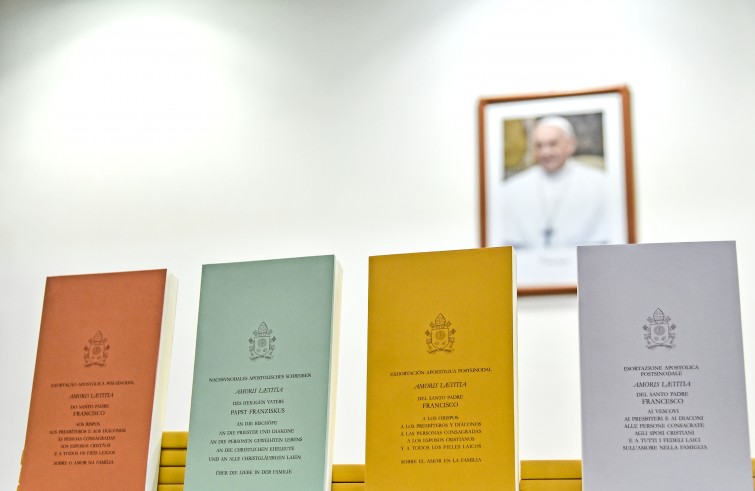
What Did the Pope Really Say? (The Amoris Laetitia Edition)

Image source: ancoraonline.it.
On Friday, as I’m sure most of you know, the Vatican Press released Pope Francis’ post-synodal exhortation Amoris Laetitia (The Joy of Love). Predictably, everyone who foresaw sweeping changes in Church doctrine and practice were proved wrong, though that didn’t stop The Usual Gang of Radical Traditionalists from proclaiming it a heretical disaster.

Amoris Laetitia Not a Wrecking Ball

If you’re going to read it, be prepared: at 264 pages (closer to 245, if you take out blank pages and such), it’s longer than any encyclical I’ve ever read, including St. John Paul’s Evangelium Vitae, longer even than Laudato Si’. It’s a wide-ranging and somewhat undisciplined ramble, as Francis occasionally breaks from the main line of his thoughts to directly address sections of his readership. For example, in paragraph 212, in the middle of discussing short-term preparations for marriage, he offers some quick advice to the engaged couples. But while fully half of the text is enclosed in quotation marks — three-quarters of one of the longest paragraphs consists of one extensive citation of a sermon given by Dr. Martin Luther King, Jr. — still Francis’ irrepressible enthusiasm comes through.

Nevertheless, the fact remains that Amoris Laetitia is an apostolic exhortation, not an apostolic constitution nor a motu proprio. Very early on, Francis defines his purpose: “to gather the contributions of the two recent Synods on the family, while adding other considerations as an aid to reflection, dialogue and pastoral practice, and as a help and encouragement to families in their daily commitments and challenges.” (AL § 4)

Since Francis’ focus is pastoral not doctrinal, no doctrine has been upset, no dogma contradicted, no norm disestablished. While Dave Armstrong exaggerates its importance to the life and future of the Church (“Francis’ ‘Humanae Vitae moment’”? Seriously?), it’s certainly not the wrecking ball many feared it would be.

Thursday, December 24, 2015

Book Review: To the Martyrs, by Cdl. Donald Wuerl

Cdl. Donald Wuerl
Emmaus Road Publishing
Cover Price: $22.95
Recommended

 Anti-Christians condemn Christians for their hypocrisy. However, not a single Christian martyr has ever suffered persecution by non-Christians for failing to live the gospel message perfectly. Rather, Christians were and are persecuted just for associating themselves with the gospel message in the first place. Imperfection of religious practice has hardly been a barrier to execution, imprisonment, maiming, rape, or torture by those who hate Christianity and that for which they think it stands.

This is the first thought that occurs to me after reading To the Martyrs: A Reflection on the Supreme Christian Witness by Cdl. Donald Wuerl. The title reflects both the title of a letter by the Church Father Tertullian and Wuerl’s own personal fascination with, and dedication to, the millions of martyrs and confessors who have been “the seeds of the Church” over the last two millennia. It’s a “reflection” as well in that it’s obviously not an exhaustive treatment of martyrdom intended for scholars and Church historians, but rather a brief overview for the ordinary layman. Written in a very accessible style, it has just enough footnotes to show that the good archbishop didn’t rely on his own memory or make things up as he went along.

As one reads To the Martyrs, though, a theme recurs. G. K. Chesterton famously noted that the Christian ideal hadn’t been “tried hard, and found wanting,” but rather had been “found difficult; and left untried.” However, as Cdl. Wuerl shows, the centuries of persecution didn’t come from people who found the Christian ideal too difficult to live up to, but rather from people who found that ideal too challenging, too uncomfortable to live with.

Monday, November 23, 2015

Welcome to the (Dysfunctional) Catholic Family!

Image source: thecatsdiary.com
So you’ve completed the RCIA program, been confirmed (possibly baptized, if you weren’t before), and have even got your first rosary, bottle of Holy Water, and collection envelopes. Congratulations, and benedicamus Domino! You’ve joined the Catholic Church! Like the song in The Music Man says, “So what the heck, you’re welcome; glad to have you with us, even though we may not ever mention it again.”

It’s theoretically possible that you were comatose for the last twenty years and, like Rip Van Winkle, just woke up before you began the conversion process. Or, you could be young enough to not remember the scandals of the “Long Lent” of 2002 (and haven’t seen Spotlight yet) — was it really that long ago? In any event, I’ll trust you decided that the people of the Church don’t have to be perfect in order for the Church to teach the fullness of Christ’s truth. Many former Protestants and non-Christians convinced themselves of the truth of the Church’s doctrines, through self-directed study, even before they registered for the classes.

If we were perfect, we wouldn’t need the Church to begin with. “Those who are well have no need of a physician, but those who are sick. ... I came not to call the righteous, but sinners” (Matthew 9:12-13).

Saturday, September 5, 2015

Absolution, excommunication, and abortion

Photo credit: Giampiero Sposito/Reuters.
Welcome to another edition of What Did the Pope Really Say? Today’s confusion is over Pope Francis’ recent letter to the President of the Pontifical Council for the Promotion of the New Evangelization, Abp. Salvatore “Rino” Fisichella. Specifically, what did the Pope command to be done about abortion for the Extraordinary Jubilee of Mercy year that is not already being done in parishes throughout the world? Did the Pope declare abortion to not be a sin? Were women unable to be absolved of the sin before? What gives?

In this case, the normal amount of mainstream-media misinformation is compounded by what Edward Peters calls “the pervasive ignorance of canon law among rank-and-file faithful brought about by fifty years of ecclesiastical antinomianism.”[*] Abortion is not only a sin in traditional Christian moral doctrine; in the Code of Canon Law it’s also a delict, analogous to a tort in civil law, with a defined punishment. Per Canon 1398, “A person who procures a completed abortion incurs a latae sententiae excommunication.”[†]

The confusing part of Pope Francis’ letter is his stated decision “to concede to all priests for the Jubilee Year the discretion to absolve of the sin of abortion those who have procured it and who, with contrite heart, seek forgiveness for it.” Boston archbishop Cdl. Seán O’Malley reinforces the bewilderment when he tells us, “Under the provisions of canon law, absolution of certain serious sins, including abortion, was reserved to the diocesan bishop. For many years in the United States, including in the Archdiocese of Boston, diocesan bishops have granted their priests the faculty to absolve the sin of abortion.” [Bold type mine.—ASL] In all fairness, canon law is a recondite subject, and neither Francis nor Cdl. O’Malley were educated as canon lawyers.

Saturday, July 18, 2015

Apologetics Toolbox: Sin, forgiveness, and reconciliation


Pope Francis hearing a confession.
(Image source: catholic.com.)
The Catholic doctrines surrounding the Sacrament of Reconciliation (aka Confession, aka Penance) present a challenge to many Protestants, especially those of the free-church/Evangelical lineage. “Why,” the Protestant asks, “must I go to a priest to have my sins forgiven? Why can’t I just pray to Jesus directly? After all, my sins are between me and God!” If the Protestant is an Evangelical of the “once saved, always saved” stripe, he may even say, “Jesus has already taken away all of my sins, past, present, and future! Why would I need to ask?”

Sin is not a private matter

I’ve already discussed the assurance of salvation elsewhere; if you need to, please consult that post first. The rest of the discussion will assume that a mere assertion of faith in Christ is not sufficient in itself to achieve salvation, that we can lose our salvation through our own fault.

Sins don’t occur in a vacuum or a void space. In all cases, there is at least one person other than God who is offended by a particular sin — namely, the sinner himself, even if he fails to recognize it. Most of the time, there is at least one direct victim of the sin; there are often witnesses. Many sins hurt the community, even when they’re not illegal. And sins done in public cause scandal in the classic sense: they testify against the Church and the Faith to non-Christians. Moreover, we know just from watching the news that many sins done in secret become public knowledge due to circumstances beyond the sinners’ control, becoming scandals in the common sense. How could you ever think that your sins are “just between you and God”?

So we’ve assumed that an assertion of faith, even a “conviction of salvation”, doesn’t of itself secure salvation, because “if we go on sinning willfully after receiving the knowledge of the truth, there no longer remains a sacrifice for sins, but a terrifying expectation of judgment and the fury of a fire which will consume the adversaries.” (Hebrews 10:26-27 NASB)[*] Only those who “persevere to the end” (Matthew 24:13), who “[do] the will of My Father who is in heaven” (Matthew 7:21), will be saved. How then, does a Christian repair the damage and put himself back on the path?

Thursday, July 16, 2015

Apologetics Toolbox: Catholic Answers for Slick Questions


A Facebook source led me to a page titled “Questions for Roman Catholics”, by Matt Slick of the Christian Apologetics & Research Ministry. “The responses [I get],” Slick states, “vary from defensive tradition to ignoring them and hoping to go away. Some of the questions are easier for Roman Catholics to respond to, and others are not. I hope that these might be helpful in your dialogs with the Roman Catholics as you try to present to them the true and saving gospel of Jesus Christ.”

Well, it depends on the context in which Slick presents the questions; some are pretty intrusive. But overall, some of the questions are no-brainers, some misrepresent Catholic doctrine to some extent, and some just show how little Slick himself understands what he’s attacking. The overall presentation is supposed to lead the Catholic to question his faith and the Church. But it’s by no means an infallible (*ahem!*) wrecking ball. Here I present it with fearful fidelity, including Slick’s misspellings, along with the answers. (Note: Questions rendered irrelevant by the answer to a previous question — or, in the case of the oral tradition questions, based on a fallacious notion — are presented in strikeouts.)


Monday, July 13, 2015

The Benedict Option: Building a Catholic counterculture—UPDATED

Rod Dreher. (Photo: John Zak.)
Saturday, on the suggestion of Brandon Vogt, I read fellow Metroplex resident Rod Dreher’s “Critics of the Benedict Option”, in which Dreher attempts to further articulate what he confesses is “an inchoate phenomenon”. It's inchoate because, while the name is taken from St. Benedict of Nursia, the idea is not a return to the great monastic period.

Indeed, Dreher doesn’t really have anything specific in mind, which is why it drives poor John Zmirak crazy. Zmirak is trying to treat as a defective syllogism what is patently a hazy vision (and therefore can’t be logically proven or disproven).

The springboard for Dreher’s idea is a passage at the end of After Virtue, written by the late Alasdair MacIntyre in 1981. MacIntyre, Dreher writes, “described the state of contemporary moral discourse as irresolvably chaotic — irresolvably, because we have no common source of moral behavior anymore, and have decided, as a culture, that moral truth is something one arrives at by feeling.” Here is the part of the passage from the end of After Virtue which to me is truly relevant in discussing the Benedict Option:

A crucial turning point in [the late Western Roman Empire] occurred when men and women of good will turned aside from the task of shoring up the Roman imperium and ceased to identify the continuation of civility and moral community with the maintenance of that imperium. What they set themselves to achieve instead — often not recognising fully what they were doing — was the construction of new forms of community within which the moral life could be sustained so that both morality and civility might survive the coming ages of barbarism and darkness. [Bold font mine.—ASL]

And thus the Benedict Option: Christian enclaves, like Front Royal, Va., or Ave Maria, Fla., existing to mutually reinforce the faith in the new Dark Age.

Saturday, June 6, 2015

The smile on the lips of martyrs

I suppose we Catholic writers are socially expected to have a massive episode of cognitive dissonance over the news of the significant drop in religious affiliation over the years 2007 to 2014. Because, of course, this sort of thing has never happened before (he said while rolling his eyes melodramatically).

Religious revivals come and go. So do intellectual fads and ideological fashions. Leftist progressivism has been in the ascent in the last few decades, and irreligion has been riding its coattails as it’s risen. As I pointed out in my very first post on this site, neither atheism nor agnosticism offers us better arguments than they did a hundred years ago. However, the bar has been lowered. Scientific advances haven’t made Christianity indefensible; rather, pedagogical innovations and ideological indoctrination in the classrooms have left fewer Christians able to defend it.

When you’re not satisfied with an answer, it doesn’t take much to change your mind. Many if not most former Catholics didn’t leave the Church so much as they formalized a separation that had been there for many years, even from childhood. There’s now almost no social cost to abandoning religious practice; in some circles, irreligion is not only tolerated but expected. And, to be perfectly frank, the Church in the West made it easier by decades of poor religious education, clerical malformation, and episcopal cowardice.

By the same token, when you find an answer that satisfies you both intellectually and emotionally, the argument against it has to be very powerful in order to change your mind about its truth. No one has yet made an argument to Catholicism’s falsehood that I find remotely persuasive, let alone convincing. Indeed, many people seem more committed to mocking, berating, and shaming me out of my illusions than they are to showing me that they are illusions.

Friday, April 10, 2015

Murphy’s Law and Jesus in Hell

Okay, if we’re all done laughing about #SalonChristianitySecrets ….

The problem with clickbait headlines is that, all too often, they don’t entice you to read the story. Rather, they become the story. More often than not, the link is shared with other people, to be ridiculed or praised whether anyone actually reads the copy or not; their joy and outrage is sparked solely by the one or two deliberately misleading lines at the top of the page. Not even the lede gets a glance. Moreover, if someone does read the copy, their understanding is front-loaded by the headline, giving false strength to weak evidence and arguments.

Such was the case with Ed Simon’s “Jesus went to hell: The Christian history churches would rather not acknowledge”. Contrary to Simcha Fisher’s impatient dismissal in her National Catholic Register blog, Simon did do some research on Jesus’ descent to Sheol, and showed some understanding of the teaching. Knowing the teaching, however, isn’t the same as knowing the divisions in modern Christian culture. It’s here that Simon trips up in his analysis, leading himself to the theme from which someone at Salon derived the title, in all its conspiracy-theorist awkwardness … and to all the hoo-hahs of the Twitterverse.

(My two favorites: “BREAKING: Jesus flipped tables in a fit of rage one time. IS THIS YOUR CHRIST?” and “‘I have not come to call the righteous, but sinners to repentance.’ #JesusMicroaggressions”)

For my own part, I suspect Simon is a Christian, even possibly one of an Eastern Orthodox communion. However, I suspect that he was raised in the West, and therefore infected by the materialism and reductionism in our culture. Certain aspects of Christianity strike him as weird because he expects everything to be rational, which no reasonable person would expect. The simplest, most readily-available cure for such an odd view of the world is to consult the many permutations of Murphy’s Law.

Sunday, March 15, 2015

Fourth Sunday in Lent: The Babylonian Exile

Image source: conformingtojesus.com.
Responsorial: Psalm 137:1-6
Second Reading: Ephesians 2:4-10
Gospel: John 3:14-21

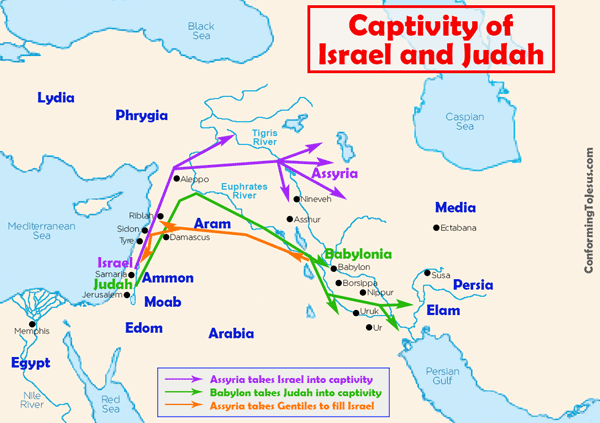
The first reading recalls the fall of the kingdom of Judah, the southern half of the Davidic Kingdom of Israel, in 586 BC. The northern half, which had retained the name of Israel, had fallen to Sargon II in 722 BC, and had been redesignated an Assyrian province with the name Samaria. Now, with the twin invasions of the Chaldeans and Idumeans, the original Kingdom of David and Solomon was no more.

Moses had given the Hebrew people God and His Law. Nebuchadnezzar gave them their identity as Jews. The seventy years of the Babylonian Exile[*] had done more to make the Jewish people monotheists than had over four centuries of self-rule. The Hebrews had had an alphabet and a written language since at least David’s time; now they began to gather such records as they had and compile their oral traditions, to redact the beginning of what would eventually become the Tanakh — the Hebrew Bible.

This period, in which Jewish identity was being crystallized, also gave us Psalm 137 [136], a song of heartbreak and loss: “How could we sing a song of the Lord in a foreign land?” Not included in the reading of the psalm is the anger:

Remember, Lord, against Edom
    that day at Jerusalem.
They said: “Level it, level it
    down to its foundations!”
Desolate Daughter Babylon, you shall be destroyed,
    blessed the one who pays you back
    what you have done us!
Blessed the one who seizes your children
    and smashes them against the rock.
Thus was forged in the minds and hearts of the Jewish people the iron triad of God, the Law, and Zion, to which they have clung with stubborn fidelity for over 2,500 years.

Sunday, March 1, 2015

Second Sunday in Lent: Generosity and Sacrifice

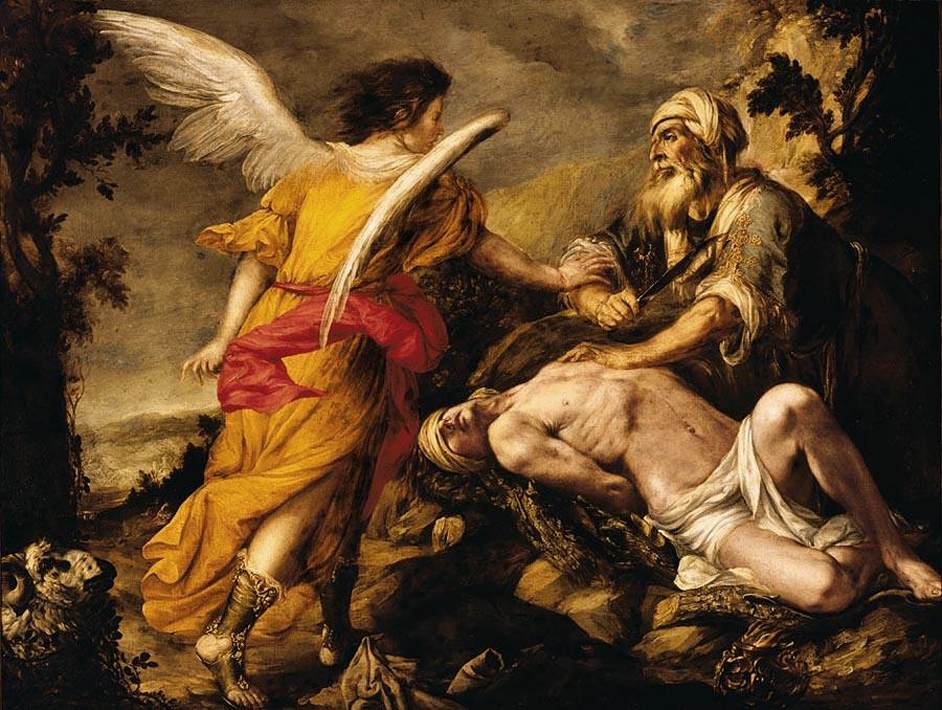
The Sacrifice of Isaac, by Juan de Valdes Leal (1659).
Responsorial: Psalm 116:10,15-19
Second Reading: Romans 8:31-34
Gospel: Mark 9:2-10

In today’s Gospel reading, Mark gives us an account of Jesus’ transfiguration in the presence of Ss. Peter, John and James. A lot is packed into this theophanic moment: Moses, the Teacher and Lawgiver, sitting with Elijah, the greatest of the Prophets, both in conversation with the Word of God Revealed — not quite in his fullness of power and glory, but in a manner (somewhat) comprehensible to the three disciples. Moreover, they are conversing: neither Moses nor Elijah is a mindless shade, as many Mediterranean cultures conceived of the dead:


Who will sing praises to the Most High in Hades,
      as do those who are alive and give thanks?
From the dead, as from one who does not exist, thanksgiving has ceased;
      he who is alive and well sings the Lord’s praises.


So wondrous is this revelation that Peter, speaking from his heart, offers to build sukkoth for them. Sukkoth, on the one hand, were temporary shelters, walled with leather and roofed with palm fronds, such as field workers and religious pilgrims used; on the other hand, just such a tabernacle had been the temple of the Hebrews as they sojourned in the desert with Moses — a holy place that was wholly portable. God had “tented” with His people in the desert, in the Ark of the Covenant, just as His Word “tabernacled” among humanity in the flesh of Christ (cf. John 1:14 LXX, eskēnōsen).

Sunday, February 22, 2015

First Sunday in Lent 2015: Spring Cleaning the Conscience

First Reading: Genesis 9:8-15
Psalm 25:4-6,7-9
Second Reading: 1 Peter 3:18-22
Gospel: Mark 1:12-15

In the first reading, God makes a covenant with every mortal being on earth through Noah: “Never again shall all creatures be destroyed by the waters of a flood.” (Genesis 9:11) In the second reading, St. Peter tells us this flood “prefigured” the sacrament of Baptism, “not as a cleansing of dirt from the body, but as an eperōtēma of a good conscience to God, through the resurrection of Jesus Christ.” (1 Peter 3:21)

The meaning of eperōtēma is uncertain. The Vulgate, following St. Jerome, translates it as interrogatio — a question, an interrogation, a cross-examination, perhaps even an argument or syllogism. The New American Bible, Revised Edition notes that it could also be rendered as pledge; “that is, a promise on the part of Christians to live with a good conscience before God, or a pledge from God of forgiveness and therefore a good conscience for us.” And Thayer’s Lexicon argues that “As the terms of inquiry and demand often include the idea of desire, the word thus gets the signification of earnest seeking, i.e. a craving, an intense desire ….

So what did St. Peter mean by calling Baptism an eperōtēma? It helps us to step backwards, not only in the epistle, but also in Genesis.


Friday, January 16, 2015

Talking smack about the Pope

It’s been over a week now, and certain people still haven’t gotten over the spanking Maureen Mullarkey received for her rather slanderous attack on Pope Francis. And a spanking it was; R. R. Reno, the editor-in-chief of First Things, not only washed his hands of her post but offered his own rebuttal to it, calling her criticisms and caricatures of Francis “overdrawn and ill-tempered”.

Oh, wait a minute — that’s not the spanking they’re not over. Rather, they’re not over the explosion from the Patheos blog, Catholic and Enjoying It, written by The Blogger Whom I’m Damn Well Going to Name for Just This Once, Mark Shea.

You see, Shea had just written the day before about the Catholic right’s pre-dismissal of Francis’ yet-to-be-completed encyclical on climate change; and lo and behold, out comes Mullarkey’s hit piece. (You could almost hear him yelling at the clay pigeon launcher, “Pull!”) So he unloaded on Mullarkey, as well as her First Things combox followers, calling it a “festival of crazy contempt for Francis” and a “revolting (in every sense) smear job”.

Christopher Ferrara at The Remnant promptly got upset on Mullarkey’s behalf, deploying even more right-wing buzzwords and straw men, along with a healthy dollop of radical-traditionalist contempt for “neo-Catholics”. (Apparently, Francis “kissed the Koran” when he posed for that shot holding the anti-fracking T-shirt.) Nevertheless, we might have been able to walk away from the shindy — certainly it doesn’t appear Shea’s given the matter any further attention — had not my Catholic Stand colleague Donald R. McClarey weighed in with further acid, preceded with the biggest straw man of them all:

“…[C]riticism of this Pope is verboten in the eyes of some bloggers.”

Thursday, December 18, 2014

The Final Report: three decades too late

Religious Sisters of Mercy. (Source: vocationblog.com)
Tuesday, December 16, saw the Holy See’s Congregation for Institutes of Consecrated Life and Societies of Apostolic Life (CICLSAL) release its long-awaited final report on the apostolic visitation of American institutes of women religious. Initiated during the pontificate of Benedict XVI, many of us saw it as the beginning of a thorough house-cleaning, while many nuns and liberals saw it as the beginning of a misogynistic oppression by a patriarchal Church.

The Final Report, however, was not the severe tongue-lashing many orthodox Catholics expected. Between the initiation of the visitation in December 2008 and its conclusion in 2012, the dicastery changed prefects, from the outspoken Lazarist Cdl. Franc Rode to the more conciliatory secular bishop Cdl. João Braz de Aviz. (Secular, in this context, simply means “not attached to any specific religious order”.) Both men have had concerns about the weakening of religious orders by liberalizing trends; +de Aviz said in an interview that he was nearly driven out of the seminary and the Church by liberation theology. Nevertheless, +de Aviz chose to take a more soft-pedaled approach with the skittish, distrusting women religious the Congregation would study.

As a result, the Final Report — which is more of a generalized executive summary — has copious praise for the work women religious have done and are still doing. Specific criticisms are presumably restricted to the reports the Congregation “foresees” will be issued to “those Institutes which hosted an onsite visitation and to those Institutes whose individual reports indicated areas of concern.”

Nevertheless, there is some steel underneath the velvet glove: not every paragraph is either laudatory or exculpating. Moreover, the report points to data which indicate that, for many American institutes, the visitation has come two or three decades too late to save them.

Thursday, December 4, 2014

The Battle at the Communion Rail

Communion rail, Church of the Holy Ghost, Tiverton, RI
(© 2012 Fr. Jay Finelli)
The new pastor of the Windy City, my fellow Omahan the Most Rev. Blase Cupich, didn’t wait too long to start the usual suspects huffing about the “Francis Effect”. In an interview with CBS News’ Norah O’Donnell, Abp. Cupich stated — or rather implied — that he wouldn’t deny participation in the Eucharist to Catholic politicians who hold positions contrary to Church teaching.

I say “implied” because, in context, +Cupich seems to be talking about an ad hoc decision during a Mass to withhold Communion: “I would not use the Eucharist, or as they call it ‘the communion rail,’ as a place to have those discussions or a way in which people would be either excluded from the life of the church.

“The Eucharist is an opportunity of grace and conversion,” he told [O’Donnell] in an interview that aired on “Face the Nation” Sunday. “It’s also a time of forgiveness of sins, so my hope would be that grace would be instrumental in bringing people to the truth.”

Naturally, this is the kind of thing that leads Huffington Post’s Carol Kuruvilla, playing the classic “good Church/bad Church” game, to gush, “Cupich’s softened approach stands in stark contrast to the position held by Cardinal Raymond Burke, a prominent conservative Catholic archbishop who has led campaigns to ban Catholic politicians who support abortions from receiving communion.” Just as naturally, it leads many in the Catholic commentariat, such as Brian Williams of One Peter Five, to wail and harrumph:

Let us hope and pray that Our Lord is not subjected to further sacrilege, and His Church to further scandal, by an outright refusal to enforce Canon 915 in Chicago. The Church loses credibility when she rightly advocates for protecting the unborn, but then gives Holy Communion to high profile, unrepentant, Catholic politicians who support the “right” to an abortion.