
 |
| Image source: ancoraonline.it. |
On Friday, as I’m sure most of you know, the Vatican Press
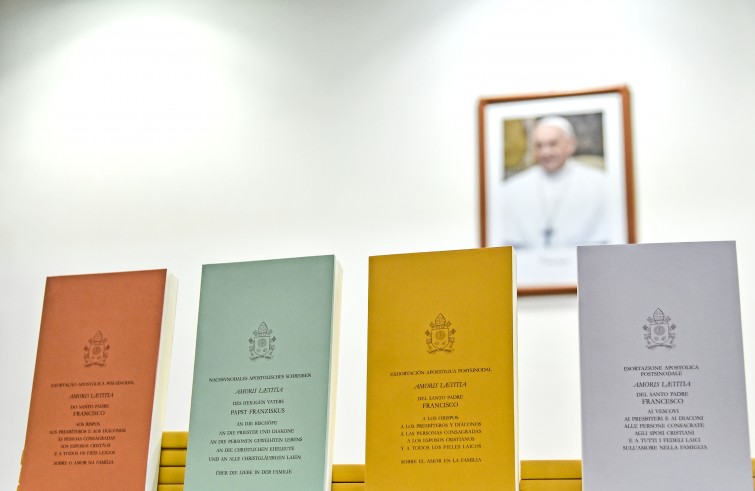
released Pope Francis’ post-synodal
exhortation Amoris Laetitia (The
Joy of Love). Predictably, everyone who foresaw sweeping changes in Church
doctrine and practice were proved wrong, though that didn’t stop The Usual Gang
of Radical Traditionalists from proclaiming it a heretical disaster.
Amoris Laetitia Not a Wrecking Ball
If you’re going to read it, be prepared: at 264 pages
(closer to 245, if you take out blank pages and such), it’s longer than any
encyclical I’ve ever read, including St. John Paul’s Evangelium Vitae, longer even than Laudato Si’. It’s a wide-ranging and somewhat undisciplined ramble,
as Francis occasionally breaks from the main line of his thoughts to directly
address sections of his readership. For example, in paragraph 212, in the
middle of discussing short-term preparations for marriage, he offers some quick
advice to the engaged couples. But while fully half of the text is enclosed in
quotation marks — three-quarters of one of the longest paragraphs consists of one
extensive citation of a sermon given by Dr. Martin Luther King, Jr. — still
Francis’ irrepressible enthusiasm comes through.
Nevertheless, the fact remains that Amoris Laetitia is an apostolic exhortation,
not an apostolic constitution nor a motu proprio. Very early on, Francis
defines his purpose: “to gather the contributions of the two recent Synods on
the family, while adding other considerations as an aid to reflection, dialogue
and pastoral practice, and as a help and encouragement to families in their
daily commitments and challenges.” (AL
§ 4)
Since Francis’ focus is pastoral not doctrinal, no doctrine
has been upset, no dogma contradicted, no norm disestablished. While Dave
Armstrong exaggerates its importance to the life and future of the Church (“Francis’
‘Humanae Vitae moment’”? Seriously?),
it’s certainly not the wrecking ball many feared it would be.
“Doctoral” vs. “Pastoral”
Let’s first make the distinction clearer: When we say a
Church document is doctoral, we mean
that it addresses what the Church
teaches. When we say a document is pastoral,
we mean it addresses how the Church
teaches — the means and methods by which the Church, particularly but not
limited to its priests and bishops, brings people into proper Christian life
and worship.
The level of authority of papal documents has never been
fully formalized. In general, however, the weightiest acts of the Church tend
to repose in apostolic constitutions, especially dogmatic constitutions. For
instance, the two universally-agreed exercises of papal definition of dogma,
the Immaculate Conception and Assumption of the Blessed Virgin Mother, were
contained in apostolic constitutions.
As the name implies, apostolic exhortations seek to
encourage the faithful to undertake certain activities; as in the present case,
they’re also used to sum up papal responses to the deliberations of the Synod
of Bishops. As such, they’re generally not considered as momentous as
constitutions, encyclicals, or motu
proprio letters.
A Quickie Overview
Let’s turn now to Amoris
Laetitia. Chapter One speaks of the Christian ideal of marriage as
expressed in Scripture, especially in the pattern of Psalm
128:1-6. Chapter Two then looks at the reality of the family in the modern
world and the challenges it faces. Chapter Three considers the family from the
aspect of vocation. Then Francis devotes two chapters to an exploration of the
meaning of love, particularly as St. Paul defined it in 1
Corinthians 13:4-7, and how it manifests in marriage and family. Chapters
Six and Seven then turn to offering suggestions for parish efforts in
strengthening marriages and families, especially in educating children. Chapter
Eight then concerns itself with treating families in “irregular situations”.
Chapter Nine concludes the exhortation with a reflection on the spirituality of
marriage and family, the final paragraph a prayer to the Holy Family.
The paragraphs which have drawn the most attention, according
to Fr. Matthew L. Schneider, LC, are 242 – 243, 250, and 298 – 305. Paragraphs
242 – 243 call for greater pastoral care for those undergoing separation and
divorce; 243 in particular emphasizes that those who have divorced and “entered
a new union” should not be frozen out, and “should be encouraged to participate
in the life of the community.” Paragraph 250 simply restates the Catechism’s call to accept gay people “with
respect, compassion, and sensitivity” (CCC 2358). Paragraph 251, however, rejects
“proposals to place unions between homosexual persons on the same level as
marriage”, citing the CDF document Considerations
Regarding Proposals to Give Legal Recognition to Unions between Homosexual
Persons.
So far we’re on solid ground. The Church’s teaching on the
acceptance of gay people in the Church hasn’t significantly changed since 1986,
when the CDF issued its letter On
the Pastoral Care of Homosexual Persons. If there were anything “new”
concerning the Church’s response to divorcing/separating couples, it would be
that Francis gives parishes a swift kick in the butt to actually respond and not just sit on the sidelines
watching the devastation unfold.
The Search For the Middle Way
When it comes to Paragraphs 298 – 305, a kind of fog
descends on Francis’ writing. Throughout his pontificate, Francis has tried to
steer the Church clear of a Pharisaical legalism that treats norms and
doctrinal points as ends in themselves, rather than as means to an end, wanting
the Church’s discipline to “err on the side of mercy”. However, he’s also been
wary of going too far in the opposite direction, of unintentionally damaging or
demeaning the teachings of the Church by too permissive an approach. These two opposing
dangers, legalism and laxness, lead him into the awkward position of trying to
articulate a “middle way” that one suspects isn’t any clearer to him than it is
to others.
The need for this via
media arises from the Synod’s appreciation of the challenges facing modern
marriage and family. C. S. Lewis once stated that the modern paganism’s
relationship to classical paganism was the same as a divorcée’s relationship to
a virgin. Put differently, where the apostles of yore encountered people with
no previous knowledge of Christ and an undiluted sense of sin, the “First World
missionary” now faces would-be pagans who have a surfeit of false knowledge and
a febrile sense of sin. In the current cultural matrix, a simple reassertion of
the Church’s magisterial authority is woefully insufficient to force the
divorced and remarried to either separate from their new spouses or seek
annulments of their previous marriages.
In seeking this rapprochement
between the ideal and the real, Francis soft-pedals the fact that, from the
perspective of the Catholic understanding of marriage, a person who ends a
valid sacramental marriage and marries another without seeking an annulment of
the first is objectively committing adultery. For instance, in paragraph 298, Francis
writes that such marriages can exhibit “proven fidelity, generous self-giving,
[and] Christian commitment”. Canon
lawyer Edward Peters drily responded, “Many will wonder how terms such as
‘proven fidelity’ can apply to chronically adulterous relationships or how
‘Christian commitment’ is shown by the public and permanent abandonment of a
previous spouse.”
Peters’ comment, however, doesn’t display Francis’ lack of
disciplined thought so much as it demonstrates his own inability to grasp the new
pastoral reality, in which monogamy
is serialized and the divorced — having parted consensually and sometimes
even amicably — often don’t think of themselves as having (been) abandoned (by)
their spouses. Post-Christian culture is shot through with the acceptance of transience; as the Avenue Q song puts it, “Everything in life is only for now.” To
call second marriages “adulterous” may be theologically correct, but it’s also
alienating and judgmental. The Church is essentially back in the position of
St. Paul, having to feed the Corinthians milk because they’re not ready for
solid food (cf. 1
Corinthians 3:1-3).
Summary
While Amoris Laetitia
addresses all types of families, its main concern is with building up marriage and
family in a macro-culture that no longer supports them and actively seeks to
replace them with ad hoc social
constructs. It can be argued that Francis’ treatment of the divorced and
remarried isn’t careful enough of doctrine; nevertheless, it would a sin of rash
judgment to call the section in question heretical.
As for giving communion to the divorced and remarried, many talking
heads are placing too much weight on John
L. Allen, Jr.’s so-called “money quote” (AL 300, footnote 336), which speaks of “discernment” finding that “no
grave fault exists”, but doesn’t offer a context in which that discernment would
take place; at no point does Francis mention the “internal forum” beloved of
the German bishops. It wouldn’t be surprising if some priests seized upon it as
an excuse to turn a blind eye … but then, said priests were probably blinding
themselves to such couples receiving communion in the first place.
It will probably be some time, perhaps years, before we see much
fruit from this particular tree (if ever); it remains for the individual
bishops in their dioceses to act on it or not. But for those of us who believed
from the beginning that too many hopes and fears were vested in this
exhortation, we can now breathe sighs of relief: given the length of Amoris Laetitia, and Francis’ tendency
to misstate his meaning, it could have been much worse.
We now return you to your regularly scheduled election
madness.
However, it’s a mistake to read this as an eschatological affirmation. Let’s look at the surrounding paragraph:
Addendum
Some people have pointed to a couple of sentences in paragraph 297 as being materially heretical: “No one can be condemned for ever, because that is not the logic of the Gospel! Here I am not speaking only of the divorced and remarried, but of everyone, in whatever situation they find themselves.”However, it’s a mistake to read this as an eschatological affirmation. Let’s look at the surrounding paragraph:
It is a matter of reaching out to everyone, of needing to help each person find his or her proper way of participating in the ecclesial community and thus to experience being touched by an “unmerited, unconditional and gratuitous” mercy. No one can be condemned for ever, because that is not the logic of the Gospel! Here I am not speaking only of the divorced and remarried, but of everyone, in whatever situation they find themselves. Naturally, if someone flaunts an objective sin as if it were part of the Christian ideal, or wants to impose something other than what the Church teaches, he or she can in no way presume to teach or preach to others; this is a case of something which separates from the community (cf. Mt 18:17). Such a person needs to listen once more to the Gospel message and its call to conversion. Yet even for that person there can be some way of taking part in the life of community, whether in social service, prayer meetings or another way that his or her own initiative, together with the discernment of the parish priest, may suggest. As for the way of dealing with different “irregular” situations, the Synod Fathers reached a general consensus, which I support: “In considering a pastoral approach towards people who have contracted a civil marriage, who are divorced and remarried, or simply living together, the Church has the responsibility of helping them understand the divine pedagogy of grace in their lives and offering them assistance so they can reach the fullness of God’s plan for them”, something which is always possible by the power of the Holy Spirit. (AL § 297; italics and bold font mine)
The phrases I’ve emphasized indicate clearly that Pope Francis is speaking of condemnation by the Church community rather than eternal damnation resulting from God’s final judgment. And, in fact, Francis is right: it’s neither the Church’s mission nor its duty to kick imperfect members to the curb. Rather, part of the Church’s evangelical charter is to keep reaching out to those in imperfect communion, to help bring them into full communion and a state of grace. If they wish to remain ex communione, it shouldn’t be because their local parish couldn’t be bothered to reach out to them, or gave up at some point, or set limits to forgiveness.
In any event, even if it were my place to judge the reigning pontiff’s orthodoxy, I’d have to say those who hold up the extract as a material heresy commit an out-of-context fallacy. Could it have been phrased a little better? Absolutely. Nevertheless, as phrased, it’s hardly a denial of the doctrines of Final Judgment and Hell.
Furthermore the deponent saith not.

