
 |
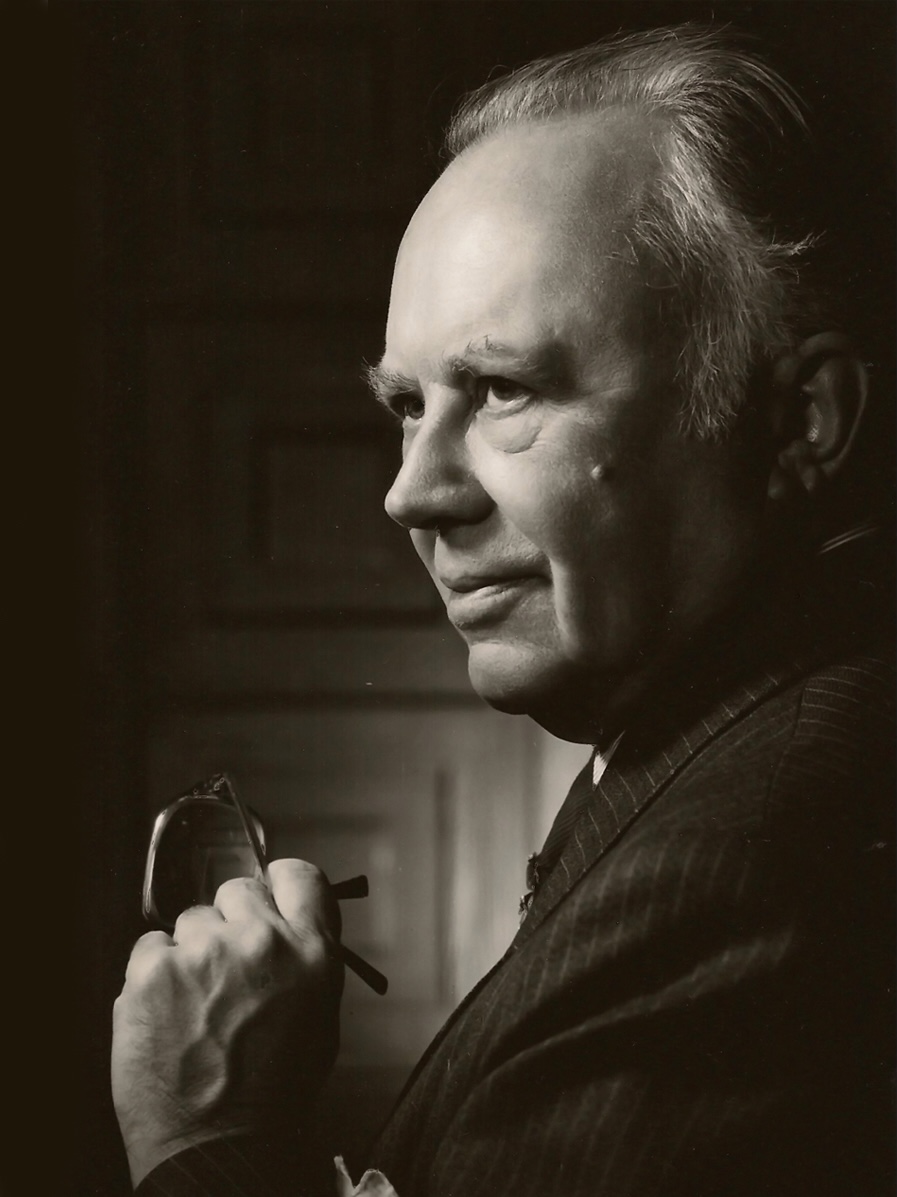
| Russell Kirk (via Wikimedia). |
Conservativism vs. Utopianism
“Can the American right free itself from the utopianism of
the post-Reagan era?” asks
Michael Lind in The National Interest.
The question would have seemed strange to mid-century American conservative thinkers like Peter Viereck, Russell Kirk and Robert Nisbet. In their view, conservatism was anti-utopian by definition. In different ways, they identified “conservatism” with a suspicion of radical schemes to revolutionize America and the world.
But today’s orthodox conservatism consists almost entirely of radical utopian schemes to revolutionize America and the world. So-called “movement conservatism” or “fusionism” in its present form is, in fact, an alliance of three distinct utopian movements in economics, domestic policy and foreign policy. All three crusades are doomed to fail in the real world.
A modern realist, I find, is very often one who, having
despaired of the real world ever meeting the standards of his ideals, goes on
to conclude that we should have no ideals. Lind, a modern realist, therefore
plunks for a bare-bones conservativism, one that seeks merely to preserve the
status quo rather than strive for a better nation.
Unfortunately, Lind doesn’t tell us why the status quo is to
be preserved, or why change is unnecessary. He merely defines three particular
efforts as “utopian” and derides any attempt to achieve them through politics
as “madness”.
The Religious Right
Let’s first grant Lind as much as we can. Lind quite rightly
points out that “mid-century American conservatives rejected libertarianism, on
the grounds that free-market utopianism is as undesirable as any other
utopianism,” reminding us that Milton Friedman and Friedrich von Hayek did not
consider themselves conservatives, while Peter Viereck defended the New Deal
and labor unions. Lind also decries as utopian the abandonment of Realpolitik for “the utterly
unconservative project of unprovoked wars to topple autocrats in the hope of
spreading a global democratic revolution,” again noting rightly that “has
backfired and spread chaos exploited by jihadists from Iraq to Syria and Libya.”
So far into his piece, Lind at least has the benefit of
appealing to historical precedents, to actual words and deeds. There’s no doubt
that the foreign-policy utopianism of Middle East king-making has made matters
worse for us, while economic utopianism has been given a test run in Kansas with
disastrous results. When Lind comes to moral utopianism, however, he resorts to
chronological snobbery, if not outright anti-Christian bigotry.
Until Donald Trump recently challenged the rules of conservative campaigning by offering qualified support for Planned Parenthood, American conservative politicians were expected to adopt the views on sexual and gender issues of the most extreme elements of the mostly-Protestant religious right. Mainstream conservatives promise to outlaw abortion and reverse the recent legalization of gay marriage and gay rights. Some social conservatives want to extend the counter-revolution to battle the use of contraceptives.
In the inaugural issue of National Review in 1955, William F. Buckley Jr. declared that conservatives wanted to “stand athwart history, yelling Stop,” rather, it must be supposed, as Joshua made the sun stand still in Joshua 10:12-13. The religious right has been more ambitious, wanting to stand athwart history and yell until it goes backward, as the sun went backward in Isaiah 38:7-8 and 2 Kings 20:8-11.
The appeal to the calendar isn’t argument — it’s merely a stale
rhetorical trope, a cliché uttered by people who have no better reasons to
offer. Furthermore, the calendar is apparently selective in what it prevents
from occurring again. Lind doesn’t see how it prevents us from adopting the Realpolitik of the Eisenhower and Nixon
Administrations; nor does he invoke it as protection from a return to the laissez-faire economic environment of
the 1880s. Indeed, his argument is for a return to what conservativism meant in the past; can you put that toothpaste
back in the tube?
“The Art of the Possible”
Lind doesn’t tell us why the sexual revolution was such a
great thing that it ought not be changed. He quotes with approval Russell Kirk’s
observation that “The socialists at least declare the existence of some sort of
moral order; the libertarians are quite bottomless.” Yet he fails to see the
connection of the moral order behind the rejection of abortion and same-sex
marriage to the moral order that rejected the libertarians’ economic
utopianism. The most he can offer is a traduction of the pro-life and pro-marriage
groups as “theologically mad” extremists. Why? Because to him “a
counter-revolutionary movement that has no prospect of success becomes just
another kind of utopianism” … forgetting that, sixty years ago, the idea that
same-sex relationships would one day be legally recognized as “marriages” would
have been laughed at by most gay people as hopelessly unrealistic and not even
particularly desirable.
“Politics is the art of the possible,” Lind pontificates. “It
follows that utopianism is unpolitical, even antipolitical.” But he doesn’t
argue that the libertarian economic agenda is impossible. Rather, he argues that it’s undesirable, a different matter. Likewise, he doesn’t argue that bringing
democracy to the Middle East is impossible,
but rather asserts that it’s been unsuccessful, even counterproductive, and
therefore undesirable. Lind’s real problem with these “utopianisms” is that
they’re really dystopian, in both
ground and consequence, not that they’re impossible.
The only thing Lind has argued to be impossible is a sexual counter-revolution, and then only on the
eyeroll-worthy grounds that it’s “so 1950s”. This Thursdayite surrender to the
postmodern sexual culture, to say nothing of the contempt he has for the
counter-revolutionaries, is inconsistent — verging on inexplicable — when
compared with the intellectual reverence he bestows upon the past. Lind
appreciates the practices of forty to sixty years ago, but doesn’t fully
understand or value the Judeo-Christian ethos which underlay them.
Next Stop: Dystopia
G. K. Chesterton said, “The business of Progressives is to
go on making mistakes. The business of Conservatives is to prevent mistakes from
being corrected.” Kirk, Buckley, and Viereck understood that to be conservative was to conserve; that is, to hold fast to those laws, programs, and social
structures worthy of preservation. That was the only acceptable motive to “stand
athwart history, yelling Stop;” they did not fear the fact of change so much as
they feared change for its own sake, or change in the wrong direction.
In this light, Lind’s conservativism is anemic, even lifeless.
It’s really a kind of progressivism that has stopped in its tracks, realizing
that the rest of the progressive herd is headed for a cliff’s edge. (“Progress
may have been all right once, but it’s gone on too long,” quoth Ogden Nash.) But
a conservativism that contents itself with merely saying “things are fine the
way they are right now” to people to whom the present system is unsatisfactory
is a conservativism doomed to fail, doomed to be despised as mere
obstructionism.
To paraphrase Flannery O’Connor: if that’s all
conservativism is, then to hell with it.
* * *
If the Republican Party is to survive, their ideological
footing must be distinct from that of the Democrat Party, even when both sides
back the same or similar policies. However, to attract the GOP should not be
content with defending the present system or denying a need for change; they must recognize current problems and
offer attractive solutions to address them. Put differently, the GOP must
become progressive according to their
own definition of “progress”, not merely obstructionist.
As far as the sexual counter-revolution goes: to argue that
social change can be had in one direction but not its opposite isn’t realistic.
If anything, it’s dogmatic, a reflexive statement of a faith in the
inevitability of Progress that, for all his worship of the conservative demigods,
Lind hasn’t been able to exorcise. Moving forward doesn’t necessarily mean we’re
getting closer to our desired destination; one can make progress in this limited sense by going downhill as well as by
going up. If one abandons all goals, all standards, all ideals, then there’s no
advantage left to making progress.
If Utopia’s not your destination, what’s left but Dystopia?

