Showing posts with label Sacraments. Show all posts

Saturday, April 9, 2016

What Did the Pope Really Say? (The Amoris Laetitia Edition)

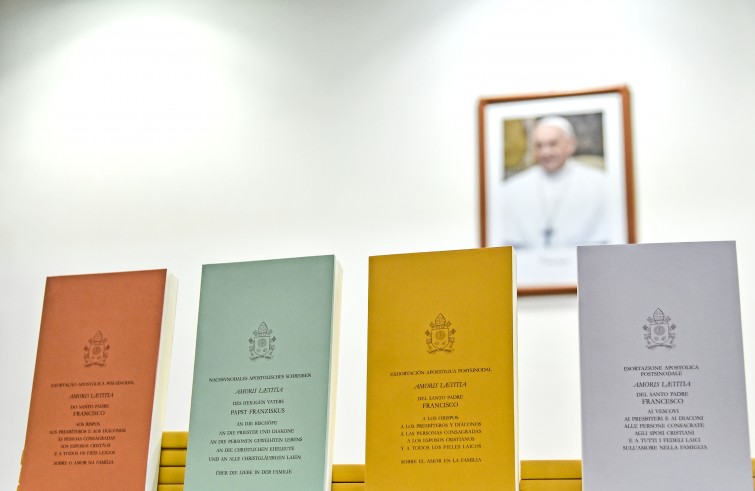
Image source: ancoraonline.it.
On Friday, as I’m sure most of you know, the Vatican Press released Pope Francis’ post-synodal exhortation Amoris Laetitia (The Joy of Love). Predictably, everyone who foresaw sweeping changes in Church doctrine and practice were proved wrong, though that didn’t stop The Usual Gang of Radical Traditionalists from proclaiming it a heretical disaster.

Amoris Laetitia Not a Wrecking Ball

If you’re going to read it, be prepared: at 264 pages (closer to 245, if you take out blank pages and such), it’s longer than any encyclical I’ve ever read, including St. John Paul’s Evangelium Vitae, longer even than Laudato Si’. It’s a wide-ranging and somewhat undisciplined ramble, as Francis occasionally breaks from the main line of his thoughts to directly address sections of his readership. For example, in paragraph 212, in the middle of discussing short-term preparations for marriage, he offers some quick advice to the engaged couples. But while fully half of the text is enclosed in quotation marks — three-quarters of one of the longest paragraphs consists of one extensive citation of a sermon given by Dr. Martin Luther King, Jr. — still Francis’ irrepressible enthusiasm comes through.

Nevertheless, the fact remains that Amoris Laetitia is an apostolic exhortation, not an apostolic constitution nor a motu proprio. Very early on, Francis defines his purpose: “to gather the contributions of the two recent Synods on the family, while adding other considerations as an aid to reflection, dialogue and pastoral practice, and as a help and encouragement to families in their daily commitments and challenges.” (AL § 4)

Since Francis’ focus is pastoral not doctrinal, no doctrine has been upset, no dogma contradicted, no norm disestablished. While Dave Armstrong exaggerates its importance to the life and future of the Church (“Francis’ ‘Humanae Vitae moment’”? Seriously?), it’s certainly not the wrecking ball many feared it would be.

Saturday, September 5, 2015

Absolution, excommunication, and abortion

Photo credit: Giampiero Sposito/Reuters.
Welcome to another edition of What Did the Pope Really Say? Today’s confusion is over Pope Francis’ recent letter to the President of the Pontifical Council for the Promotion of the New Evangelization, Abp. Salvatore “Rino” Fisichella. Specifically, what did the Pope command to be done about abortion for the Extraordinary Jubilee of Mercy year that is not already being done in parishes throughout the world? Did the Pope declare abortion to not be a sin? Were women unable to be absolved of the sin before? What gives?

In this case, the normal amount of mainstream-media misinformation is compounded by what Edward Peters calls “the pervasive ignorance of canon law among rank-and-file faithful brought about by fifty years of ecclesiastical antinomianism.”[*] Abortion is not only a sin in traditional Christian moral doctrine; in the Code of Canon Law it’s also a delict, analogous to a tort in civil law, with a defined punishment. Per Canon 1398, “A person who procures a completed abortion incurs a latae sententiae excommunication.”[†]

The confusing part of Pope Francis’ letter is his stated decision “to concede to all priests for the Jubilee Year the discretion to absolve of the sin of abortion those who have procured it and who, with contrite heart, seek forgiveness for it.” Boston archbishop Cdl. Seán O’Malley reinforces the bewilderment when he tells us, “Under the provisions of canon law, absolution of certain serious sins, including abortion, was reserved to the diocesan bishop. For many years in the United States, including in the Archdiocese of Boston, diocesan bishops have granted their priests the faculty to absolve the sin of abortion.” [Bold type mine.—ASL] In all fairness, canon law is a recondite subject, and neither Francis nor Cdl. O’Malley were educated as canon lawyers.

Saturday, July 18, 2015

Apologetics Toolbox: Sin, forgiveness, and reconciliation


Pope Francis hearing a confession.
(Image source: catholic.com.)
The Catholic doctrines surrounding the Sacrament of Reconciliation (aka Confession, aka Penance) present a challenge to many Protestants, especially those of the free-church/Evangelical lineage. “Why,” the Protestant asks, “must I go to a priest to have my sins forgiven? Why can’t I just pray to Jesus directly? After all, my sins are between me and God!” If the Protestant is an Evangelical of the “once saved, always saved” stripe, he may even say, “Jesus has already taken away all of my sins, past, present, and future! Why would I need to ask?”

Sin is not a private matter

I’ve already discussed the assurance of salvation elsewhere; if you need to, please consult that post first. The rest of the discussion will assume that a mere assertion of faith in Christ is not sufficient in itself to achieve salvation, that we can lose our salvation through our own fault.

Sins don’t occur in a vacuum or a void space. In all cases, there is at least one person other than God who is offended by a particular sin — namely, the sinner himself, even if he fails to recognize it. Most of the time, there is at least one direct victim of the sin; there are often witnesses. Many sins hurt the community, even when they’re not illegal. And sins done in public cause scandal in the classic sense: they testify against the Church and the Faith to non-Christians. Moreover, we know just from watching the news that many sins done in secret become public knowledge due to circumstances beyond the sinners’ control, becoming scandals in the common sense. How could you ever think that your sins are “just between you and God”?

So we’ve assumed that an assertion of faith, even a “conviction of salvation”, doesn’t of itself secure salvation, because “if we go on sinning willfully after receiving the knowledge of the truth, there no longer remains a sacrifice for sins, but a terrifying expectation of judgment and the fury of a fire which will consume the adversaries.” (Hebrews 10:26-27 NASB)[*] Only those who “persevere to the end” (Matthew 24:13), who “[do] the will of My Father who is in heaven” (Matthew 7:21), will be saved. How then, does a Christian repair the damage and put himself back on the path?

Thursday, December 4, 2014

The Battle at the Communion Rail

Communion rail, Church of the Holy Ghost, Tiverton, RI
(© 2012 Fr. Jay Finelli)
The new pastor of the Windy City, my fellow Omahan the Most Rev. Blase Cupich, didn’t wait too long to start the usual suspects huffing about the “Francis Effect”. In an interview with CBS News’ Norah O’Donnell, Abp. Cupich stated — or rather implied — that he wouldn’t deny participation in the Eucharist to Catholic politicians who hold positions contrary to Church teaching.

I say “implied” because, in context, +Cupich seems to be talking about an ad hoc decision during a Mass to withhold Communion: “I would not use the Eucharist, or as they call it ‘the communion rail,’ as a place to have those discussions or a way in which people would be either excluded from the life of the church.

“The Eucharist is an opportunity of grace and conversion,” he told [O’Donnell] in an interview that aired on “Face the Nation” Sunday. “It’s also a time of forgiveness of sins, so my hope would be that grace would be instrumental in bringing people to the truth.”

Naturally, this is the kind of thing that leads Huffington Post’s Carol Kuruvilla, playing the classic “good Church/bad Church” game, to gush, “Cupich’s softened approach stands in stark contrast to the position held by Cardinal Raymond Burke, a prominent conservative Catholic archbishop who has led campaigns to ban Catholic politicians who support abortions from receiving communion.” Just as naturally, it leads many in the Catholic commentariat, such as Brian Williams of One Peter Five, to wail and harrumph:

Let us hope and pray that Our Lord is not subjected to further sacrilege, and His Church to further scandal, by an outright refusal to enforce Canon 915 in Chicago. The Church loses credibility when she rightly advocates for protecting the unborn, but then gives Holy Communion to high profile, unrepentant, Catholic politicians who support the “right” to an abortion.

Friday, July 18, 2014

“The Mass of All Time”: Epilogue

No accounting for taste

De gustibus non est disputandum has been loosely translated as, “There’s no accounting for taste.” But when we say it like that, we imply flippantly that someone has chosen to pursue a godawful aesthetic choice despite our best efforts to point them in the right direction.

Unless there’s some objective criteria to which both sides agree, then no dispute over tastes can ever be resolved — you like what you like, and there’s an end of the matter. No matter how detailed your technical analysis, you’re not going to make a Billy Joel fan give up “the Piano Man” in favor of Elvis Costello, or force a person to get more pleasure out of listening to Metallica than to Barry Manilow. Concerning tastes there are no common grounds for disputation, and therefore no hope for resolution: you’re arguing for the sake of being ornery, that’s all.

Now, I’m not such a naïf as to believe that Anthony J. J. Mathison’s essay, which I’ve posted over the last four days, is The Last Word on the Novus Ordo Mass. People have been writing Last Words on topical issues since people have had writing, and the disputes have gone merrily on despite such thunder from the rostrum. The same is true for Catholics; we never resemble sheep so much as when we go astray, each of us turning to his own way (Isaiah 53:6). Rome may have spoken, but not everybody gets the memo that the case is now closed.[*]

What Mathison has done is clear the field of some errors, both historical and liturgical. This gives us room to consider the debate between traditionalists and “neo-Catholics” on grounds other than that of aesthetic “taste”, if you will.

Thursday, July 17, 2014

"The Mass of All Time": Part IV

[This is the last installment of a Facebook post by a Dominican novice, Anthony J. J. Mathison. I’ve done some minor detail work, such as replacing straight quotes with “smart quotes”, justification of the margins, inclusion of links, and so forth. I’ve also broken down long paragraphs into two or three smaller paragraphs for easier reading. Otherwise, I've left it pretty much as it appeared in Facebook. For this last installment, the combox will be open; I'll have my own final observations posted tomorrow.—ASL]

Part IV

“Organic Development” Reconsidered

Perhaps now it would be best to leave the weeds of this issue of “organic development” and revisit the larger paradigm; especially considering how fundamental it is to criticisms of the liturgical reforms.

I contend that the “organic development” of the Sacred Liturgy is better understood as a garden than a forest. I grew up in the country, so I ask that the reader please humor me. A forest grows wild and the changes that occur in its environment are due to natural events (storms, wildfires, animal life, etc.) which lack any human design or interference (generally speaking). A garden however is often changed due to the decisions of the gardener. Of course the gardener cannot change the nature of what he is growing or alter the substance of the herbage(!); he can and should however intervene (sometimes rather violently) in moving plants, pruning them, or even rooting them up entirely.

So it is with the Sacred Liturgy. The Pope and the Bishops alone are the stewards of the liturgical practice of the Church. Period. Like gardeners, they watch over and intervene in the liturgical life of God’s People to better allow the Sacred Liturgy to perform its intended action. If things arise in it that are detrimental to this goal, or are even simply seen as detrimental by the Magisterium, she will remove or change them as she sees fit. A Coptic Catholic helped to teach me that, so it’s not just a “Roman” thing.

Many reject this view however as giving too much authority to the Pope, but this not the case at all. To support their opinion, the critics quote Joseph Ratzinger before his election to the Papacy, but I hesitate to remind these same critics that a Cardinal’s words are not immediately given authority at the election of that hierarch to the Papacy. This especially goes for the previously mentioned and famous “banal, fabricated” quote that is used both out of context and endlessly. In any case, the quotes cited do not say what critics appear to think they are saying; but even if they did, it does not really help them. Why? Because Pope Benedict XVI said this about the OF in relation to the EF:

“There is no contradiction between the two editions of the Roman Missal. In the history of the liturgy there is growth and progress, but no rupture.” (Letter to the Bishops w/ SP)


Wednesday, July 16, 2014

"The Mass of All Time": Part III

[For the next four days, I will be reprinting in its full length a Facebook post from a Dominican novice, Anthony J. J. Mathison. I’ve done some minor detail work — replacing straight quotation marks with “smart quotes”, justification of the margins, inclusion of links, etc. — broken it into four subtitled sections because of the length (over 5,300 words), and broken long paragraphs into two or three for easier reading. In all other respects, the essay is just as it appeared in Facebook. I’ll reserve my own comments until Friday; I’ll also turn the combox off until the final post.]

Part III

The “Organic Development”

More sophisticated critics of the reform rest most of their arguments on the question of the “organic development” of the Roman Liturgy. Their contention, more or less, is that the changes made by Ven. Paul VI were too abrupt, drastic, and different from the EF to be justified. They quote both Ven. Pius XII in this matter (see above) as well as Vatican II itself, which mandated that no changes be made unless it is for the good of the Church and that such changes come organically from forms that already exist.

While it is quite true that liturgy is an organic thing (in that it grows under the guidance of the Church), there is false understanding running around lately that suggests that the organic development aspect is far more “powerful” or authoritative than it really is. Let us remember that not everything that develops organically is good. Barnacles, parasites, pathogen-borne illnesses, and genetic deviations are all natural organic developments; yet they often cause malaise or even death in the organisms to whom they attach themselves.

Vatican II understood this and openly noted that many things that had “organically developed” in the Roman Rite were simply unnecessary and even detrimental. That was a decision of the Church solemnly convened in Ecumenical Council; we must remind ourselves of this. We must also remember that the judge of what is “organic” (not to mention the interpretation and implementation of Ecumenical Councils in general) is the Magisterium: the Pope and the Bishops. Theologians and liturgists can assist the Magisterium in its work, but the latter alone has both the authority and prerogative to determine how the reforms are carried out.

Despite this, these same critics (many of them theologians and liturgists, sadly) continue their objections by pointing out what appear to be two glaring “inorganic” developments: more than one anaphora, and the new offertory prayers. Indeed, these two changes are the only ones that lacked prior Roman liturgical antecedents. In the Church’s wisdom however, she decided that their addition was both needed and laudatory. I will begin showing this by talking a little about the original Roman Canon and the new Eucharistic Prayers.

Tuesday, July 15, 2014

"The Mass of All Time": Part II

[For the next four days, I will be reprinting in its full length a Facebook post from a Dominican novice, Anthony J. J. Mathison. I’ve done some minor detail work — replacing straight quotation marks with “smart quotes”, justification of the margins, inclusion of links, etc. — broken it into four subtitled sections because of the length (over 5,300 words), and broken long paragraphs into two or three for easier reading. In all other respects, the essay is just as it appeared in Facebook. I’ll reserve my own comments until Friday; I’ll also turn the combox off until the final post.]

Part II

How “old” is the “Old Use” really?

To continue to speak as though there is some intrinsically aesthetic inequality between the two uses of the Roman Rite is disturbing. It denotes the very false comparison practices that lead to misconceptions about what exactly the Roman Rite is in its most authentic character (we will revisit that soon). The long and the short of it is that we must abjure such comparisons because they are both needless and grievously misleading. Aesthetics are, in many cases, merely in the eye of the beholder. I cherish the EF (I truly do!), but I do not find in it the same grandiose reverence that devotees of it find. Yes, it is beautiful in a general sense but, for me, it is nowhere near as mystically edifying as a well celebrated OF. Of course, I don’t criticize those who find the EF spiritually more nourishing than the OF ... but I also do not brook those who make their personal preferences (anymore than I my own) quasi-equivalent to “proper” liturgy.

I believe that I can demonstrate the errors these false comparisons cause by pointing out another common objection to the OF: one that characterizes some of the older prayers in the usus antiquior as “ancient”. The reality is that only about a handful or so of the rich, layered text of the old use are really ancient (that is, pre-medieval). Many things from the old offertory prayers, to the prayers accompanying liturgical actions, to the very symbolic rituals themselves are incredibly late in their origin. Some do not even out-date Protestantism!

To use unnecessarily caustic language like “trashing”, as is often done, to refer to the removal of these prayers is a characterization that is both uncharitable and false. The Second Vatican Ecumenical Council mandated (not suggested, not speculated about — mandated) that many of the late additions that had crept in to the Roman Rite were to be removed (cf. Sacrosanctum Concilium II:50). That was the word of an Ecumenical Council — the highest expression of the Church’s magisterial authority. Ven. Paul VI and his Consilium did exactly as the Ecumenical Council asked of them and removed many of these things, while (as I showed above) keeping some of the more demonstrably valuable practices. Now, one can respectfully disagree with some of what they did to a certain extent, but, in the end, the complaints may(!) have more to do with what Vatican II asked of the Pope rather than what he actually did. One should take note of this; I had to and it was helpful.

Monday, July 14, 2014

“The Mass of All Time”: Part I


[For the next four days, I will be reprinting in its full length a Facebook post from a Dominican novice, Anthony J. J. Mathison. I’ve done some minor detail work — replacing straight quotation marks with “smart quotes”, justification of the margins, inclusion of links, etc. — broken it into four subtitled sections because of the length (over 5,300 words), and broken long paragraphs into two or three for easier reading. In all other respects, the essay is just as it appeared in Facebook. I’ll reserve my own comments until Friday; I’ll also turn the combox off until the final post.]


Part I

Introduction

One of the greatest and most salutary aspects of the liturgical reforms carried out by Ven. Pope Paul VI at the behest of the Second Vatican Ecumenical Council was the restoration of numerous elements of the ancient Roman liturgical rite and character that were lost over the centuries. The unique genius of the Roman Rite was recaptured and accentuated, while non-Roman elements (e.g. Gallican, Celtic, Sarum, etc.) were reduced greatly. The Holy Mass that we have today is almost a complete recovery of that used by Pope St. Gregory the Great in the seventh century A.D. It would be an error however to think that the restorations of the ancient Roman Rite consisted of a complete rejection of all post-Gallican Rite and medieval influences. Such a thing would be the very false archealogism condemned by Ven. Pope Pius XII in his encyclical, Mediator Dei (cf. no. 61-63).  

While the reformed Roman Rite of today does marvelously make visible the pure Latin liturgical character of the Western Fathers, it also maintains many of the salutary and beautiful practices gained from non-Roman Western rites, and, especially, medieval piety. For example: In the Holy Mass alone we have the “Orate Fratres” prayer;[1] the Offertory secret; the practice of genuflection; the opening sign of the Cross; the Penitential Rite; the Niceno-Constantinopolitan Creed; the post-consecration elevation of the Host and Chalice; the swinging of the thurible; the blessings of various objects; the priest’s private pre-communion prayers; and many more elements of the Roman Eucharist can be shown to have, often quite late, medieval or renaissance origins. Thus, not only did the Roman Rite of Ven. Pope Paul VI restore the pre-medieval character of the Roman Liturgy, it also continued the medieval piety that so richly adorned our ancestors; as well as the Gallican elements that make our liturgical heritage rightly “Romano-Frankish” (much as how the modern Byzantine Rite is “Greco-Slavic” in character).

Put more simply, the so-called “new” Roman Rite is not really “new” at all. In fact, it restores ancient, Patristic practices lost from the Western liturgy by accidents of history, but it also continues the Gallican and medieval elements that made the Roman Rite so beautiful and rich. Celebrants who utilize the modern Roman Rite alongside the pre-conciliar Roman Rite and other older liturgical uses (e.g. the Dominican Rite) will be able to see this quite clearly; hence the immense wisdom of Pope Benedict XVI in his now famous motu proprio, Summorum Pontificum.


Saturday, September 14, 2013

The passion of Dan Grieco

Daniel Ralph Grieco
SK Daniel J. Grieco: Beloved husband, father,
friend and brother Knight.
Dan Grieco (1948 – 2013) was in many ways the man I want to be when I grow up.

Dan was one of the first people I met when my brother Bob and I joined our parish’s Knights of Columbus council in 2007. If you met him only once, you might just write him off as a “nice guy”. As you got to know him, however, you learned just how shallow such an assessment could be.

Dan was singularly passionate about everything, from the Church and the pro-life movement to hardwood floors. Whatever he was doing, he was excited about it, and he did his level best to get you excited about it too. Commitment was not a dirty word to Dan; it was almost his motto. If there was a project, he would be the first person to arrive — ready to work — and the last person to leave.

So far as Dan was “nice”, it wasn’t just a general air of bonhomie: he took avid interest in other people’s lives, was warm, engaging and funny, and had no hesitation about telling other people — even other men — “I love you”. If you were in the hospital, you could pretty much count on a visit from Dan. His love for his wife and children was boundless, a shining constant in his life.

But the reason I write of Dan here is because that same vital combination of passion and commitment showed through in his religiosity. Dan’s love of God and the Church was just as fierce, devoted and fully committed as his love for his family and friends. You could almost use the word zealous, except that the idea of zealotry has been spoiled by violent nutjobs; Dan was disgustingly sane. Of all the people I’ve known, he was the best at “walking the talk”.

Sunday, March 25, 2012

Stop with the whining! ... again!

I think this is where I came in ....

Back on February 1, 2011, I asked whether eating “Jesus chicken” makes you a homophobe, because LGBT activists of the supremely bratty sort were kvetching about the ties between Chick-fil-a president/COO Dan Cathy and various pro-life, pro-family organizations.  Cathy and his family, who own Chick-fil-a,  have yet to be accused of discrimination in hiring and serving homosexuals; nevertheless, their overt religiosity and opposition to same-sex marriage make them high-profile (or at least medium-profile) targets for the bullies in the LGBT lobby.

Now, according to LifeSiteNews (courtesy of Baptist Press), students on nine college campuses (campi?) are trying either to block franchise stores from entering their campuses or to close franchises that are already open precisely because WinShape, the Cathys’ charitable foundation, has made over $2 million in contributions to groups such as the Marriage & Family Legacy Fund, Focus on the Family, Exodus International, and the Family Research Council.

These donations, say NYU freshman Hillary Dworkoski, show that the restaurant is out of sync with her university’s “open and inclusive campus.”
“Maintaining a contract with an anti-gay vendor like Chick-fil-A undermines what makes this university so great,” she wrote, in a Change.org petition asking the school to give the fast food chain the boot.
Dworkoski, a bi-sexual, acknowledges that the Student Senators Council recently voted against removing vendors for “political reasons,” but argues that the school still allows the removal of companies that “violate human or labor rights.”
“As Secretary Clinton recently announced, ‘gay rights are human rights, and human rights are gay rights,’” she writes. “As such, I respectfully request that NYU remove Chick-fil-A from campus.”

Sunday, March 18, 2012

On marriage and mortgages (Part II)


I ended Part I by saying that the “warm, fuzzy feeling” most people associate with love is a good and necessary component for marriage but that it isn’t sufficient cause for marriage.  I suspect in saying that many people will feel that I’ve committed at least an impiety on the order of suggesting that St. John the Baptist was a cross-dresser.

First, we need to draw a distinction between the conscious motives people have for getting married and the underlying anthropological rationale for the institution’s existence.  Certainly people marry who have never had a desire to raise children, just as others have married for status or to cement political alliances or to make a public statement; nor do all such marriages end in divorce decrees or murder investigations. 

But just because somebody has used that butter knife to remove a screw from the wall doesn’t mean that it’s become a screwdriver or that it can no longer spread cream cheese on your morning bagel.  Why you got married and why you stay married doesn’t affect one way or another the reason marriage exists as an institution, just as the reason why you choose to have sex on a particular day with a particular person has no influence over whether you get pregnant or not.

But the “warm, fuzzy” feeling isn’t a sufficient cause for marriage in the sense that you don’t need to be married to maintain that feeling.  Indeed, if for some strange reason you believe love should require no effort to maintain, then — all moral and spiritual considerations aside — cohabitation is less expensive and has fewer complications.  They used to call cohabitation “playing house”, and in a large part it still has that essence of childhood games: we’ll pretend we’re a married couple, but only until it stops being fun. 

Thursday, March 8, 2012

On marriage and mortgages (Part I)

After a few weeks back in the mortgage game, I’m reminded of why it’s better for couples not only to be married but to stay married.

Doctor Hilary Towers and Mike McManus provide a very strong argument for creating a counter-revolution against the culture of cohabitation and easy divorce. Especially haunting is their quote of Michael Reagan, who writes in his book Twice Adopted:


Divorce is where two adults take everything that matters to a child – the child’s home, family, security, and sense of being loved and protected – and they smash it all up, leave it in ruins on the floor, then walk out and leave the child to clean up the mess.

The center of the sexual relationship is the creation and rearing of children; because they require time and stability to come to maturity, they need a home environment not just of love but of commitment to love over the long term. For as we have forgotten but are being reminded, love does not “work” or last of its own accord; it requires effort, communication and self-sacrifice from both parties.

Living together without the commitment to stay together for the long run simply doesn’t work. Marriages preceded by cohabitation tend to split up in greater numbers than marriages that aren’t; second, third and fourth marriages have worse track records the higher the numbers go.

But it’s not just that non-traditional relationships don’t succeed as well as do traditional marriages in establishing that stable environment for childrearing. As Reagan so tellingly illustrates, it’s also that divorces are often nasty, ugly events, legal processes whose outcomes are often unjust and absurd, and whose effects can be felt years after the decree is issued. And nothing drives that point home like trying to refinance or modify a thirty-year mortgage on one income.

Monday, January 23, 2012

Paul VI read the signs of the times prophetically

One of the hardest things for many people to understand is, “Why would the Catholic Church insist, after all these years, that contraception is wrong?  Moreover, why do they insist on resisting the tide?  After all, most Catholic women practice some form of it!  Can’t they tell that no one is listening to them anymore on birth control?”

Well, that’s not quite true.  While 98% of Catholic women have practiced birth control at some point in their lives, the most recent Guttmacher study only claims that nearly 70% currently practice birth control.  In this area, the Church is beginning to gain some traction.

Nevertheless, it is true that, when Pope Paul VI promulgated Humanae Vitae in 1968, it caused a severe rift within the Church, as many Catholics of the time expected and hoped for a change in doctrine.  Since then, it’s been the one area in which otherwise-orthodox Catholics have entrusted themselves to God’s forgiveness even when they confess other sins … that is, when they agree that it is a sin, which many don’t.

Of course, many people understand that the Church shouldn’t change its teaching to match every whim and fad of the people.  But after fifty years, it’s not really a “fad” anymore, is it?  Can’t the Church recognize the signs of the times?

Monday, January 16, 2012

The Sunday obligation


“I’m so tempted not to go to Mass,” Mom said as we prepared to pull out of the garage.  “I have so many things to do before we go over to Ted’s house tonight” — we were to celebrate the January birthdays together — “and I have a hard enough time hearing the Mass anyway even without Fr. George’s accent.”  (Mom’s hearing is severely impaired, though not completely lost.)

“It’s your decision, Mom,” I replied neutrally.  I don’t want to force her to go, but I don’t want either of us to fall back out of the habit of going, either, which we did while Bob was alive.

“Well, lead me not into temptation,” she sighed, and put the car in reverse.

The first reading, of course, was from 1 Samuel 3:3-10, 19, in which Samuel, called by God to be his prophet, responds, “Speak, Lord, your servant is listening!”  Deacon LeRoy gave the homily, building on that passage, telling us to listen for His voice, through all the noise pollution that surrounds us every day and in the stillness of quiet.  And, of course, the Communion hymn was “Here I Am”.

When we were walking to the car, Mom started talking quite enthusiastically.  Everything about this Mass had been perfectly timed to reach her where she was.  “I’m really, really glad I didn’t give into the temptation to skip,” she said happily.  “Well, next time,” I joked, “I promise I won’t give you an ‘out’.”

Thursday, October 20, 2011

29th Friday in Ordinary Time, Cycle I: Interpreting the present time

[Jesus] also said to the crowds, “When you see a cloud rising in the west you say immediately that it is going to rain – and so it does; and when you notice that the wind is blowing from the south you say that it is going to be hot – and so it is. You hypocrites! You know how to interpret the appearance of the earth and the sky; why do you not know how to interpret the present time?
“Why do you not judge for yourselves what is right? If you are to go with your opponent before a magistrate, make an effort to settle the matter on the way; otherwise your opponent will turn you over to the judge, and the judge hand you over to the constable, and the constable throw you into prison. I say to you, you will not be released until you have paid the last penny” (Lk 12:54-59 NAB).

“Discerning the signs of the times” is the favorite activity of many people. In particular, “the signs of the times” are always telling certain Catholics that the Church should change its teaching on x, y or z. But as we unpack this passage, we find that “interpreting the present time” isn’t a license but a warning.

Saturday, October 1, 2011

Imagination and immateriality

Joe Heschmeyer’s post on “the dog that didn’t bark” is turning out (for me, at least) to be a gift that keeps giving.

If you’ll remember — if not, just follow the link — Joe’s post was on Eucharistic theology. His major point was, if Catholic Eucharistic theology is wrong, then we should see in the writings of the Church Fathers a theology that the Church denies; we should see a Lutheran or Calvinist or Evangelical theology. But since several of the Church Fathers directly assert that the bread and wine become the true Flesh and Blood of Christ, we must believe that Protestant interpretations are wrong and the Catholic understanding correct.

Into the combox came a particularly long and rambling vomit from an ex-Catholic turned anti-Catholic. Two-thirds of the way through, we finally come across a specific, on-topic objection:

Anyways, again, as I’ve stated in other posts, the Lord’s Supper MUST be symbolic since, “Not one of His bones shall be broken” [Jn 19:36, cf. Ps 34:20]. Think about it, if the Eucharist is the true body, blood, soul, and divinity, then His bones would be broken every time your teeth crush the host. Yet, “the Scripture cannot be broken” [Jn 10:35]. Also, since He called himself the Door [Jn 10:7-10] and Vine [Jn 15:1-8] (among others), should I take that literally and worship doors and vines as you do with the host? It’s irrational. Not just Eucharistic or “apostolic succession” teachings, but almost all RCC teachings.

Is the Church being overly literal in insisting on the Real Presence? Or is what we’re seeing here a failure of imagination?

Saturday, September 24, 2011

Some thoughts on “Dating With An Audience”


There isn’t a St. Patrick’s Day that goes by that I don’t try to watch that great John Ford classic, The Quiet Man. The picture it gives of Ireland in the 1920s may strike modern sensibilities as a bit saccharine, especially in its almost total ignorance of Catholic-Protestant tensions (the Catholic priest even subtly helping the Church of Ireland vicar retain his benefice). However, it’s a great story, with fine moments from the whole cast, and fairly authentic in its portrayal of small-town Irish sensibilities.

The mainspring of the plot is the attempts of Sean Thornton (John Wayne), a man born in the little village of Innisfree but who grew up in America, to woo and win the fiery Mary Kate Danaher (Maureen O’Hara), the sister of a rival landowner, “Red” Will Danaher (Victor McLaglen). But besides Squire Danaher’s malicious hatred, Thornton must also deal with the Irish rules of courtship and marriage; for all her seeming independence, Mary Kate can’t — or won’t — marry Thornton without Danaher’s acquiescence.

I bring all this up because Elizabeth Hillgrove’s fine essay on Virtuous Pla.net, “Dating With An Audience”,  reminded me of one particular scene: Thornton trying to court Mary Kate traditionally while riding with her on a jogging cart under the vigilant (and quite intoxicated) eye of Michaleen Og Flynn (played to perfection by Barry Fitzgerald).

Elizabeth was talking of teens dating in the presence of chaperones. It occurred to me that adults could stand to be monitored by third parties as well.

Wednesday, August 10, 2011

Separation of church and sex


One night, my buddy Larry was driving me home from the house he shared with his then-fiancée, Mary. The two of them were in the early stages of wedding planning; I was to wear two hats — music coordinator and best man. As part of the process, to satisfy Mary’s parents, they were also going through the archdiocesan wedding preparation classes so the marriage could be blessed by the Catholic Church.

Larry, a generic Methodist, was grumbling about the unnecessary megillah (as he saw it) of taking the classes; although I was veering towards liberalism, I tried to play devil’s advocate. Finally, he stated, “I just don’t believe priests can say anything useful to me about marriage.” I asked why not.

He glanced at me in surprise, and barked, “Because I can f***!

After a moment to swallow my irritation, I decided to paraphrase a riposte made by John Randolph when ridiculed for his impotence. “Congratulations; you’ve just declared yourself the equal of every dog and jackass in the world.”

After almost twenty years’ reflection, I’ve decided that the reason so many people — men more than women, I would hazard a guess — take such silly, inordinate pride over a successful conquest is because we’re not like other animals. With animals, pheromones and cerebral cortices take over; consent is rarely an issue, though male dogs and cats have been known to rape neuters. But a human can say no … worse, s/he can laugh derisively.

Sunday, August 7, 2011

Some thoughts on Mass improvisations


Auxiliary Bishop Chris Coyne of Indianapolis had an interesting story yesterday about "Why I Didn't Go to Confession Today". While, to do the full story justice, you should read his account of the matter let me give you a précis of it:

It seems Bp. Coyne had need of an early morning Saturday Mass, but couldn't find one until late Friday night, when it was too late to make arrangements to concelebrate it. So he went as an attendant; whether he went in his episcopal robes or in mufti he doesn't say.

When Mass began, the priest, a guy about my age, came out and said, "Hello," and then proceeded with the Mass. The only problem was he had forgotten the Sign of the Cross. Well, maybe he was just a little distracted. I think we did the penitential rite but I'm not sure. There was no "Gloria" so I was beginning to think we weren't going to be celebrating the Feast of the Transfiguration since it hadn't been mentioned yet but eventually we got there when he "prayed" a spontaneous opening prayer that did mention the Transfiguration.

And it didn't get any better after that. Though Bp. Coyne conceded the validity of the celebration, he decided, for both his sake and that of the offending priest, not to have his confession heard by "Father X".