Showing posts with label Religion and Law. Show all posts

Thursday, August 25, 2016

Four Life Issues and Catholic Social Doctrine

There are several political issues commonly wrapped in the social-justice banner that are also issues affecting life and the family. In theory, a Catholic ought to support those policies which support life and family regardless of which party proposes them. However, when the two parties split on abortion and (later) euthanasia, so did American Catholics. Now the nation is so polarized politically that, as Scott Eric Alt explains, any Catholic who demands we pay attention to life issues outside of abortion and euthanasia is accused of “trying to kill opposition to abortion”.

“A Catholic CANNOT Vote Democrat”

On August 23, my friend and Catholic Stand colleague Matthew Tyson published “Yes, You Can Be Catholic AND Vote Democrat” on his Patheos blog Mackerel Snapper. On the face of it, I can’t conceive a more quixotic and desperate cause than trying to convert the Democrat Party to a “whole life” position, as the Democrats for Life want to do. Besides, the demographics have been shifting leftward (and away from party labels) for the last three generations, and the Republican Party is shredded in two. There’s arguably as much hope for converting the Democrats to the “seamless garment” as there is for converting the Republicans. (Yes, I went there.) But, as GKC said, hope only begins to be really useful when things appear to be hopeless.

For the record: Though I probably agree with many if not most of Matthew’s positions (I don’t fully know what they are), I refuse the label liberal. Classical liberalism, as I recently pointed out, was and is premissed on a faulty anthropology; the postmodern left’s social liberalism is progressing towards an authoritarian statism, and the postmodern right’s economic liberalism enables crony capitalism. Precisely because I am a Catholic, I hold neither the Republicans’ nor the Democrats’ ideological biases and policy preferences to be above challenge or criticism.

The post’s title was guaranteed to attract a knee-jerk contradiction. Sure enough, a reader (whom I’ll call Cato) declared, “A Catholic CANNOT vote Democrat,” and that “being a [Catholic] Democrat is indistinguishable from being a pro-equality KKK member, a Catholic Nazi, or a Catholic Stalinist.” Why? Apparently, because Cato, bless his heart, believes the national platform makes all the party’s members co-conspirators, despite the fact that individual candidates are not and cannot be required to support every platform plank. It’s stupid sweeping generalizations like this which are driving Gen-Xers and millennials away from party identification.

Sunday, February 14, 2016

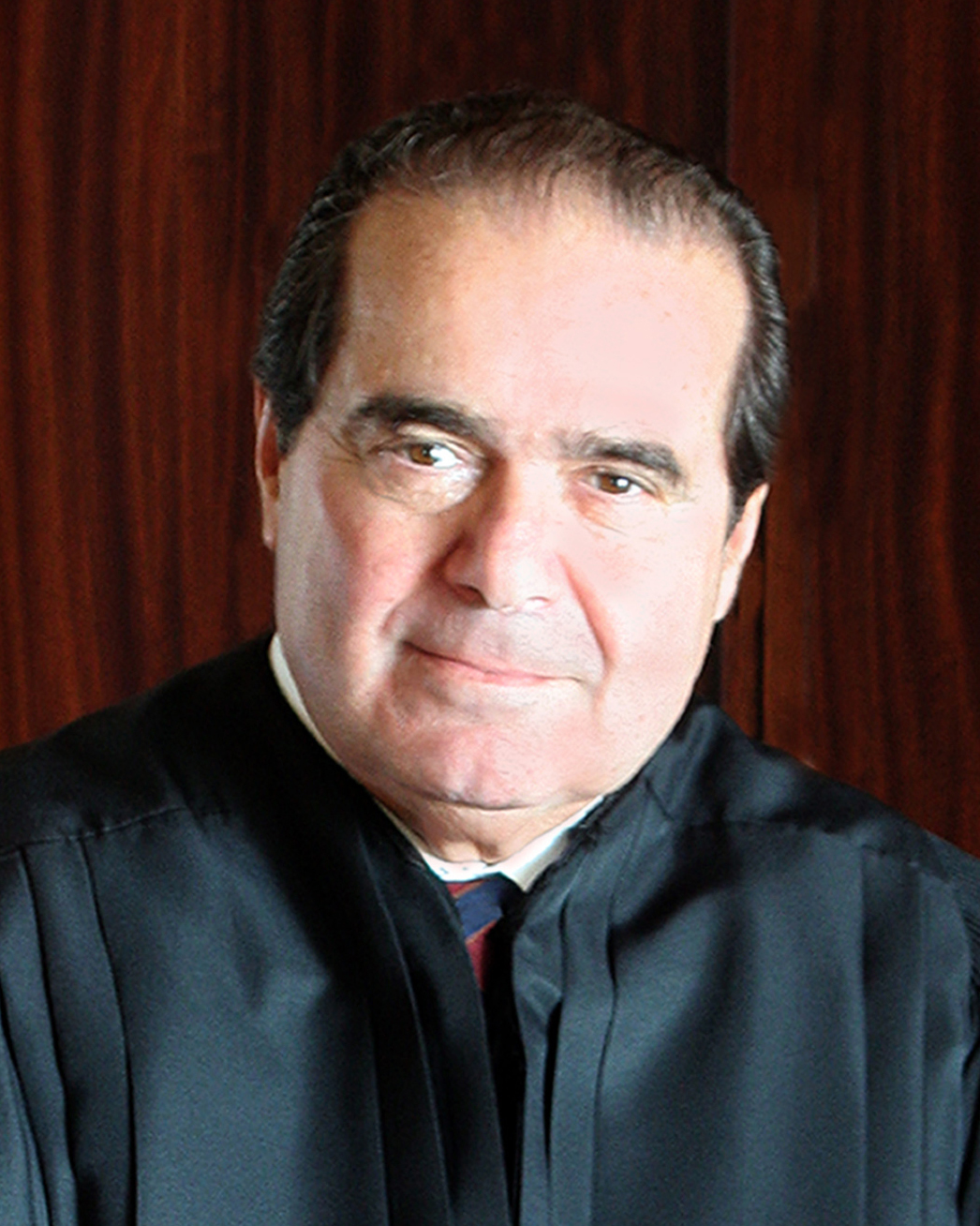
Requiescat in pacem, Antonin Scalia

Oddly enough, according to a couple of sources, Associate Justice Antonin G. Scalia’s best friend was AJ Ruth Bader Ginsburg. Said Marcia Coyle on PBS NewsHour Weekend, Scalia, who passed away Saturday at the age of 79, “was widely liked ... a very colorful writer, and in person ... a consummate gentleman, ... could be very funny. He is going to be missed ... especially by Justice Ginsburg, with whom he had a special friendship — they called each other best friends — and with whom he went to opera and ... to India.

“He does not write like a happy man”

To hear Scalia described as “widely liked” and a “consummate gentleman” may sound improbable to people who only knew of him through his strident, hectoring argumentation on the bench, especially to liberals and progressives who came to hate him as a conservative obstructionist. (One gay man of my acquaintance sneered, “My condolences to the Koch brothers for their loss.”)

Because Scalia’s opinions coincided often with conservative interests, it was all too easy to claim his originalism was merely intellectual cover for his political views — in fact, so easy that more substantive legal criticism often went lacking. His dissents — and he wrote plenty of dissents in his nearly thirty years’ tenure on the SCOTUS bench — often sacrificed detailed analysis of the legal principles involved in favor of sarcastic fiskings of the majority opinion and fervent homilies on the wider implications of the decision; e.g., his dissent in Obergefell v. Hodges (513 U.S. ___ [2015]; pp. 69 ff.). So acidic were his opinions that, as Conor Clarke observed in Slate, “Scalia’s opinions read like they’re about to catch fire for pure outrage. He does not, in short, write like a happy man.”

Thursday, December 24, 2015

Book Review: To the Martyrs, by Cdl. Donald Wuerl

Cdl. Donald Wuerl
Emmaus Road Publishing
Cover Price: $22.95
Recommended

 Anti-Christians condemn Christians for their hypocrisy. However, not a single Christian martyr has ever suffered persecution by non-Christians for failing to live the gospel message perfectly. Rather, Christians were and are persecuted just for associating themselves with the gospel message in the first place. Imperfection of religious practice has hardly been a barrier to execution, imprisonment, maiming, rape, or torture by those who hate Christianity and that for which they think it stands.

This is the first thought that occurs to me after reading To the Martyrs: A Reflection on the Supreme Christian Witness by Cdl. Donald Wuerl. The title reflects both the title of a letter by the Church Father Tertullian and Wuerl’s own personal fascination with, and dedication to, the millions of martyrs and confessors who have been “the seeds of the Church” over the last two millennia. It’s a “reflection” as well in that it’s obviously not an exhaustive treatment of martyrdom intended for scholars and Church historians, but rather a brief overview for the ordinary layman. Written in a very accessible style, it has just enough footnotes to show that the good archbishop didn’t rely on his own memory or make things up as he went along.

As one reads To the Martyrs, though, a theme recurs. G. K. Chesterton famously noted that the Christian ideal hadn’t been “tried hard, and found wanting,” but rather had been “found difficult; and left untried.” However, as Cdl. Wuerl shows, the centuries of persecution didn’t come from people who found the Christian ideal too difficult to live up to, but rather from people who found that ideal too challenging, too uncomfortable to live with.

Wednesday, July 1, 2015

The end of the American experiment

I had to take my time with my reaction to the Supreme Court’s decision in Obergefell v. Hodges (576 US __ [2015]), because there were some comments and criticisms that led me to suspect it was worse than I thought it would be. The suspicion was confirmed.

As expected, Associate Justice Anthony Kennedy authored the decision, which is the latest in the logical progression from Lawrence v. Texas (539 US 558 [2002]) through United States v. Windsor (570 US __ [2013]), the majority opinions of which Kennedy also wrote. Also as expected, Kennedy premissed his opinion on the dubious concept of “substantive due process”, the pre-eminent rationale for judicial legislation, and invoked the “equal protection” clause without bothering to explain — as, indeed, none of his decisions explain — how homosexuals qualify as a “protected class”. (Sorry, neither “Well, duh!” nor “Because I said” is a valid legal argument.)

In its way, Obergefell was an even greater assertion of SCOTUS power than was Windsor. As I explained at the time, Kennedy justified striking down the Defense of Marriage Act (DOMA) by arguing that the right to define marriage lay with the States, not explaining how the State’s authority to confer State benefits could rob the Federal government of its authority to decide who gets Federal benefits. Now, however, the States can exercise their authority only until the Court develops a “better informed understanding” (slip opinion at 19), at which time it can impose a school solution on everyone.

For Alexis de Tocqueville, the great French commentator on early America, the great danger of democracy was “tyranny of the majority”; i.e., the insufficiency of institutions to protect individual rights. The problem for the last few decades has been exactly the opposite — aristocracy, the rise of a self-selected élite willing to frustrate the democratic process, distort the plain meaning of the Constitution, and violate long-standing political rights in order to impose its superior mores. Obergefell signals the triumph of that élite and the functional advent of limited self-government.

Wednesday, April 1, 2015

The Indiana RFRA and the torn-down forest


As of this writing, it appears that the Indiana state government is taking steps to undermine its own Religious Freedom Restoration Act. According to the Associated Press, Gov. Mike Pence has called for legislation “clarifying that [the RFRA] does not allow discrimination on his desk by the end of the week ... to address concerns that the law will allow businesses to deny services to gays and lesbians.” Arkansas Gov. Asa Hutchinson, facing similar pressure, has already preemptively called for changes to an RFRA bill on his desk.

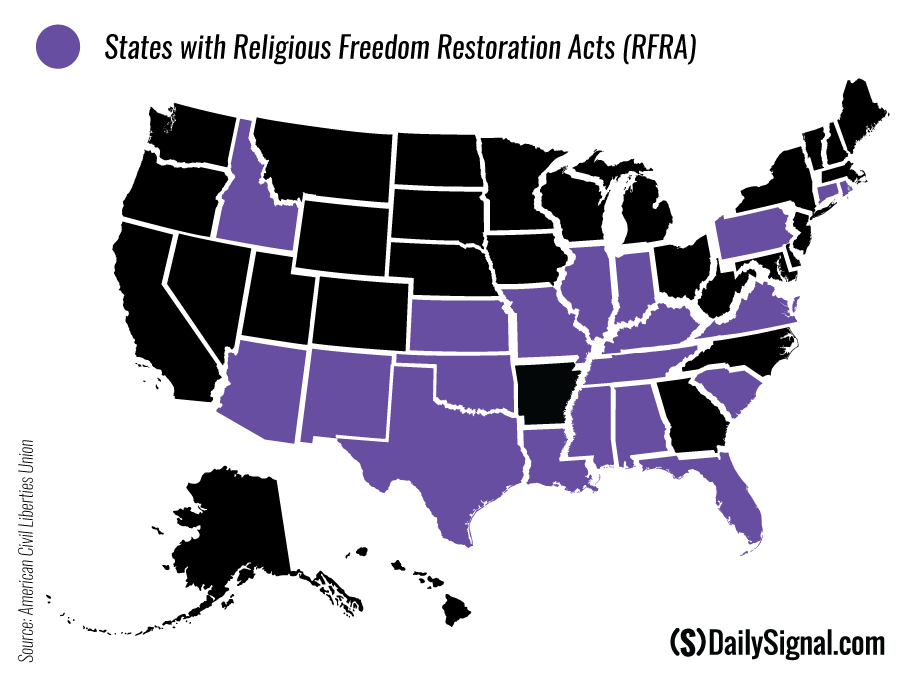
Nineteen states have RFRAs. Of these, eleven have non-discrimination laws at the city or township level, and two (Illinois and New Mexico) have state laws protecting gays, lesbians, and bisexuals. Another eleven have RFRA-like restrictions based on SCOTUS decisions. (Source: Daily Signal.) On the surface, the problem with Indiana’s RFRA is that it’s loosely written; critics claim that businesses can refuse gay people’s business, and that the civil-rights legislation and decisions of the last sixty years have determined that “you don’t have the right to choose who gets to sit at the counter.”

The truth of the matter, though, is that the other states all caught the RFRA wave at the right time, before SCOTUS’ decision in Lawrence v. Texas (539 US 558, 2003) made it “okay to be gay”. Now that wave has long passed; the LGBT lobby has command of a sizeable chunk of the culture factories, as well as the allegiance of the majority of our celebrities and politicians.

This makes the conditions most favorable for anti-RFRA moral posturing, along with its attendant obliviousness. For instance, the Daily Caller reports, “Connecticut Gov. Dannell Malloy will issue an executive order on Monday calling for a ban on state-funded travel to Indiana” … conveniently forgetting that Connecticut has an arguably more restrictive RFRA. Oops.

Monday, December 29, 2014

What took Robert Tracinski so long?

You know things are getting pretty bad when a libertarian atheist devoté of Ayn Rand links arms (albeit grudgingly) with conservative religious types. That’s just what Robert Tracinski does in his Federalist post, “Confessions of a Reluctant Culture Warrior”.

Why would it be such as surprise? Because libertarians tend to be liberal where a Christian who takes traditional Christian morality seriously ought to be conservative, and vice versa. Because many atheists, like Tracinski himself, object to select parts of traditional Christian morality, and clamor that adopting anything they don’t like into law is tantamount to enacting a “Judeo-Christian Sharia” or a “theocracy”. Because Ayn Rand’s objectivism is, as Marina Galperina so charmingly put it, “the philosophical system for people who pleasure themselves over thoughts of laissez-faire capitalism and believe that self-interest is the highest moral purpose and that’s that, the objective truth, f**k you;” Tracinski proposes it as a “third way” precisely because it isn’t and can’t be considered a religion-based ethos.

Whatever else you can say about self-interest, though, it can occasionally prompt you to recognize that precedents established to destroy your cultural nemeses can — and often will — be turned against you and your allies sooner or later. And in the struggles over the last year, from the Hobby Lobby decision to gendered toys, Tracinski, whose normal position on cultural issues was “Could we talk about something else, please?”, heard Martin Niemöller begin his famous poem with a new line: “First they came for the Christians ….”

Tracinski the libertarian objectivist atheist has finally seen the Progressivist Thought Police on the march.

Tuesday, July 29, 2014

Why I’m neither a conservative nor a liberal


The other night, I ran across a headline in my Facebook feed which said that Michele Bachmann had suggested the children of illegal immigrants be put into labor camps. I forgot my own rule and “shared” it; in mitigation of my own stupidity, I did ask that someone tell me the story was a distortion of something she actually said.

Not fifteen seconds after “sharing” it, I came across a status update from Simcha Fisher that said in essence, “Stop sharing the Michele Bachmann story. It’s a satire.” Quickly I took it down and replaced it with an apology and Tom McDonald’s meme (left).

Minutes later, a friend of mine who’s a member of the Omaha tribe posted yet another headline, in which Ted Nugent allegedly called Native Americans “vermin”. I told Verdel (my friend) what had just occurred with me, giving him a “heads up” that the story might not be what it appeared. In fact, it seems that the quote may have been taken out of context, and Nugent’s organization has posted an official denial on his website. I’m willing to give Nugent the benefit of the doubt because I distrust journalists more than I dislike him.

It’s not just liberals who do this. Just over a month ago, I debunked a clip that took a couple of phrases spoken by Pres. Obama in his Address to European Youth out of context, mashed them together and created a Hitleresque sentiment that, on his worst, most careless day, the man would never say in front of cameras. (He may or may not think like that, but he’s too smart a politician to ever publicly say it.)

Once upon a time, the self-dubbed electronic journalists of the new media loudly proclaimed that they would keep the mainstream media honest. Unfortunately, all they seem to do now is make the MSM look honest by comparison.

Saturday, July 5, 2014

Burwell v. Hobby Lobby and leftist bigotry

http://crooksandliars.com/files/vfs/2012/12/Hobby_Lobby.jpeg
Not a Catholic-owned company ... not that the left cares.
Has anyone else noticed how very few of the left’s attacks on SCOTUS’ decision in Burwell v. Hobby Lobby involve little real legal analysis of the opinion? Perhaps we shouldn’t be surprised; very few journalists are lawyers, after all, and many are simply political activists pretending to report news.

Instead, what we see is a lot of unhealthy focus on the religious and sexual makeup of the bench. Forget that, of the men on the majority, at least two would continue to uphold Roe v. Wade without reservations; forget that one of those men, just over a year ago, voted to strike down DOMA in United States v. Windsor; forget that one of the two women in the minority shares the same religious self-identification as the five men in the majority. Haters gonna hate; and when they hate, facts, logic and even recent history can just go whistle.

As I said of the Windsor decision, progressivist rhetoric about “the inevitability of change” and being “on the right side of history” disappears whenever there’s a significant setback, and various activists and talking heads start talking as though every key civil right is about to be rolled back. Now HuffPo is sweating out the implications of Burwell for gay rights, while the Guardian’s Jessica Valenti is hyperventilating over the Court’s “obsession with female purity”.

And through it all are constant references to the number of Catholic men on the bench and in the majority, as if the decision had been dictated by Catholic doctrine and Y chromosomes rather than by proper legal reasoning. They forget that the six Catholics and three Jews on the bench were all appointed by Protestant presidents; the only Catholic president, Kennedy, appointed an Episcopalian and a Jew.

Leftists, you see, have their own brand of bigotry.

Wednesday, April 30, 2014

When God and Caesar collide

On Divine Mercy Sunday, April 27, 2014, I had to do something I never imagined I’d have to do: kick beggars off of church property.

A Hispanic woman and her two children were standing at the exit of our parking lot on the driveway median, mooching from the parishioners as they were driving out. Our pastor, Fr. George, is a lovely man, very good-humored and self-effacing. But you don’t want to be within fifty feet of him when he needs to delegate something, because he’s likely to grab the first unwitting soul available. He was discussing the issue with Bret, the Grand Knight of our Knights of Columbus council, when I stepped out of the church and went over to greet them.

“Ah, hello, Tony!” Fr. George exclaimed. As he reached out to give me a perfunctory handshake, he continued to speak to Bret: “Here we are, then; Tony can do this!” Herding me away from Bret and the building, he pointed out the beggars to me. “Go over there and tell them they cannot stand there; it’s illegal and dangerous. Make sure they leave.”

Moving the family on was fairly simple: I simply put my most pleasant face on and requested that they leave. And as I was walking back, one of the children, who unseen by me before had gone up to the church and was now walking back to the family, asked me, “Sir, do you think we’d be able to talk to someone at the church tomorrow at nine o’clock?” Yes, I agreed, someone should certainly be there.

Nevertheless, the irony of bustling poor people away from Christ’s church rather than bringing them in was too obvious. I can hear Jesus say, “I was hungry, and you gave me the bum’s rush” (cf. Matthew 25:42).

Monday, March 3, 2014

What are you prepared to suffer?


Now that Arizona’s SB 1062 is dead as last week’s roast chicken, you might think some sanity might descend upon the public square. Don’t count on it.

Let’s set out the inarguables. SB 1062 was Arizona’s reaction to the case in New Mexico where a photographer was sued under that state’s human rights laws for refusing to provide her services for a gay wedding. The relevant passage, as noted by constitutional law professor Josh Blackman, is virtually cut and pasted from the federal Religious Freedom Restoration Act of 1993: “STATE ACTION shall not substantially burden a person’s exercise of religion even if the burden results from a rule of general applicability.”

According to a bipartisan commission of law professors, SB 1062 would not have “allow[ed] any restaurant or bar-owner to puts up a sign that says ‘No Gays Served’,” as one email from the Democratic Congressional Campaign Committee hysterically asserted. Rather, under the law, “business people can assert a claim or defense …, in any kind of case (discrimination cases are not even mentioned, although they would be included), that they have the burden of proving a substantial burden on a sincere religious practice, that the government or the person suing them has the burden of proof on compelling government interest, and that the state courts in Arizona make the final decision.” Neither discrimination nor homosexuals were mentioned in either SB 1062 or RFRA 93.

In any event, Gov. Jan Brewer’s veto message correctly pointed out that Arizona doesn’t have a New Mexico or Illinois-style human rights law to be used as a progressivist ratchet. And as Kevin D. Williamson correctly argues, “If anything, it is much more likely in 2014 that a business exhibiting authentic malice toward homosexuals would be crushed under the socio-economic realities of the current climate.”

Monday, January 6, 2014

Catholics can’t have “designated sinners”

Little Sister with a patient. (Source: Becket Fund.)
Barack Obama will not make the history books on the strength of his ability to compromise. At best, the Obama Administration’s “compromises” are the same demands made previously, spun differently to make it appear that concessions are being offered when in fact nothing is conceded.

So far, Obama & Co. have been able to get away with stiff-necking their agenda through Congress because they’ve had the backing of the majority of the mainstream media, who are more than happy to blame the opposition for failures to “compromise” (i.e., give in). Despite the ideological crystallization of the parties which has led to the near-disappearance of political moderates in Congress, there are a few Republicans who, as Theodore Roosevelt said of William McKinley, have “the backbone of a chocolate éclair”, and will sign off on fig-leaf “concessions” to end the confrontation and “save GOP face”.

However, such tactics don’t necessarily work when the opponent is a litigant party who isn’t elected to any office and thus can’t be scared off with the specter of defeat at the next polls. It’s amazing to see an Administration so driven by image politics risk that image by holding the HHS mandate line against the Little Sisters of the Poor, a company of Catholic nuns.

In a sense, the Administration’s tactics are determined by the wider context of their battle against the Catholic Church in America as the Last Bastion of Conservative Morality. However, the standard party ballyhoo about “the war on women” and “Church imposing its morality” fails to erase the image of a monstrous bureaucracy intent on beating down a bunch of ladies who take care of sick people. Nuns evoke the kind of sympathy that bishops don’t.

Monday, August 26, 2013

Bottum, Zmirak and the battle of Verdun

French Gen. Robert Nivelle

If Joseph Bottum’s 6,000-word Commonweal ramble, “The Things We Share,” doesn’t read or feel like a structured argument for Catholic acceptance of same-sex marriages, that’s because it’s not — the subtitle (“A Catholic Case for Same-Sex Marriage”) notwithstanding. Rather, it’s the erstwhile First Things editor’s story of how and why he came to strike the flag of opposition. Some of his statements of fact are so wrong, you can’t help but howl with either rage or laughter. But you can’t fault as an argument that which never pretended to be an argument.

In fact, if there were just one fault (there are more, I promise), it’s precisely that it is Bottum’s personal conversion story, as it were, and not a real case against further resistance. For by the time he actually gets down to the meat of his contentions, he’s lost half his audience through lack of interest. In the combox for Matthew J. Franck’s rather impatient takedown in First Things, “Joseph Bottum, Weary and Wearisome,” at least two or three people admit they couldn’t get all the way through it.

Sorry, Jody, either your life or the way you wrote about it is just not that gripping. Next time, cut to the chase.

Moreover, throughout Bottum’s essay you can pick up strains that tell us he isn’t comfortable with the idea of surrender. For instance, in discussing David Blankenhorn’s New York Times flip-flop,  Bottum muses that it’s “not enough for a Catholic to say that legal fairness and social niceness compel us.” And of the anti-Christian element who use SSM as a stick to bash the Church with, he snarls, “if that’s what the same-sex marriage movement is really about … then to hell with it.”

Sunday, April 14, 2013

Caricatures of the Catholic Church

Abp. Fulton J. Sheen and his Life Is Worth Living blackboard.
One of the eminently quotable Archbishop Fulton J. Sheen’s most well-known dicta is this: “There are not a hundred people in America who hate the Catholic Church. There are millions of people who hate what they wrongly believe to be the Catholic Church — which is, of course, quite a different thing.”

Let’s face it: The history, beliefs and culture of the Catholic Church comprises almost 2,000 years of development. To do justice merely to the last hundred years or so would require two or three volumes the size of the Catechism of the Catholic Church, which is thick enough to make Stephen King pale with fright. Frankly, non-Catholics ought to read Frs. John Trigillio and Kenneth Brighenti’s Catholicism for Dummies® and at least peruse the Catechism before they attempt to comment on matters of the Faith. All too often, though, people hate a caricature of the Church, usually one they learned from similarly ill-informed people, like a person who hates Pres. Obama based on editorial cartoons he’s enjoyed.

Case in point: Before I went on my post-Easter “Internet fast”, I wrote a post for The Impractical Catholic arguing that the “rich Catholic Church” trope was a simplistic and unjustified treatment of Church finances. When I came back online Saturday, I found a reply from “Chester” which was little more than a dismissal. For our purposes, two lines stand out which illustrate this tendency to beat the stuffing out of straw men:

I think you raise some good points about businesses, but the Catholic church claims to be above human law, above mere business dealings.
The Catholic church is claimed to be a charitable organisation, but they actively discriminate against women and gays. If your god is good enough for everyone, so is your time and money.

Thursday, March 21, 2013

O those awful Catholic writers!

Nope, no religious bigotry here in the Land of Tolerance!
My last post, on gender differences, drew attention from an unexpected source. I mentioned that SisterLisa, the author of a condescending piece on women’s ordination and male insecurity, had drawn inspiration in part from a piece of satire written for Forbes by Victoria Pynchon. I just mentioned it; I neither praised nor blamed it.

In the marvelous world of cyberspace, that’s all you need; it must have shown up as a trackback. Pynchon decided to be the first to comment. As of this writing [3/21/13 @ 12:27 am], I’m having issues with IntenseDebate, so her comment hasn’t shown up yet.

There are a few lines that deal with Pynchon’s own experience of gender stereotyping and social role expectations. It’s not my purpose to devalue or minimize them; while the examples she quotes may sound quaint to postmodern ears, there are still parents who are pleased when their daughter is a “girly girl”, and who are more apt to give them a cosmetics case for their twelfth birthday rather than a chemistry set. No, I’m simply cutting to the chase:


I have no business telling Catholics what they should do, think or believe. I’d prefer it if Catholics didn’t tell non-Catholic American women what they should do, think or believe. [That’s a first.] If Catholic writers would like to tinker with women’s lives, perhaps they should stick to reconciling the gap between the Church’s position on birth control (it’s wrong) and American Catholic women’s refusal to stop using it.


In other words, she’s happy to “discuss” gender biological differences — so long as it’s her talking and me shutting up. Drat that pesky First Amendment, which allows me to shoot my mouth off whenever I please on whatever I please! Why … it even allows Catholics to have opinions on secular subjects! O the outrage!

Sunday, January 27, 2013

Reinventing the Republican vision

Bobby Jindal, Catholic convert
Up until now, I’ve been avoiding any breakdown of the last election, largely because of shame.

If you read some of the posts, you can tell I’d allowed my hopes to rise despite my conviction that selling Mitt Romney as The Only Possible Victor Against Obama was a strategy doomed to defeat. I’d even gone so far as to predict that some of the loonier aspects of the Democrat campaign would be net negatives, like the “war on women” meme — especially Sandra Flake’s mind-boggling vision of misogynist hordes waiting to (re-)enslave women while the Code Pink vaginas danced and demonstrated outside the DNC — and that stupid freakin’ Lena Dunham “Your First Time” commercial. And I have to tell you this, Mr. President: I do not belong to the government; the government is our servant, not our master.

As you’re no doubt aware, the GOP also had its share of bizarre moments: Clint Eastwood’s supposed-to-be-funny “dialogue” with the empty chair at the RNC, Richard Mourdock and Todd Akin’s facepalm-inducing remarks about forced sex, Mitt’s “binders full of women” and the cringeworthy “47 percent” remark. 

But more critical than these were the Republicans’ overall failure to present an attractive and compelling vision of what a GOP victory would mean for Joe and Jane Schmuckatelli, their failure to connect with women and Latino voters — not to mention their ongoing concession of the African-American vote — and their ill-advised, quixotic attacks against Obamacare in general. Moreover, the “Chick-fil-A flap” and Catholic opposition to the HHS mandate handed the GOP a genuine, this-gets-us-where-we-live issue — the First Amendment vs. progressivist tyranny — and they wasted it, ceding the mandate spotlight to the “war on women” meme and largely passing over the LGBT “two minutes’ hate” with an embarrassed silence.

And I still predicted a Republican victory. *sigh* All of which is part of the reason that my crystal ball is less accurate than your typical weather forecast.

Friday, January 18, 2013

The sacramentality of oaths

Dean Obeidallah is apparently one of those people who believe that, if you say “separation of church and state” over and over long enough, the “free exercise” clause will disappear from the First Amendment. Just read his latest post on CNN.com if you don’t believe me.

Obeidallah, if you’ll remember, is the guy who accused Rick Santorum of wishing to impose a “Christian Sharia” with such overwrought language that I almost forgot he’s a comedian — or at least he’s been billed as a comedian. This post is more lucid and more thoughtful than the Santorum nutty — perhaps he’s finally getting the hang of this mug’s game — so we can and should do him the courtesy of taking him seriously.

Obeidallah doesn’t believe Pres. Obama should use any Bible, let alone two when he swears in for the second time. He points out, quite correctly, that Article IV prohibits the government from imposing religious tests for public office or trust. He points out, again most correctly, that Theodore Roosevelt and John Q. Adams did not use Bibles at their own oaths of office. 

For the record, I’ll provide the information Obeidallah was lacking about TR’s motives: like Adams, Roosevelt believed in a fairly strict construction of the “establishment clause”, going so far as to try to have “In God We Trust” stricken from our money. Also for the record, both Roosevelt and Adams were devout, churchgoing mainline Protestants.

“Some will argue,” Obeidallah writes, “that swearing on the Bible ensures the president adheres to his oath. But let’s be honest: We have seen presidents and other elected officials swear to uphold the laws of our country with their hands on a Bible and go on to break many laws and ethical rules. It comes down to the person’s moral code, not a 30-second oath.”

Sunday, August 12, 2012

Democracy, truth and the death of liberalism


©1980 David Horsey, Seattle Post-Intelligencer.
Democracy is the worst form of government, except for all the others that have been tried.
—Winston S. Churchill


In First Things, Matthew Schmitz writes an interesting breakdown of some recent social-survey data which indicate that youth support of gay marriage is somewhat soggy and undependable as a sign of the future.  His basic premiss, of course, is that liberals in the media misrepresent the numbers; a couple of years ago I would have argued that the misrepresentation wasn’t all intentional … in fact, on another subject, I did.  (Now, after the blanket party they threw for Dan Cathy and Chick-fil-A, not so much.)

As good as it was, I wouldn’t even bring the article up except for a disturbing “drive-by” comment by a person identifying himself as “Dan”:


I realize that this article pertains to generational opinions on marriage equality for gays and lesbians, however a larger issue is being ignored. The USA is the only nation on earth that has allowed the public to decide this important civil rights issue via ballot measures. This is a grossly immoral act which violates every principle of our Republic. Ultimately, the majority has no right to determine the civil rights of minorities. Have we learned nothing from the struggles of women for the right to vote or blacks to attend the same schools? Therefore, whatever young people think regarding this issue is irrelevant [bold font mine].


So much for “government of the people, by the people, for the people”.  Perhaps Dan merely wanted to throw a cold bucket of disillusionment over our grand national fantasy of representative democracy.  Perhaps in reality we were always just token participants in our government; perhaps even the modern cumbersome and expensive primary process is just an elaborate scheme for putting the élite’s Chosen Ones in office and judicial chambers.

Considering Mitt Romney, I half believe it myself.

Sunday, August 5, 2012

Hurt feelings a “human rights violation”?


“Chick-fil-A faces vandalism, ‘human rights violation’ complaints for defending marriage”


Almost as soon as I read the LifeSiteNews headline, I had to double-check the story.  I knew about the vandalism at the Torrance, Calif., unit, but … human rights violation complaints? Are you freakin’ kidding me?  I simply could not believe it — no, no, LSN had to be exaggerating something, or simply reporting one of the many bogus bits of information that spread like Captain Trips throughout the ‘Net (remember last year, when Jon Bon Jovi died in that New York hotel room — oh, waitaminnit, no he didn’t!).  Nobody could possibly be that petty and hysterical!

But no, the Civil Rights Agenda’s own website confirms the action, reporting sadly that “Chick-fil-A’s ‘intolerant corporate culture’ violates the Illinois Human Rights Act, which prohibits a ‘public accommodation’ from making protected classes ‘unwelcome, objectionable or unacceptable.’”  To get to the story, you have to click on a Photoshopped picture of a Chick-fil-A sign whose marquee proclaims, “YOU & YOUR GAY FAMILY ARE OBJECTIONABLE & UNACCEPTABLE”; the caption sullenly informs you, “Our lawyers are making us say: the above graphic is obviously a parody and what we believe LGBTQ folks see when they look at a Chick-fil-A sign.”

Not only will this story not die a natural death, it doesn’t appear even to be suffering a summer cold.  Could this be the year the left goes so far over the top that they lose all credibility even among those they purport to champion?

Sunday, March 18, 2012

On marriage and mortgages (Part II)


I ended Part I by saying that the “warm, fuzzy feeling” most people associate with love is a good and necessary component for marriage but that it isn’t sufficient cause for marriage.  I suspect in saying that many people will feel that I’ve committed at least an impiety on the order of suggesting that St. John the Baptist was a cross-dresser.

First, we need to draw a distinction between the conscious motives people have for getting married and the underlying anthropological rationale for the institution’s existence.  Certainly people marry who have never had a desire to raise children, just as others have married for status or to cement political alliances or to make a public statement; nor do all such marriages end in divorce decrees or murder investigations. 

But just because somebody has used that butter knife to remove a screw from the wall doesn’t mean that it’s become a screwdriver or that it can no longer spread cream cheese on your morning bagel.  Why you got married and why you stay married doesn’t affect one way or another the reason marriage exists as an institution, just as the reason why you choose to have sex on a particular day with a particular person has no influence over whether you get pregnant or not.

But the “warm, fuzzy” feeling isn’t a sufficient cause for marriage in the sense that you don’t need to be married to maintain that feeling.  Indeed, if for some strange reason you believe love should require no effort to maintain, then — all moral and spiritual considerations aside — cohabitation is less expensive and has fewer complications.  They used to call cohabitation “playing house”, and in a large part it still has that essence of childhood games: we’ll pretend we’re a married couple, but only until it stops being fun. 

Thursday, February 2, 2012

American or Catholic? Why must we choose?

Since January 20th, when the Obamination confirmed the HHS rule heavily restricting religious exemptions to the new health insurance requirements, the outcry from American Catholics has been overwhelming in its unity.  Even Sean Michael Winters wrote in his Fishwrap column, “They have punched Sr. Carol Keehan and Fr. Jenkins and many other Catholics who have taken shots for this Administration in the nose.”

On CatholicVote, Tom Peters the American Papist has been keeping a running tally of bishops who have written and spoken out against the HHS ruling (135 out of 187 dioceses that aren’t currently sede vacante as of January 30).  My friend Stacy Trasancos has written a self-critical piece arguing that, by not educating Catholic doctors on the problems and perils of contraceptives, Catholic women have been part of the problem (and can be part of the solution by being more proactive … ugh, I said that word).  Fellow devil-dog Frank Weathers has gotten a petition at WhiteHouse.gov going that has collected 11,376 signatures (out of 13,624 needed by February 27 — have you signed yet?).

Indeed, as the USCCB blog notes, the amazing unity this outrage has prompted is “a true ‘here comes everybody’ moment.”  But Louie Verrecchio at Catholic Lane sees “far more to lament than to applaud in this situation, beginning with the fundamental question of Catholic identity that it naturally begs.”

If current events indicate anything at all it’s that we really need to take a step back and ask ourselves who we are. Are we Catholics first and Americans second, or vice versa?