
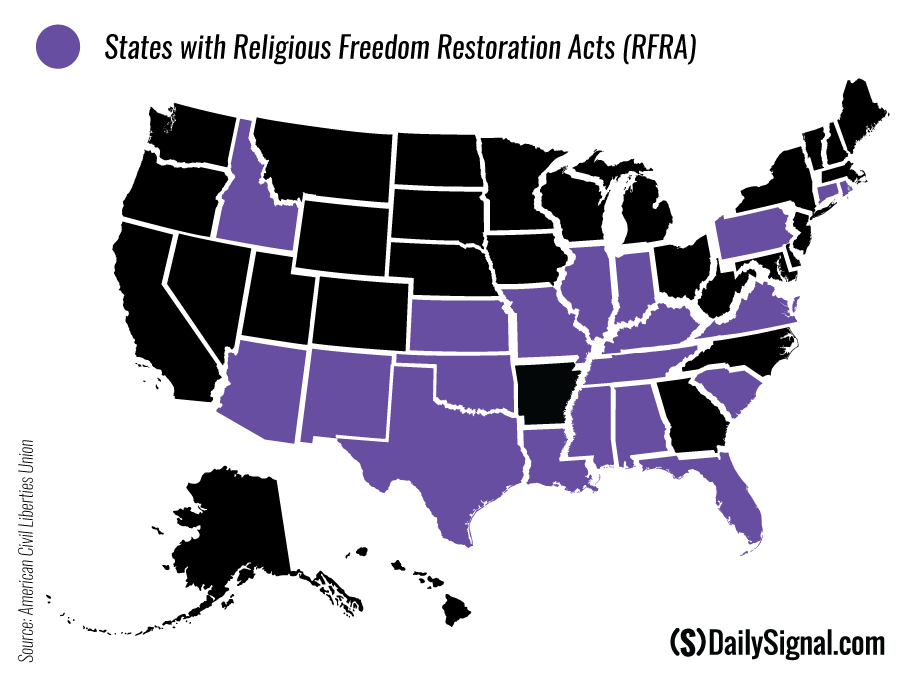
As of this writing, it appears that the Indiana state government is taking steps to undermine its own Religious Freedom Restoration Act. According to the Associated Press, Gov. Mike Pence has called for legislation “clarifying that [the RFRA] does not allow discrimination on his desk by the end of the week ... to address concerns that the law will allow businesses to deny services to gays and lesbians.” Arkansas Gov. Asa Hutchinson, facing similar pressure, has already preemptively called for changes to an RFRA bill on his desk.
Nineteen states have RFRAs. Of these, eleven have
non-discrimination laws at the city or township level, and two (Illinois and
New Mexico) have state laws protecting gays, lesbians, and bisexuals. Another
eleven have RFRA-like restrictions based on SCOTUS decisions. (Source: Daily
Signal.) On the surface, the problem with Indiana’s RFRA is that it’s
loosely written; critics claim that businesses can refuse gay people’s
business, and that the civil-rights legislation and decisions of the last sixty
years have determined that “you don’t have the right to choose who gets to sit
at the counter.”
The truth of the matter, though, is that the other states
all caught the RFRA wave at the right time, before SCOTUS’ decision in Lawrence v. Texas (539 US
558, 2003) made it “okay to be gay”. Now that wave has long passed; the
LGBT lobby has command of a sizeable chunk of the culture factories, as well as
the allegiance of the majority of our celebrities and politicians.
This makes the conditions most favorable for anti-RFRA moral
posturing, along with its attendant obliviousness. For instance, the
Daily Caller reports, “Connecticut Gov. Dannell Malloy will issue an
executive order on Monday calling for a ban on state-funded travel to Indiana” …
conveniently forgetting that Connecticut
has an arguably more restrictive RFRA. Oops.
Of course, Malloy has the option of claiming he didn’t have
anything to do with the Connecticut RFRA, which was signed and passed in 1993.
A better example, for our purposes, is the indie-rock band Wilco. On Monday,
the band tweeted, “We’re canceling our 5/7 show in Indianapolis. ‘Indiana
Religious Freedom Restoration Act’ feels like thinly disguised legal discrimination.
Hope to get back to the Hoosier State someday soon, when this odious measure is
repealed.”

Well, my dears, are the band members of Wilco taking a moral
stance by denying people their services? Do they have a right to heroically refuse business — and yes, musical performance is a business, if you’re doing it for money — and choose who gets
to watch them play in a concert? Will they avoid concerts in the other states
with conscience protections?
I bring this up not to underscore Wilco’s unconscious
hypocrisy, or to mock them for courageously suffering the PR boost for their
stand. Rather, it’s to point out the dynamic that finds Wilco’s discrimination against
Indianapolis praiseworthy while finding
the refusal to create floral arrangements for a gay wedding intolerable.
[The same dynamic which tweets, “Who's going to Walkerton, IN to burn down #memoriespizza w me?” The same dynamic which allows Tim Cook to pontificate on the dangers of the Indiana RFRA while opening Apple stores in homophobic Saudi Arabia.]
[The same dynamic which tweets, “Who's going to Walkerton, IN to burn down #memoriespizza w me?” The same dynamic which allows Tim Cook to pontificate on the dangers of the Indiana RFRA while opening Apple stores in homophobic Saudi Arabia.]
The problem didn’t exactly start with Brown v. Board of Education (347 US
483, 1954). However, between Brown
and Burwell v. Hobby Lobby (573 US __, 2014),
we learned the wrong lessons from the various civil rights laws and decisions:
that businesspersons can be coerced into providing goods and services against
their will, and that they aren’t allowed to have consciences or principles that object to any lawful
transaction. And Christians, especially Catholics, must shoulder at least part
of the blame for that.
William Roper:
So, now you give the Devil the benefit of law!
Sir Thomas More:
Yes! What would you do? Cut a great road through the law to get after the
Devil?
William Roper:
Yes, I’d cut down every law in England to do that!
Sir Thomas More:
Oh? And when the last law was down, and the Devil turned ’round on you, where
would you hide, Roper, the laws all being flat? This country is planted thick
with laws, from coast to coast, Man’s laws, not God’s! And if you cut them
down, and you’re just the man to do it, do you really think you could stand
upright in the winds that would blow then? Yes, I’d give the Devil benefit of
law, for my own safety’s sake!
—Robert Bolt, A
Man for All Seasons, Act I
For most of the play, Roper, St. Thomas’ eventual
son-in-law, is a contrarian, obtuse man given to loud moral posturing. Near the
end of it, before the trial, he begs the imprisoned More to sign the Act of
Succession; the implication is that he’s caved in, for his and More’s daughter’s
sake. It’s the pragmatic lawyer, the one who would “give the Devil benefit of
law”, who dies a martyr of the Church. Every law he tried to hide behind to
avoid this end was torn down to force his submission.
To force racists and sexists to submit to the principle of
equal rights, Christians cheerfully adopted the belief that those who
discriminate — for any reason, in any manner — are ipso facto bad people, and
that they can have no principle which we are obliged to respect. Blessed John
Henry Newman would have called this “poisoning the
wells”: once you sufficiently blacken the character of your opponent,
nothing he says afterward can be trusted or accepted.

But we did the next best thing: we made it a social crime to hate. We passed laws piling additional penalties for “hate crimes”; we allowed schools to ban and repress “hate speech”; we’re now ostracizing “haters” as people undeserving of jobs or social contact; we’ve done everything save put definite, reasonable borders on what could be considered hate. Hate is the thoughtcrime of the twenty-first century; and those who are accused of it can never prove themselves innocent.
It never occurred to any Christian that one day we would be “it”,
tagged as the “haters”. But there it is — the well is poisoned. There’s little
to no receptivity to our best-reasoned arguments. Our opposition is now
well-versed in the “protective stupidity”, as Orwell characterized it, of crimestop, which “includes the power of
not grasping analogies, of failing to perceive logical errors, of
misunderstanding the simplest arguments if they are inimical to [the ruling
ideology], and of being bored or repelled by any train of thought which is
capable of leading in a heretical direction” (1984, pp. 220-221).
In other words, the Wilco musicians suffer no cognitive
dissonance because “we’re the good guys; they’re the bad guys.”
From that position no appeal is possible: crimestop.
The tragedy is that the initial wave of RFRA laws were never
directed against gay rights. Rather, they were passed to protect medical
personnel from being coerced into providing or participating in abortions
against their will.
But the Hobby Lobby
decision put conscience protection into disrepute, because we’ve had fifty
years in which we’ve told each other that bad guys (i.e., those who oppose the Zeitgeist) have no conscience worthy of
protecting. We’ve had fifty years to develop a socially-enforced version of thoughtcrime and adopt the process of crimestop. We’ve had fifty years to tell
ourselves that we’re entitled to whatever goods and services we can legally get,
providers’ moral qualms be damned.

Nevertheless, as Govs. Pence and Hutchinson disembowel
conscience protection to stave off further damage from the PR debacle, I can’t see
how the US can avoid becoming an anti-Christian state in the not-very-distant
future. Our last line of defense, the Supreme
Central Committee, has shown every willingness to sacrifice the text of the
Constitution for the sake of the Zeitgeist.
We cheered them on when doing so produced decisions we liked; why should we be
surprised now that we’ve been wrong-footed by our own culture?
The Devil is turning on us even now. What tree can we hide behind that we didn’t help tear down?

