Showing posts with label Bible Belts. Show all posts

Thursday, August 6, 2015

The Chittister Challenge

Sister Joan Chittister, OSB, is arguably the Church in America’s best-known “Spirit of Vatican II” relic, a visible reminder of why so many orders of nuns are failing. The Limousine Left loves Sr. Joan not only because she’s a programmatic liberal but also because she’s an exponent of the “primacy of conscience” argument, which is the Catholic left’s favorite fig leaf for its divergences from orthodoxy. Nevertheless, occasionally, like a broken clock, she’s right every once in a while.

Some years ago, Sr. Joan said (to the delight of the pro-abortion establishment):

I do not believe that just because you’re opposed to abortion, that that makes you pro-life. In fact, I think in many cases, your morality is deeply lacking if all you want is a child born but not a child fed, not a child educated, not a child housed. And why would I think that you don’t? Because you don’t want any tax money to go there. That’s not pro-life. That’s pro-birth. We need a much broader conversation on what the morality of pro-life is.

A person on Facebook asked a question that The Blogger Who Must Not Be Named reprinted: “Would you accept a 50% income tax if it ensured that no woman would ever feel compelled to have an abortion because of financial worries?” It’s the same question Sr. Joan asks from a different angle — how far is the pro-life movement prepared to go to diminish the incidence of abortion?

Despite what Leslie Salzillo of the Daily Kos thinks, there are plenty of pro-lifers who support government safety-net programs, especially those geared toward poor single mothers. Contrapositively, there are also those who plug abortion to save tax money paid in welfare; so it’s not as if the pro-life movement has a monopoly on anti-tax tightwads.

Still, as Elizabeth Stoker Bruenig points out, “If a woman considers herself too destitute to care for a child, there is no transvaginal ultrasound demoralizing enough and no accompanying narration excoriating enough to make her decision [to abort] seem any less plausible.” So are we prepared to pay higher taxes if by doing so we could see a reduction in abortions?

Wednesday, July 22, 2015

Progressive fundamentalism and gay wedding cakes

On July 17 on the Patheos blog Unfundamentalist Christians, a blog dedicated to repackaging Christianity for greater feminist and LGBT friendliness, guest contributor April Kelsey’s bio proclaims her goal to be “to put the final nail in fundamentalist Christianity”. Well, everyone should have a goal in life, although it’s far more probable that progressive Christians like Kelsey will cease to be Christians even in name long before fundamentalist Christians cease to be fundamentalist.

However, Kelsey is unaware that she, too, is a fundamentalist, albeit one who skews her reading of the Bible leftward rather than to the right. Indeed, the last line of her post “Your ‘Deeply-Held Belief’ Isn’t Biblical” — “… [I]f it isn’t in the Bible, I don’t have to believe it” — is the most common expression of one of the “two pillars” of Christian fundamentalism: sola scriptura, “only Scripture”.[*] I too would like to see the end of Christian fundamentalism, because I’d like to see the end of Christian disunity, which sola scriptura helps to propagate.

Now, if you want to stop being a fundamentalist, you have to reject sola scriptura (and there are many reasons you should do so). There are really only three ways to accomplish this. One is to stop being Christian altogether. The second is to regard the Bible as fallible and make Christ your ideological sock puppet, like Jimmy Carter. The third is to become Catholic, or at least Eastern Orthodox, and let the apostolic tradition guide your understanding of Scripture. Whichever way you do it, you can’t say, “I only believe what I read in the Bible,” and still pretend you’re not a fundamentalist. Fundamentalist does not equal politically conservative.

Saturday, July 18, 2015

Apologetics Toolbox: Sin, forgiveness, and reconciliation


Pope Francis hearing a confession.
(Image source: catholic.com.)
The Catholic doctrines surrounding the Sacrament of Reconciliation (aka Confession, aka Penance) present a challenge to many Protestants, especially those of the free-church/Evangelical lineage. “Why,” the Protestant asks, “must I go to a priest to have my sins forgiven? Why can’t I just pray to Jesus directly? After all, my sins are between me and God!” If the Protestant is an Evangelical of the “once saved, always saved” stripe, he may even say, “Jesus has already taken away all of my sins, past, present, and future! Why would I need to ask?”

Sin is not a private matter

I’ve already discussed the assurance of salvation elsewhere; if you need to, please consult that post first. The rest of the discussion will assume that a mere assertion of faith in Christ is not sufficient in itself to achieve salvation, that we can lose our salvation through our own fault.

Sins don’t occur in a vacuum or a void space. In all cases, there is at least one person other than God who is offended by a particular sin — namely, the sinner himself, even if he fails to recognize it. Most of the time, there is at least one direct victim of the sin; there are often witnesses. Many sins hurt the community, even when they’re not illegal. And sins done in public cause scandal in the classic sense: they testify against the Church and the Faith to non-Christians. Moreover, we know just from watching the news that many sins done in secret become public knowledge due to circumstances beyond the sinners’ control, becoming scandals in the common sense. How could you ever think that your sins are “just between you and God”?

So we’ve assumed that an assertion of faith, even a “conviction of salvation”, doesn’t of itself secure salvation, because “if we go on sinning willfully after receiving the knowledge of the truth, there no longer remains a sacrifice for sins, but a terrifying expectation of judgment and the fury of a fire which will consume the adversaries.” (Hebrews 10:26-27 NASB)[*] Only those who “persevere to the end” (Matthew 24:13), who “[do] the will of My Father who is in heaven” (Matthew 7:21), will be saved. How then, does a Christian repair the damage and put himself back on the path?

Thursday, July 16, 2015

Apologetics Toolbox: Catholic Answers for Slick Questions


A Facebook source led me to a page titled “Questions for Roman Catholics”, by Matt Slick of the Christian Apologetics & Research Ministry. “The responses [I get],” Slick states, “vary from defensive tradition to ignoring them and hoping to go away. Some of the questions are easier for Roman Catholics to respond to, and others are not. I hope that these might be helpful in your dialogs with the Roman Catholics as you try to present to them the true and saving gospel of Jesus Christ.”

Well, it depends on the context in which Slick presents the questions; some are pretty intrusive. But overall, some of the questions are no-brainers, some misrepresent Catholic doctrine to some extent, and some just show how little Slick himself understands what he’s attacking. The overall presentation is supposed to lead the Catholic to question his faith and the Church. But it’s by no means an infallible (*ahem!*) wrecking ball. Here I present it with fearful fidelity, including Slick’s misspellings, along with the answers. (Note: Questions rendered irrelevant by the answer to a previous question — or, in the case of the oral tradition questions, based on a fallacious notion — are presented in strikeouts.)


Sunday, March 15, 2015

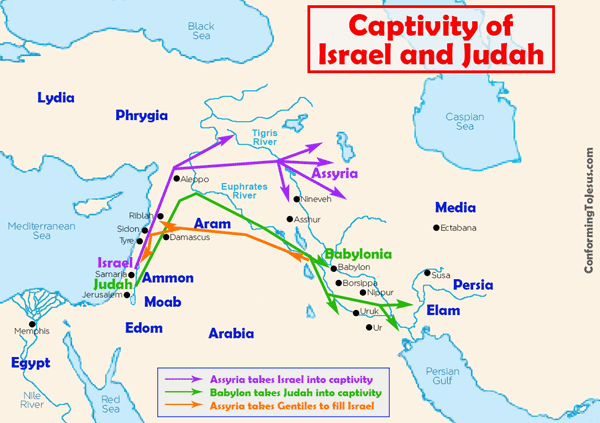
Fourth Sunday in Lent: The Babylonian Exile

Image source: conformingtojesus.com.
Responsorial: Psalm 137:1-6
Second Reading: Ephesians 2:4-10
Gospel: John 3:14-21

The first reading recalls the fall of the kingdom of Judah, the southern half of the Davidic Kingdom of Israel, in 586 BC. The northern half, which had retained the name of Israel, had fallen to Sargon II in 722 BC, and had been redesignated an Assyrian province with the name Samaria. Now, with the twin invasions of the Chaldeans and Idumeans, the original Kingdom of David and Solomon was no more.

Moses had given the Hebrew people God and His Law. Nebuchadnezzar gave them their identity as Jews. The seventy years of the Babylonian Exile[*] had done more to make the Jewish people monotheists than had over four centuries of self-rule. The Hebrews had had an alphabet and a written language since at least David’s time; now they began to gather such records as they had and compile their oral traditions, to redact the beginning of what would eventually become the Tanakh — the Hebrew Bible.

This period, in which Jewish identity was being crystallized, also gave us Psalm 137 [136], a song of heartbreak and loss: “How could we sing a song of the Lord in a foreign land?” Not included in the reading of the psalm is the anger:

Remember, Lord, against Edom
    that day at Jerusalem.
They said: “Level it, level it
    down to its foundations!”
Desolate Daughter Babylon, you shall be destroyed,
    blessed the one who pays you back
    what you have done us!
Blessed the one who seizes your children
    and smashes them against the rock.
Thus was forged in the minds and hearts of the Jewish people the iron triad of God, the Law, and Zion, to which they have clung with stubborn fidelity for over 2,500 years.

Sunday, March 1, 2015

Second Sunday in Lent: Generosity and Sacrifice

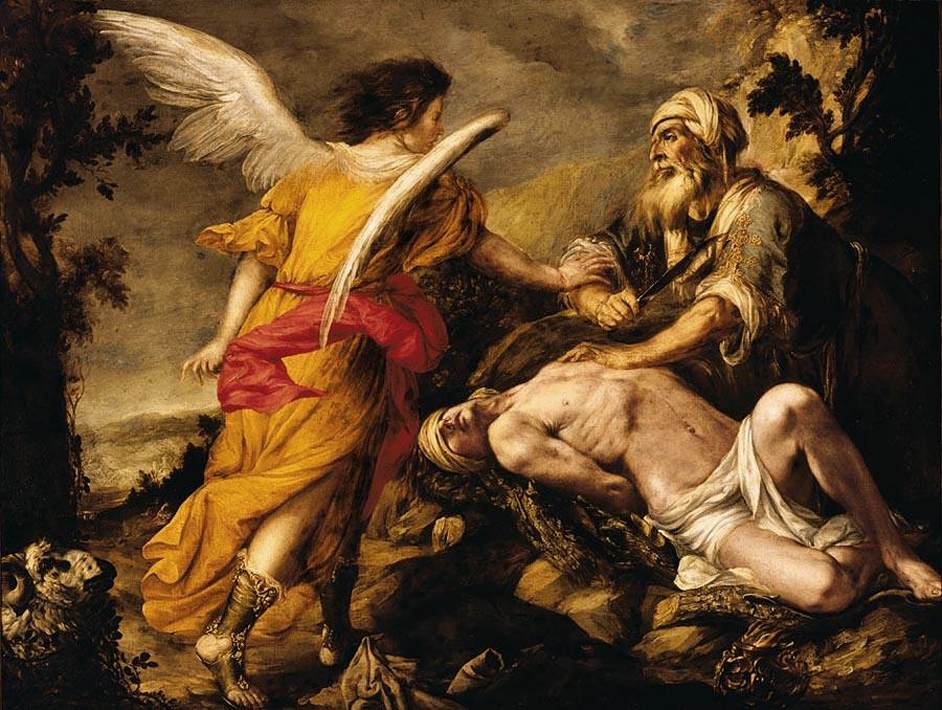
The Sacrifice of Isaac, by Juan de Valdes Leal (1659).
Responsorial: Psalm 116:10,15-19
Second Reading: Romans 8:31-34
Gospel: Mark 9:2-10

In today’s Gospel reading, Mark gives us an account of Jesus’ transfiguration in the presence of Ss. Peter, John and James. A lot is packed into this theophanic moment: Moses, the Teacher and Lawgiver, sitting with Elijah, the greatest of the Prophets, both in conversation with the Word of God Revealed — not quite in his fullness of power and glory, but in a manner (somewhat) comprehensible to the three disciples. Moreover, they are conversing: neither Moses nor Elijah is a mindless shade, as many Mediterranean cultures conceived of the dead:


Who will sing praises to the Most High in Hades,
      as do those who are alive and give thanks?
From the dead, as from one who does not exist, thanksgiving has ceased;
      he who is alive and well sings the Lord’s praises.


So wondrous is this revelation that Peter, speaking from his heart, offers to build sukkoth for them. Sukkoth, on the one hand, were temporary shelters, walled with leather and roofed with palm fronds, such as field workers and religious pilgrims used; on the other hand, just such a tabernacle had been the temple of the Hebrews as they sojourned in the desert with Moses — a holy place that was wholly portable. God had “tented” with His people in the desert, in the Ark of the Covenant, just as His Word “tabernacled” among humanity in the flesh of Christ (cf. John 1:14 LXX, eskēnōsen).

Sunday, February 22, 2015

First Sunday in Lent 2015: Spring Cleaning the Conscience

First Reading: Genesis 9:8-15
Psalm 25:4-6,7-9
Second Reading: 1 Peter 3:18-22
Gospel: Mark 1:12-15

In the first reading, God makes a covenant with every mortal being on earth through Noah: “Never again shall all creatures be destroyed by the waters of a flood.” (Genesis 9:11) In the second reading, St. Peter tells us this flood “prefigured” the sacrament of Baptism, “not as a cleansing of dirt from the body, but as an eperōtēma of a good conscience to God, through the resurrection of Jesus Christ.” (1 Peter 3:21)

The meaning of eperōtēma is uncertain. The Vulgate, following St. Jerome, translates it as interrogatio — a question, an interrogation, a cross-examination, perhaps even an argument or syllogism. The New American Bible, Revised Edition notes that it could also be rendered as pledge; “that is, a promise on the part of Christians to live with a good conscience before God, or a pledge from God of forgiveness and therefore a good conscience for us.” And Thayer’s Lexicon argues that “As the terms of inquiry and demand often include the idea of desire, the word thus gets the signification of earnest seeking, i.e. a craving, an intense desire ….

So what did St. Peter mean by calling Baptism an eperōtēma? It helps us to step backwards, not only in the epistle, but also in Genesis.


Monday, December 22, 2014

Virginity is Not Purity

Purity ring. (Photo source: JamesMarner.com)
There are three posts you should read: “Christians, Stop Staying Pure Till [sic] Marriage” by Sarah (last name unknown), “I Didn’t Wait For My Future Spouse, and You Shouldn’t Either” by Daniel Wilde, and “I Kept My Virginity, But Not My Purity” by Danielle Renfrow. By no means do these young Christian writers — two single, one married — suggest that other Christians engage in premarital sex. Rather, all three are critics of the Evangelical “purity movement” and the language with which it’s been taught.

Until recently, there’s never really been an explicit Christian theology of sexuality to tie the various prescriptions and proscriptions of sexual behavior together. You could even say, with some justice, that Christianity has always been ambivalent about sex.

On the one hand, the Church long ago rejected the Gnostic position that even sex for the sake of reproduction was sinful; on the contrary, she taught that marriage, childbearing and childrearing were positive goods. On the other hand, passages from both Christ and St. Paul suggest that people could pursue celibacy “for the sake of the kingdom of heaven” (Matthew 19:12), that there is something of value to celibacy that doesn’t obtain to marriage (vide 1 Corinthians 7:32-34).

This ambivalence persists about fornication. Considered strictly as sex between two unmarried people, with the implication that neither one intends or is committed to marry the other, it has always been considered a sin (e.g., St. Thomas Aquinas, Summa Theologica II-II:154:2 SC); however, as a pastoral matter, its gravity was (and still is) often underplayed. And premarital sex — that is, sex between people who do intend to marry — hasn’t always been considered a grave matter in every time by every communion.

So marriage has always been good — but not better than celibacy, while fornication has always been bad — but not always as bad as other sexual sins. Nevertheless, the idea that sex is an unclean necessity isn’t authentic to the Christian tradition. That fact, however, hasn’t stopped some Christian idiots from teaching it as a “biblical” principle. (Exhibit #2,623 in the case against sola scriptura.)

Wednesday, October 29, 2014

To a friend who is leaving the Catholic Church


A Hard Saying

I so totally admire your love of the Catholic Church Tony. I am saddened that some of the rules I can not live with and will be joining a Lutheran one that will accept me.
What could I say? Facebook is where I keep in touch with my family and friends; I don’t go there to engage in verbal fisticuffs or stand on my soapbox. And yet, I can’t help feeling the answer I gave — “Forget it, lady. You gotta do a lot worse than that to lose my friendship” — was well-meaning but unsatisfactory.

I suppose I could have been a smartass and built some quibbles based on the precepts of the Church or on canon law. But either of those sallies would have ended in an exasperated “You know what I mean!”

In fact, I do know what you meant, my friend. It’s not really the rules you can’t live with, but rather some of the teachings. It isn’t a question of whether the Catholic Church accepts you: she does, and always has. Rather, it’s a question of what you accept — or, rather, what you reject.

You’re not the first person to abandon the Church over a teaching that sticks in the craw. Read the “Bread of Life” discourse (John 6:22-66): as Jesus insists that “unless you eat the flesh of the Son of man and drink his blood, you have no life in you” (v. 53), his verbs in the Greek become more graphic, switching from phagō (to eat) to trōgō (to chew, or gnaw like an animal). At the end of it, many of his disciples leave him, telling themselves and each other, “This is a hard saying; who can listen to it?” (vv. 60, 66)

Thursday, August 7, 2014

Praying for Obama

Is he really praying? Does it really matter?

Respecting the President’s Name

Living in Texas, I often have occasion to reflect on Elton John’s satirical “Texas Love Song”. The link takes you to a live version of it performed in Austin, possibly the bluest city in Texas, in 1998, with Sir Elton’s pre-performance caution, “Don’t be offended.” Probably they weren’t; many square miles of Texas hold people who still wouldn’t recognize the song as satire, and the people of Austin most likely hold them in as much contempt as did lyricist Bernie Taupin.

One line especially stands out to me right now: “And kids still respected the President’s name.” Personally, I can’t think of a single POTUS whose name was universally respected in his lifetime; even ol’ George Washington came in for some calumny during his second term, and didn’t achieve veneration second only to the Blessed Virgin Mother until some years after he passed. When Taupin wrote the song, the President was Richard M. Nixon, who had succeeded Lyndon B. Johnson — ’nuf ced; hippies weren’t totally to blame.

Still ….

Father Erik Richtsteig at Orthometer and I have a couple of things in common: 1) We’re both friends of Katrina Fernandez (and, I believe, Frank Weathers); 2) We’re both Knights of Columbus. Yesterday, attending the Knights’ annual convention in Orlando, he posted on his status:


The cold silence didn’t bother me; that was possibly the least disrespectful thing the Knights could have done in response to Pres. Obama’s message. Nor did the reactions of Fr. Erik’s followers, which all told wasn’t a Facebook “two-minutes’ hate” so much as an all-day grump, bother me … except for one:


“Let his days be few; and let another take his office.” Brrr, yikes.

Wednesday, April 30, 2014

When God and Caesar collide

On Divine Mercy Sunday, April 27, 2014, I had to do something I never imagined I’d have to do: kick beggars off of church property.

A Hispanic woman and her two children were standing at the exit of our parking lot on the driveway median, mooching from the parishioners as they were driving out. Our pastor, Fr. George, is a lovely man, very good-humored and self-effacing. But you don’t want to be within fifty feet of him when he needs to delegate something, because he’s likely to grab the first unwitting soul available. He was discussing the issue with Bret, the Grand Knight of our Knights of Columbus council, when I stepped out of the church and went over to greet them.

“Ah, hello, Tony!” Fr. George exclaimed. As he reached out to give me a perfunctory handshake, he continued to speak to Bret: “Here we are, then; Tony can do this!” Herding me away from Bret and the building, he pointed out the beggars to me. “Go over there and tell them they cannot stand there; it’s illegal and dangerous. Make sure they leave.”

Moving the family on was fairly simple: I simply put my most pleasant face on and requested that they leave. And as I was walking back, one of the children, who unseen by me before had gone up to the church and was now walking back to the family, asked me, “Sir, do you think we’d be able to talk to someone at the church tomorrow at nine o’clock?” Yes, I agreed, someone should certainly be there.

Nevertheless, the irony of bustling poor people away from Christ’s church rather than bringing them in was too obvious. I can hear Jesus say, “I was hungry, and you gave me the bum’s rush” (cf. Matthew 25:42).

Monday, April 14, 2014

What the Bible says about slavery

Discourtesy of the Richard Dawkins Foundation for Reason
and Science.
New Atheists have a tendency to ask questions about Scripture and Christian belief they intend to be purely rhetorical but which reveal defects in their knowledge and assumptions. Case in point: Mira Sorvino’s  set of “rhetorical” questions about the lack of a passage in the Bible stating positively the evil of slavery.

Precisely because the questions are intended to be rhetorical, the New Atheist isn’t looking for an answer — it’s supposed to be a slam-dunk “gotcha”, and anything you say is mere thimble-rigging, a pathetic attempt to rationalize an obvious error. Moreover, the proper response requires something of a full history lesson, for which many people have no patience … especially if it challenges cherished myths about ante-Internet European history.

That the Bible was never intended to be treated as the sole infallible source of Christian beliefs is not a sufficient answer in itself. To understand where the defect lies, first ask yourself this question: How, after thousands of years in which the propriety and naturalness of slavery was taken for granted, did the West come to believe it wrong? I’ll give you a couple of clues: 1) It had nothing to do with the rise of the scientific method; 2) it also had nothing to do with the Renaissance and the so-called “Enlightenment”.

It’s very tough for Americans to remember that we were almost the last of the modern First World countries to abandon slavery, and then only as a byproduct of a horrific struggle that decimated a generation of young men. It’s tougher to remember that people convicted of felonies can still be forced to work by the state, as a stated exception in the Thirteenth Amendment, or that international treaties still conditionally allow forced labor by prisoners of war. But only history wonks like me know that, from about 1100 until 1492, slavery as we understand it was all but dead in Christian Europe, hanging on mostly in the borderlands between the Christian and Moslem worlds.

Friday, April 4, 2014

Catholic Pharisees and the sin of rash judgment

The most dreaded implement of the Internet Inquisition:
the comfy chair. (© 1970 Python (Monty) Pictures, Ltd.)
That the accusations came in on a post dedicated to shoring up the tradition of worshiping on Sunday was bizarre as the accusations themselves. Said Kelly Lexy:

You seem to be an adherent to the Novus Ordo sectarian community. That is bad news. That means you are pro-abortion and a supporter of the engagers of the Sin of Sodom. …
One must say that you are obstinate. You are familiar with the sedevacante position [Indeed I am, especially with its similarity in flaws to Protestantism]. You have a familiarity concerning the heresies of the post-Vatican II claimants to the papacy. Baptism is absolutely necessary for salvation: the heretics you promote reject this Dogma. …

If you’re at all familiar with my writings of the last five years plus, the statement that I am “pro-abortion and a supporter of the engagers of the Sin of Sodom” must have had you howling with either rage or laughter. The bit about baptism is a bit trickier; let me just content myself for now with saying that this is willful misinterpretation of Pope Francis’ words on the part of Ms. Lexy.[1]

When I denied her charge and told her she’d committed the sin of rash judgment, she doubled down on it: “Your false religion recognizes pro-abortion politicians as having a  good standing. Your false religion celebrates the sodomites since you have sodomite ‘masses.’ You are therefore pro-sodomite and pro-abortion since you are in communion with this evil and all such persons. You are an apostate.”

Not even Bernardo Gui — the real Bernardo Gui, not the cardboard-cutout antagonist of Umberto Eco’s The Name of the Rose — would have brought me to trial under such specious reasoning. In any event, since the inquisition is defunct and has been for a very long time (even in Spain), I’m not worried about an auto-da-fé just yet.

Sunday, March 23, 2014

Apologetics toolbox: Sunday worship II — St. Paul and the Law of Moses

Part I concerned itself with the basic case for Sunday worship against those communions which argue that we ought to worship on Saturdays, that Sabbath worship is mandated by “God's law” (i.e., the Law of Moses). Part II looks at a particular argument, which tries to reintroduce the Law of Moses via St. Paul.

Yesterday (3/22/14), I engaged in a Facebook argument in which a Seventh-Day Adventist attempted to lecture The Blogger Who Must Not Be Named on St. Paul and Sabbath worship. Apparently it carried over from someplace else, for when she posted to The Blogger’s wall a link to a video that asked, “Can the Majority Ever Be Wrong?”, he replied (quite lucidly), “Of course the majority can be wrong. But that is useless for demonstrating that you are right.” He then asked SAD why Christians are bound to observe the Jewish Sabbath when we’re not bound to observe anything else the Law of Moses mandates (i.e., phylacteries, kashrus, etc.).

Someone else noted that the Israelites were never bound to observe all 613 mitzvoth, a contention on which I held my piece though I felt it didn’t really answer the question. So I cited Colossians 2:16-17, with the punctuation, “Saint Paul FTW.” The Blogger, probably after heaving a mental sigh, advised me, “I’ve cited that previously. [SDA] shrugs it off with ‘you don’t understand Paul’ and then supplies no explanation of what he ‘really’ means.”

To her credit, SDA tried to enlighten The Blogger and me. However, within two sentences, her analysis went off the rails: “When the NT was written it had to line up in agreement with the OT.”

This is a problem we encounter quite frequently in combox controversies with less sophisticated sola scriptura types: Although we all acknowledge Scripture to be “inspired by God” (2 Timothy 3:16) — literally, Theopneustos, “God-breathed” — and thus to have a unity in the Holy Spirit, some Protestants treat the New Testament as if the books and letters were intended to be treated the same way they treated Old Testament Scripture. In fact, though, the NT works, especially the letters, were “occasional” in nature, written ad hoc to address contemporary issues and needs, without any obvious consciousness that they would one day be gathered together in a single codex.[*]

This makes a difference, because SDA continues, “The OT was the reference guide for Paul used [sic]. Paul had to learn and memorize the entire OT and not only that he was taught by the top notch Rabbi [Gamaliel]. Who is better at understanding and writing the NT. Obviously the NT had to be in agreement with the OT.”

Saturday, March 22, 2014

Apologetics toolbox: Sunday worship I — the basic case

As a result of a Facebook argument, I decided to repost this as the first part of a two-part series. Part II was posted March 23, 2013, and concerns itself with an attempt to sneak the Law of Moses into Christianity through a back door; this is the basic case.

*          *          *

“The Sabbath was made for man, not man for the Sabbath. So the Son of Man is Lord even of the Sabbath” (Mk 2:27-28 NIV).

With these words, Jesus reminded the Pharisees that the Sabbath, the Jewish day of rest, was commanded not for the benefit of God, who can be — and ought to be — worshipped any and every day of the week, but for the benefit of his creatures doomed to eat their bread in the sweat of their face (Gen 3:17-19), to give them a day of rest (Ex 20:10; cf. Ex 23:12, 31:15, Dt 5:14). Indeed, the English word holiday is a contraction of “holy day”, a fact G. K. Chesterton played on when he said of the ancients, “And only when they made a holy day for God did they find they had made a holiday for men.”[*]

But Jesus doesn’t simply remind the Pharisees that the Sabbath is for man’s sake … he also associates the Sabbath to himself: “The Son of Man is Lord of the Sabbath” (Mk 2:28; cf. Lk 6:5). Tertullian argued from the relevant passages, the plucking of grain from the fields (Mk2:23-28; Lk 6:1-5) and the curing of the withered hand (Lk 6:6-10), that Jesus as Son of Man and Son of God had the power to transfer the Sabbath to another day:


Now, even if He had annulled the Sabbath, He would have had the right to do so, as being its Lord, (and) still more as He who instituted it. But He did not utterly destroy it, although its Lord, in order that it might henceforth be plain that the Sabbath was not broken by the Creator, even at the time when the ark was carried around Jericho. … Now, although He has in a certain place expressed an aversion of Sabbaths, by calling them your Sabbaths (Is 1:13-14), reckoning them as men’s Sabbaths, not His own, … He has yet put His own Sabbaths (those, that is, which were kept according to His prescription) in a different position. Thus Christ did not at all rescind the Sabbath: He kept the law thereof, and both in the former case did a work which was beneficial to the life of His disciples, for He indulged them with the relief of food when they were hungry, and in the present instance cured the withered hand; in each case intimating by facts, I came not to destroy, the law, but to fulfill it (Mt 5:17), although Marcion has gagged His mouth by this word (Against Marcion 4:12).


Sunday, December 8, 2013

“Ecce ancilla Domini …”

From Genesis 3:9-15, 20:

After the man, Adam, had eaten of the tree, the Lord God called to the man and asked him, “Where are you?” He answered, “I heard you in the garden; but I was afraid, because I was naked, so I hid myself.” Then he asked, “Who told you that you were naked? You have eaten, then, from the tree of which I had forbidden you to eat!” The man replied, “The woman whom you put here with me, she gave me fruit from the tree, and so I ate it.” The Lord God then asked the woman, “Why did you do such a thing?” The woman answered, “The serpent tricked me into it, so I ate it.”

Then the Lord God said to the serpent: “Because you have done this, you shall be banned from all the animals and from all the wild creatures; on your belly shall you crawl, and dirt shall you eat all the days of your life. I will put enmity between you and the woman, and between your offspring and hers; he will strike at your head, while you strike at his heel.”

The man called his wife Eve, because she became the mother of all the living.

Blessed John Paul tells us that the story of Genesis contains not only the story of the first sin and Man’s fall but also “the first foretelling of victory over evil, over sin” (Mulieris Dignitatem 11, emphasis in original). Our enmity with Satan stems not from our being children of Adam but rather from our being children of Eve, the Progenetrix; and it is her remote offspring, the Son of Man, who will crush the serpent in retribution for his deception.

Sunday, July 21, 2013

Mary, Martha and earning readers

Now as they went on their way, [Jesus] entered a village; and a woman named Martha received him into her house. And she had a sister called Mary, who sat at the Lord’s feet and listened to his teaching. But Martha was distracted with much serving; and she went to him and said, “Lord, do you not care that my sister has left me to serve alone? Tell her then to help me.” But the Lord answered her, “Martha, Martha, you are anxious and troubled about many things; one thing is needful. Mary has chosen the good portion, which shall not be taken away from her.”

Jacopo Comin (Tintoretto) (1518-1594)
Christ in the House of Mary and Martha
I’ve referred to Luke 10:38-42 before, somewhat tongue-in-cheek, as Jesus’ big convention-crossing moment, when he allows Mary the sister of Lazarus to sit at his feet as a disciple, a place only men could take. Here, if one wishes, one finds Jesus unequivocally treating a woman as an equal to the men around her, refusing to relegate her to the role of servant to men against her will.

That’s if one wishes to do so. G. K. Chesterton noted, in The Everlasting Man, that Christ “did not particularly denounce slavery … [but] he started a movement that could exist in a world without slavery. He never used a phrase that made his philosophy depend even upon the very existence of the social order in which he lived. He spoke as one conscious that everything was ephemeral, including the things that Aristotle thought eternal.”[1]

In the same way, the passage in Luke’s Gospel is not about sexual politics or women’s equality. Rather, it’s about how we let the thousand details of quotidian life distract us from discipleship.

By “we”, of course, I mean “I”.

Sunday, May 12, 2013

To a very special Mother

Originally posted May 8, 2011

Fundamentalists and Evangelicals sing in truth, "What a friend we have in Jesus!" But I wonder what their Friend thinks about the way they talk about His Mother.

You may read the Bible. You may read it so much that you can rattle off whole chapters from memory without missing a word. But if you don't have a proper love and reverence for the Blessed Virgin Mother, then either you don't truly understand what you read, or your relationship with Jesus is way off. Or both.

Yes, Marian devotion can be overdone, just as you can have an inordinate or improper love for your own mother. But the opposite is just as true. "As a protestant," Randy at Speak the Truth in Love writes, "I looked at Mary and saw a concubine. Someone who performed a biological function. A surrogate mother. I was told to look at her and marvel at how amazing a thing she did. God using her body to bring Jesus to the world. That contemplating that was dangerous. It might lead me to worship Mary."

Yes, Randy has come past that point. And to be fair, there are Protestants who love Mary as well. "You Catholics don't have sole claim on her," one woman said, and I for one am willing to share. But to regard Mary as important only for her uterus? That wrongs not just Mary — and all women should take umbrage at it — but God as well.

Sunday, May 5, 2013

The foundations of the New Jerusalem

Today, the sixth Sunday of Easter, almost starts us on a countdown to Pentecost, the “birthday of the Church”. For the first reading (Ac 15:1-2, 22-29) concerns the Council of Jerusalem (ca. 42) and the letter the Council sent to the gentile Christians of Antioch, Syria and Cilicia — not just the first ecumenical council, but also the first instance in which the Church instructed others without appeal to Scripture, Christ’s teaching or other precedent.

There is a choice of second reading; for our purposes, let’s take Revelation 21:10-14, 22-23. In this reading, the angel shows St. John the heavenly Jerusalem, the City of God, which he tells us “had twelve courses of stones as its foundation [the Greek has themelious dōdeka, “twelve foundations”], on which were inscribed the twelve names of the twelve apostles of the Lamb.” This should call back to our minds St. Paul’s words to St. Timothy, where he refers to the Church as “the pillar and foundation [hedraiōma][1]of the truth”.

Again with the Gospel we have our choice, so let’s follow John 14:23-29, which forms part of Jesus’ “Last Supper discourse”. In this passage, the Lord promises the gathered disciples, who will (with one lamentable exception) become his first apostles, that “The Advocate, the holy Spirit that the Father will send in my name — he will teach you everything and remind you of all that I told you.” Earlier, he had said, “And I will ask the Father, and he will give you another Advocate to be with you always, the Spirit of truth, which the world cannot accept, because it neither sees nor knows it. But you know it, because it remains with you, and will be in you” (vv. 16-17).

Monday, September 24, 2012

The futility of minimal goodness

When men are pure, laws are useless; when men are corrupt, laws are broken.
—Benjamin Disraeli, Contarini Fleming, Part 6, Chap. 3

Yesterday, of course, was the 25th Sunday in Ordinary Time (Cycle B).  The theme running through the readings was of strife, envy and jealousy; the only counter to these problems is to humble oneself and become a servant to those whom one wishes to rule.

However — and this might be grounds for censure — the selected Gospel text (Mk 9:30-37) isn’t the one that occupied my attention at Mass.  Rather, another one floated into mind, a text that has had a lot of personal meaning:

[The Lord said,] “Will any one of you, who has a servant plowing or keeping sheep, say to him when he has come in from the field, ‘Come at once and sit down at table’?  Will he not rather say to him, ‘Prepare supper for me, and gird yourself and serve me, till I eat and drink; and afterward you shall eat and drink’?  Does he thank the servant because he did what was commanded?  So you also, when you have done all that is commanded you, say, ‘We are unworthy servants; we have only done what was our duty’” (Lk 17:7-10).

It’s worth noting that the Greek word translated in most versions as “servant”, doulos, has the primary meaning “slave”.  In fact, that’s how the New American Bible had it translated when it was originally published.  It was re-translated back to “servant” with the 1986 revision, which is a pity; translating doulos as “slave” brings a lot more to the theological party.[*]

“We are worse than useless slaves, for we have done no more than what was required of us.”  That’s how it went, if my memory doesn’t play me false.  Doing the bare minimum is not a guarantee of a passing grade.

Or, at least, that was the initial impression.