Showing posts with label Social Justice. Show all posts

Tuesday, May 30, 2017

Scarcity No Excuse For Avoiding Health Care Reform

Image Source: Center for American Progress.
Plenty of people have written ad nauseam about liberal smugness. Heck, even liberals have written about liberal smugness. I’ve already pointed out that liberals’ supposed intellectual superiority is oversold. But for sheer condescension, try reading a conservative on economic issues. It’s hard to find a conservative talking head who doesn’t assume liberals know nothing about economics, who doesn’t treat liberals like third-graders in need of a stern talking-to about grown-up stuff. Case in point: Kevin D. Williamson, whose National Review piece, “Health Care, from the Top”, can serve as a model for How to Write Like a Patronizing Ass.

“Those Poor, Simple Liberals”

“Our ongoing troubles with health care,” Williamson begins, “stem from an unwillingness to deal with certain facts. One of those facts is scarcity.” Just from the way Williamson tees up the ball you can see where he’s aiming: “Those poor, simple liberals think everything is available in mind-dazzling abundance and shouldn’t have to be paid for (except by other people).” Apparently, to Williamson liberals are all college-age kids going to school on Mommy and Daddy’s nickel, who don’t have to pay for anything except Jell-O shots and the occasional reefer (thanks to Obamacare, the Trojans are covered).

To give Williamson his due, his attitude never verges into a Scroogean desire for the unfortunate to die and decrease the surplus population. “There is a certain libertarian tendency,” he writes,  “to … throw up one’s hands, exclaiming: ‘Just let markets work!’ We should certainly let markets work, but not ‘just.’ We aren’t going to let children with congenital birth defects suffer just because they might have stupid and irresponsible parents [people are poor because they’re stupid and irresponsible, don’cha know], and we are not going to let old people who have outlived their retirement savings die of pneumonia because we don’t want to spend a couple of thousand bucks treating them.” He even writes approvingly of “giving poor people money and money analogues (such as food stamps) to pay for food,” which makes him a rarity among conservatives.

However, these heartwarming glimpses of Williamson’s humanity aren’t enough to dispel the irritation produced by his ham-handed belaboring of the obvious. It might distress him to learn that not all liberals are spoiled-brat millennials mindlessly parroting Bernie Sanders’ Facebook memes. Indeed, it might cause him consternation to know that liberals are fairly evenly distributed among income strata and that college graduates are a bit more likely to lean left than right. I can’t imagine what would happen to Williamson if it were revealed to him that there are even a few liberal economists still around.

Wednesday, February 1, 2017

The Chittister Challenge 2: Supply, Demand, and the “Culture of Life”

On Saturday, January 28, Joe Heschmeyer published an essay, “Seven Answers to the ‘Pro-Lifers are just Pro-Birth’ Argument,” in his blog Shameless Popery. The essay offers rebuttals to a meme featuring the quote from Sr. Joan Chittister, OSB, that I wrote of a couple of years ago. I have a lot of respect and admiration for Joe, who is a student at the Pontifical American College in Vatican City (and, I believe, should be coming up on his transitional diaconate this year). I earnestly commend the essay to your attention; it’s very well balanced in its treatment of the argument.

Supply and Demand

However, Joe’s essay did prompt me to do a little more drilling on the subject, to embrace a little more of the political context in which the argument arises. The recent elections brought to the surface a long-standing tension between two different camps within the pro-life movement, camps which I will for brevity’s sake call the supply-side and demand-side branches. While the meme Joe dissects arose in a pro-abortion context, the quote has also had currency among demand-side pro-lifers.

The supply-side pro-life camp, which we could also call the first-wave movement, is mostly concerned with the legality of abortion and euthanasia, along with some related issues such as assisted suicide, cloning, IVF, and contraception. Politically, they tend to be older and more conservative or right-wing libertarian. As Joe rightly points out, conservatives are more likely to donate time and money to support charitable causes than are liberals, so it’s not like they’re stingy. However, precisely because their politics are more conservative, their view of the scope of “pro-life” is, for want of a more charitable word, narrower. They highly resist the importation of other issues, such as Syrian refugees or undocumented immigrants, into the pro-life purview and refuse the creation of government intervention programs. Because their concern is mostly with the legal and political mechanisms permitting the “death industry” to exist, one can say they seek to shut off the supply.

By contrast, the demand-side camp or second-wave movement tends to be younger, as well as more moderate to liberal in their politics though less willing to affiliate with either party or identify with either ideology. The demand-siders recognize that economic and social issues often drive the choice for death; by addressing those issues, they seek to reduce the demand. For this reason, they’re more likely to support government intervention and more willing to pay the taxes required to support the efforts. The pro-life movement as a whole is concerned with what Vice-President Mike Pence called “[society’s] most vulnerable, the aged, the infirm, the disabled, and the unborn.” The second-wave movement, influenced by the consistent life ethic articulated most notably by Cdl. Joseph Bernardin and in St. John Paul II’s Evangelium Vitae, extends its recognition of vulnerability to immigrants, refugees, the homeless, and other socially marginalized people.[*]

Saturday, January 21, 2017

The Absurdity of “Values-Free” Economics

Image source: marketoracle.co.uk.
While reading John C. Médaille’s Toward a Truly Free Market: A Distributist Perspective on the Role of Government, Taxes, Healthcare, Deficits, and More (Wilmington, Delaware: ISI Books, 2010), I couldn’t help thinking of Pascal-Emmanuel Gobry’s admission three years ago that “economists actually know very, very little, and that a lot of what we thought we knew [prior to the last recession] turned out to be wrong.” Yet the defenders of what Gobry calls “the Washington consensus” still talk and think as though their economic dicta were enshrouded in papal infallibility. Toward a Truly Free Market helped me to realize that the economists were wrong because the entire discipline is not (and never could be) “values-free”; the very notion is inherently absurd. And the values enshrined in modern economic theory not only blind economists to impending market failures but make them inevitable.

What is Distributism?

Distributism holds that a community’s economic health is better secured when the ownership of capital — the means of production, including everything from office ball-point pens to factories, especially land — is spread out (distributed) widely among the population. It champions smaller, more localized businesses, especially cooperatives and employee-owned corporations, and considers globalism and the huge multinational conglomerates positive evils.

Distributism is not, however, a form of socialism. It rejects state ownership of property and demands a reordering of government power to prioritize the community over the nation. Nor does distributism necessarily require a forced redistribution of capital by the government, though Médaille doesn’t rule it out (see pp. 243-245).

Monday, October 31, 2016

Doing Wrong By the Country: The “Lesser Evil” Vote

I’m sick to death of this election. The most distressing aspect of this election cycle is that it’s revealed the extent to which American Catholics, particularly those of a conservative bent, have embraced utilitarianism. For some, it’s a half-hearted utilitarianism — “Oh, we have a lot of qualms about our candidate, but we’ll manfully swallow them to prevent The Evil Candidate from being elected” — but it’s utilitarianism nonetheless.

A Priest Endorses Utilitarianism

Nothing so forcefully illustrates this as the final paragraph of this op-ed from the Wall Street Journal by James Freeman, “Doesn’t Clinton Embarrass the Democrats?”:

Voters who wish to reject the Clintonization of America’s governing institutions have a choice on Nov. 8. They can feel good about themselves by writing in the name of a third-party candidate. Or they can do right by the country by selecting the only person who can stop the Clintons: a very flawed candidate named Donald Trump.

Not only is the argument utilitarian, it sneers at third-party/write-in voters as vain fools voting their self-images. Ad hominem much? The kicker: the paragraph had been posted on Facebook by a priest whose name I shall not mention … and who ought to know better than that.

That Freeman and the WSJ would be for Trump is no surprise. Remarking on the last debate, Freeman comments, “Mr. Trump, for his part, deviates from many Republicans on trade and immigration but has otherwise embraced a growth agenda of lower taxes and regulatory relief for an economy that sorely needs it.” In other words, Freeman and (by extension) the Journal believe the only cure for our current economic doldrums is a hair of the dog that bit us in 2007.

Thursday, August 25, 2016

Four Life Issues and Catholic Social Doctrine

There are several political issues commonly wrapped in the social-justice banner that are also issues affecting life and the family. In theory, a Catholic ought to support those policies which support life and family regardless of which party proposes them. However, when the two parties split on abortion and (later) euthanasia, so did American Catholics. Now the nation is so polarized politically that, as Scott Eric Alt explains, any Catholic who demands we pay attention to life issues outside of abortion and euthanasia is accused of “trying to kill opposition to abortion”.

“A Catholic CANNOT Vote Democrat”

On August 23, my friend and Catholic Stand colleague Matthew Tyson published “Yes, You Can Be Catholic AND Vote Democrat” on his Patheos blog Mackerel Snapper. On the face of it, I can’t conceive a more quixotic and desperate cause than trying to convert the Democrat Party to a “whole life” position, as the Democrats for Life want to do. Besides, the demographics have been shifting leftward (and away from party labels) for the last three generations, and the Republican Party is shredded in two. There’s arguably as much hope for converting the Democrats to the “seamless garment” as there is for converting the Republicans. (Yes, I went there.) But, as GKC said, hope only begins to be really useful when things appear to be hopeless.

For the record: Though I probably agree with many if not most of Matthew’s positions (I don’t fully know what they are), I refuse the label liberal. Classical liberalism, as I recently pointed out, was and is premissed on a faulty anthropology; the postmodern left’s social liberalism is progressing towards an authoritarian statism, and the postmodern right’s economic liberalism enables crony capitalism. Precisely because I am a Catholic, I hold neither the Republicans’ nor the Democrats’ ideological biases and policy preferences to be above challenge or criticism.

The post’s title was guaranteed to attract a knee-jerk contradiction. Sure enough, a reader (whom I’ll call Cato) declared, “A Catholic CANNOT vote Democrat,” and that “being a [Catholic] Democrat is indistinguishable from being a pro-equality KKK member, a Catholic Nazi, or a Catholic Stalinist.” Why? Apparently, because Cato, bless his heart, believes the national platform makes all the party’s members co-conspirators, despite the fact that individual candidates are not and cannot be required to support every platform plank. It’s stupid sweeping generalizations like this which are driving Gen-Xers and millennials away from party identification.

Monday, August 15, 2016

Jon Stewart, The Daily Show, and the Trump Campaign

Jesse Bernstein of Tablet blames Donald Trump on Jon Stewart. Well, partially, at least; he does admit upfront that there are plenty of factors in the matter. But apparently Stewart and his The Daily Show compatriot Stephen Colbert are partially to blame because they “helped to create the very specific type of internet-era liberal smugness (and, consequently, ignorance) that, though far from the sole cause by any means, has been a significant factor in both the rise of Trump and our current political fracturing.”

The Daily Show’s Liberal Smugness

Here’s the centerpiece of Bernstein’s argument:

[Stewart’s] show [The Daily Show] was a cultural touchstone that dealt in mockery and ridicule, as good political comedy should. It parsed the bluster to find the nugget of insincerity that drives selfish politics. But as the democratization of media made it easier and easier to hear only from the sources you wanted to hear from, those who counted The Daily Show and its even jokier spawn, The Colbert Report, as news sources slowly but surely created an echo chamber.

The process went something like this: Someone said something on Fox News that mainstream liberalism didn’t like; Stewart and/or Colbert aired a sustained critique of the idea and the thinking behind it; liberal internet publications hailed it as the greatest rhetorical victory since Darrow argued for Scopes; liberals’ Facebook feeds full of liberal friends filled up with clips of the takedown. No one learned anything, no one engaged with an idea, and nothing outside of a very specific set of ideas was given any real credence. As Emmet Rensin so perfectly put it:

Finding comfort in the notion that their former allies were disdainful, hapless rubes, smug liberals created a culture animated by that contempt. The result is a self-fulfilling prophecy. … Over 20 years, an industry arose to cater to the smug style … and culminated for a time in The Daily Show, a program that more than any other thing advanced the idea that liberal orthodoxy was a kind of educated savvy and that is opponents were, before anything else, stupid.

As Rensin deftly discerns, this sort of intellectual elitism is probably part of the reason that the Democratic Party went from getting 66 percent of the manual laborer vote in 1948 to outpolling the GOP by just 2 points in 2012. It’s the inevitable consequence of eight years of reducing George W. Bush and all of his supporters to dumbass hicks, and choosing to denigrate the poor and uneducated (if only they read The Atlantic!), rather than doing real outreach to them. But as Christopher Hitchens learned on Bill Maher’s show, people don’t want to consider that possibility[.]

Saturday, June 18, 2016

Why We Can’t “Do Something” About the Gun Problem

Sig Sauer MCX, similar to rifle used at Pulse massacre.
(Image source: newweaponsandmore.blogspot.com)
In the wake of the horrific massacre in Orlando, people are once again demanding we “do something” about the massive number of guns in American hands — an estimated 357 million privately-owned guns as of 2013, or about 112 guns per 100 citizens. Some demand we get rid of guns altogether; others demand we loosen the legislation to put guns in the hands of more people. And both sides are churning out bogus “facts” to support their positions.

To be clear about my own biases: I believe the Second Amendment as written is outdated and needs revision. I favor reasonable legislation which includes mandatory training and certification as well as reasonable restrictions on carrying and purchasing. However, the research and statistical analysis I’ve done over the last couple of days highlighted for me both the drama and the intractability of the problem. To put it concisely, there’s plenty we can do about the American gun problem … most of which will do little if anything to solve it.

By the Numbers

To give you an idea of the legislative mess:

  • Only 17 states[*] require some form of permit or license to purchase a weapon; in many cases, the requirement only obtains for pistols.
  • Only 9 states require registration, mostly of handguns, sometimes only under certain circumstances.
  • Only 6 states require a license to own a handgun.
  • The concealed-carry laws of 42 states vary from very strict may-issue conditions to non-mandatory permits issued on request for the sake of reciprocity with other states.
  • Open-carry is permitted to some degree in 30 states.
  • There are only 8 states in which local ordinances can do more than limit discharge of weapons; in 22 states, state pre-emption is total.
  • Eleven states have no magazine capacity restrictions; 8 have no “assault weapon” restrictions.
  • Nineteen states require no background checks for private sales.
  • Only one state, California, imposes a mandatory waiting period as well as requiring a purchase permit.
  • Thirty-three states have some version of “castle doctrine” or “stand your ground” law, either on the books or through case law.

Wednesday, June 1, 2016

Justice for Harambe … or Revenge?

Photo source: Nature World News.
A recent petition on Change.org, titled “Justice for Harambe”, makes me wonder if anyone really knows what justice is anymore.

Harambe’s Death

On Saturday, May 28, a four-year-old boy managed to slip out of his mother’s sight at the Cincinnati Zoo. Nothing new or surprising in that. However, this four-year-old boy made short work of a series of barriers separating visitors from the gorillas at the zoo’s Gorilla World, and fell fifteen feet into the moat surrounding the habitat. Harambe, a 17-year-old western lowland gorilla, found the boy and — well, the boy survived, and has all his limbs. Harambe, on the other hand, was shot to keep the boy from further harm.

Strange to say, very little public concern has been devoted to questioning the design of the barriers. No, most of what can with some stretch of the imagination be called concern has been devoted to punishing the boy’s mother for the death of the gorilla (and, incidentally, for letting the kid out of her sight).

The Change.org petition is demanding, based on eyewitness claims for which it offers no source, “an investigation of the child’s home environment in the interests of protecting the child and his siblings from further incidents of parental negligence that may result in serious bodily harm or even death.” Note the words “further incidents of parental negligence”; that the parents are already guilty of one count is a verdict immune to challenge or contradiction. The Court of Public Opinion has already spoken.

Wednesday, February 24, 2016

Republican Fixation on Sanders’ Socialism Misses the Point

Governments were intervening for the common good before
the first socialist theories were invented.
I know many of you Republicans right now are fixated on the awful prospect of Donald Trump becoming the party nominee for President. It may be of some comfort that the Democrats are also displaying cracks in their unity along much the same lines: they too are going through a revolt of the Populists against the Optimates. The only difference is, their Optimate candidate, Hillary Clinton, is in a much better position to steal — er, win the nomination than is the Republicans’ Optimate, Jeb! Bush. (However, if Clinton gets the nod, Republicans have a better chance of winning in November.)

Sanders Still Viable

Right now, though, explaining how we got to this point is of less interest than considering how we get out of this mess … or, at least, how we avoid repeating it four years down the line. Bernie Sanders is still a viable candidate, despite the poor turnout in Nevada; if he pulls off the nomination, the GOP will likely lose the White House no matter who they nominate.

This fact doesn’t seem to register with Republicans: Optimate Democrats are much less concerned about Sanders than Optimate Republicans are scared (yes, scared) of Trump and Cruz. There are fewer Democrats who would never vote for him than there are Republicans who would never vote for Trump or Cruz.

I hate writing about Sanders’ candidacy again so soon after my last post on the topic. However, in thinking about it, my last post was too indirect, too reflective. What needs to be said, has to be said bluntly:

Republicans, wake the [deleted] up. You’re missing the point.  You’re not paying attention, and that’s going to cost you every other November until you get the hint. Here’s why:

Saturday, February 6, 2016

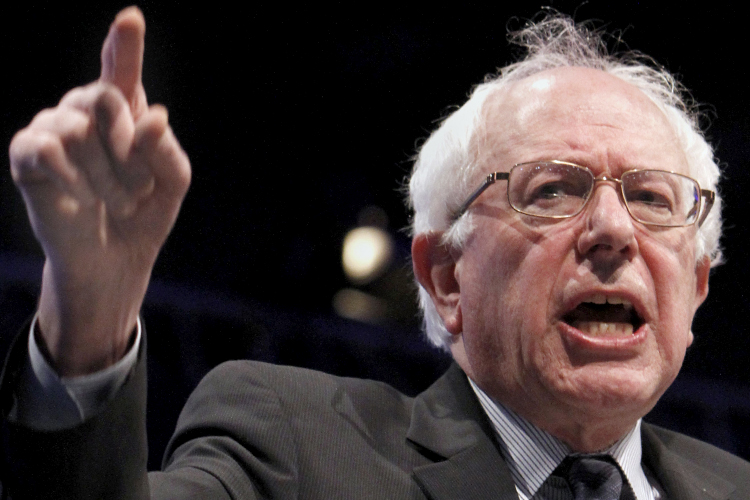
Bernie Sanders, OWS, and the Children of Allentown

Bernie Sanders. (Credit: AP/Rich Pedroncelli.)
Does anybody remember Occupy Wall Street? As nutty and quixotic as it was, it grew out of real social problems and concerns. And the improbable success of Bernie Sanders as a presidential candidate is a reminder that the problems didn’t go away just because the protesters did.

“We Are the 99%”

To refresh your memory: OWS never had a single public list of demands, although several people posted lists on their website which the press then published as “official”. Nevertheless, Roger Lowenstein wrote in Bloomberg.com, “the overall message is reasonably coherent. They want more and better jobs, more equal distribution of income, less profit (or no profit) for banks, lower compensation for bankers, and more strictures on banks with regard to negotiating consumer services such as mortgages and debit cards. They also want to reduce the influence that corporations — financial firms in particular — wield in politics, and they want a more populist set of government priorities: bailouts for student debtors and mortgage holders, not just for banks.”

This “reasonably coherent message”, give or take an exaggeration or two, could just as easily be Sanders’ platform.

Even near the end, OWS had support from about one-third of American voters, finding some little support even among Republicans, according to Public Policy Polling, while just over half the Democrats responded favorably. The cry “We are the 99%”, as inapposite as it was, found resonance with a significant percentage of the people; Paul Taylor of the Pew Research Center told Scott Horsley of NPR that it was “arguably the most successful slogan since ‘Hell no, we won’t go,’ going back to the Vietnam era. … [It] certainly triggered a lot of coverage about economic inequality.”

Monday, January 11, 2016

Defining the “Disappearing Middle Class”

Michael J. Perry
(Image source: sacbee.com.)
On December 30, 2015, economist Mark J. Perry published in his American Enterprise Institute blog Carpe Diem a couple of charts purporting to show that the American middle class, so far as it can be said to be disappearing, is doing so into higher-income households. Said Perry:

Over the last nearly 50 years the biggest gain for US households has been the 16.6 percentage point increase in the share of high-income households earning $100,000 or more per year, which accounts for the declining share of low-income and middle-income households (by two different measures). Yes, the middle-class has been disappearing over the last generation or more, but they have moved into higher-income categories of household income, not moving down into lower-income categories of household income.


“Cooking the Books”

Of course, Perry is a recognized economist, and I’m just a smart-aleck with a computer and three credit-hours in Econ 201. But I’m also a son of a bookkeeper, and have seen many interesting tricks people can play with numbers. Science is heavily dependent for its effectiveness on the honesty by which it applies numbers to phenomena, and is therefore vulnerable to anyone who knows how to “cook the books”. And the “dismal science”, like the others, tends to suffer when the numbers collide with policy preferences.

The picture Perry paints is of a middle class that was better off in 2014 than it was in 1967 — at the very least, that said middle class is making more money even after inflation is taken into account. However, to get an apples-to-apples comparison, he has to account for inflation. And here’s where the problem begins: there are a number of tools an analyst can use for inflating and deflating number … but none of them are 100% accurate. (For a comparison of four common price indexes used in policy analysis, see this post in The FRED Blog.)

Monday, November 16, 2015

“Safe Spaces” and the Fear of Growing Up

Protesters at Amherst College. (Twitter via Daily Beast)
On Thursday, November 12, Amherst College in Amherst, Massachusetts joined the list of institutions that have suffered student protests. According to MassLive, the protest “was sparked by the shared experiences of students who felt discriminated against on campus ..., as well as recent incidents on campus, like the papering-over of ‘Black Lives Matter’ posters with anti-abortion messaging that said ‘All Lives Matter.’”

“The turning point and why it got so large is that multiple students of all sorts of background recognized a feeling of feeling marginalized, or feeling invisible or  feeling isolated in some important way,” [organizer Mercedes] MacAlpine said. “It really took off just being to come together and talk about those experiences.”

What began as a sympathetic sit-in strike in support of the protests at Yale and the University of Missouri took an uglier turn when signs appeared claiming that freedom of speech was the “real victim” at Mizzou. In a response freighted with irony, the protesters demanded that Amherst president Biddy Martin issue a statement saying that Amherst would not tolerate the actions of the students behind the “All Lives Matter” stickers and the “Free Speech” posters, and that said students could be punished and re-educated in “racial and cultural competency”.

Devin Foley, in a post on Intellectual Takeout, asks what’s the matter with kids these days. “At the same time some students are flexing their political muscles (with the help of some professors) at the University of Missouri, Yale, and other schools demanding ‘safe space’, we’re treated to an increasing number of stories about the lack of resilience and overall fragility of many college students.”

This juxtaposition of intolerance and delicacy isn’t as oddly self-contradictory as it appears on the surface. The need for “safe spaces” is individual, while the strong-arm tactics belong to the group: “safety in numbers”, as the saying goes. However, it’s clear more is happening on our campuses than an increase in racial tensions and student political activism. The safety the protesters seek is far less from physical assault than it is from fear itself: more and more students are demanding that colleges rescue them from everything that causes them the least anxiety or unhappiness, from racism and sexism to bad break-ups and failing grades.

Leftist politics has found its home in the children of helicopter parents.

Monday, August 17, 2015

Altruism Without a Chest

© United Feature Syndicate.
It almost sounds like the plot of an absurdist comedy written by the team that brought us Revenge of the Nerds: Computer scientists gather to combat global poverty, only to become increasingly obsessed with interstellar travel and potential artificial intelligence-driven doomsday scenarios. Yet that’s what Dylan Matthews of Vox found at the Effective Altruism Global conference at the Google Quad campus in Mountain View, Calif., a couple of weeks ago — a convention of (mostly) white males more worried about a Terminator-like Götterdämmerung in a speculative future than about the homeless in present-day Los Angeles.

Pascal’s Mugging

Explains Matthews:

Effective altruism (or EA, as proponents refer to it) is more than a belief .... It’s a movement, and like any movement, it has begun to develop a culture, and a set of powerful stakeholders, and a certain range of worrying pathologies. At the moment, EA is very white, very male, and dominated by tech industry workers. And it is increasingly obsessed with ideas and data that reflect the class position and interests of the movement’s members rather than a desire to help actual people.
In the beginning, EA was mostly about fighting global poverty. Now it’s becoming more and more about funding computer science research to forestall an artificial intelligence-provoked apocalypse. At the risk of overgeneralizing, the computer science majors have convinced each other that the best way to save the world is to do computer science research. Compared to that, multiple attendees said, global poverty is a “rounding error.”

In a review of Jeremy Beer’s The Philanthropic Revolution: An Alternative History of American Charity, philanthropist Fred Smith muses, “I often wonder if philanthropy is one of those words that has either lost its traditional definition (love of mankind) or never should have been used to describe giving in the first place.” Certainly, a preference for saving 1052 estimated future lives rather than improving the lives of 3 billion existing people who live on less than $2.50 a day (2013) speaks more of a love of numbers than a love of mankind.

The mathematics by which the EA Global nerds justify this preoccupation with existential risk is a kind of “Pascal’s Mugging”, creating a false risk-reward analysis by slapping high probability values on events which are too hypothetical to give honestly estimable odds. Even within the often-repugnant calculations of utilitarianism, a life five generations from being conceived has no claim on us equal to that of a life currently being lived.

Thursday, August 6, 2015

The Chittister Challenge

Sister Joan Chittister, OSB, is arguably the Church in America’s best-known “Spirit of Vatican II” relic, a visible reminder of why so many orders of nuns are failing. The Limousine Left loves Sr. Joan not only because she’s a programmatic liberal but also because she’s an exponent of the “primacy of conscience” argument, which is the Catholic left’s favorite fig leaf for its divergences from orthodoxy. Nevertheless, occasionally, like a broken clock, she’s right every once in a while.

Some years ago, Sr. Joan said (to the delight of the pro-abortion establishment):

I do not believe that just because you’re opposed to abortion, that that makes you pro-life. In fact, I think in many cases, your morality is deeply lacking if all you want is a child born but not a child fed, not a child educated, not a child housed. And why would I think that you don’t? Because you don’t want any tax money to go there. That’s not pro-life. That’s pro-birth. We need a much broader conversation on what the morality of pro-life is.

A person on Facebook asked a question that The Blogger Who Must Not Be Named reprinted: “Would you accept a 50% income tax if it ensured that no woman would ever feel compelled to have an abortion because of financial worries?” It’s the same question Sr. Joan asks from a different angle — how far is the pro-life movement prepared to go to diminish the incidence of abortion?

Despite what Leslie Salzillo of the Daily Kos thinks, there are plenty of pro-lifers who support government safety-net programs, especially those geared toward poor single mothers. Contrapositively, there are also those who plug abortion to save tax money paid in welfare; so it’s not as if the pro-life movement has a monopoly on anti-tax tightwads.

Still, as Elizabeth Stoker Bruenig points out, “If a woman considers herself too destitute to care for a child, there is no transvaginal ultrasound demoralizing enough and no accompanying narration excoriating enough to make her decision [to abort] seem any less plausible.” So are we prepared to pay higher taxes if by doing so we could see a reduction in abortions?

Thursday, July 30, 2015

An Irish Catholic’s Look at White People—UPDATED

Jose Antonio Vargas with two unnamed men. (© 2015 MTV.)
At first, I was reluctant to watch the MTV documentary White People. I’d seen a trailer for it a couple of weeks before, which gave me the impression that a good portion of it was white college kids simply regurgitating the “privilege” narrative. Besides, it was an MTV project; whatever else you expect an MTV program to provoke, thought is not usually one of them.

It was better executed than I thought it would be. This was largely due to Jose Antonio Vargas, the Pulitzer Prize-winning journalist and filmmaker who did the interviews and asked the questions. Throughout the film, Vargas is charming, receptive, and avoids all appearance of being accusatory or condemnatory. Although he takes one occasion to change minds, for the most part he simply looks on and asks questions as young people struggle to break through the barriers to openly talk about racial perceptions.

That’s not to say the documentary is, shall we say, without its moments. A young man in a “privilege workshop” talks about “never having to represent your race to other people.” My first reaction on hearing that was: “You’re a kid. You’ll get your chance soon enough.”

One of my sharpest memories is of a discussion I had twenty years ago with a coworker and her fiancé about mixed couples. My coworker noted that black parents seemed to welcome such couples, while white parents didn’t, then turned to me and said, “Why are they like that, Tony?” The only thing I could tell her is that my previous girlfriend had had an opportunity to meet my dad and his wife, and that she had ducked out. I’d been called upon to explain white people, as if we were all of a piece.

Monday, July 13, 2015

The Benedict Option: Building a Catholic counterculture—UPDATED

Rod Dreher. (Photo: John Zak.)
Saturday, on the suggestion of Brandon Vogt, I read fellow Metroplex resident Rod Dreher’s “Critics of the Benedict Option”, in which Dreher attempts to further articulate what he confesses is “an inchoate phenomenon”. It's inchoate because, while the name is taken from St. Benedict of Nursia, the idea is not a return to the great monastic period.

Indeed, Dreher doesn’t really have anything specific in mind, which is why it drives poor John Zmirak crazy. Zmirak is trying to treat as a defective syllogism what is patently a hazy vision (and therefore can’t be logically proven or disproven).

The springboard for Dreher’s idea is a passage at the end of After Virtue, written by the late Alasdair MacIntyre in 1981. MacIntyre, Dreher writes, “described the state of contemporary moral discourse as irresolvably chaotic — irresolvably, because we have no common source of moral behavior anymore, and have decided, as a culture, that moral truth is something one arrives at by feeling.” Here is the part of the passage from the end of After Virtue which to me is truly relevant in discussing the Benedict Option:

A crucial turning point in [the late Western Roman Empire] occurred when men and women of good will turned aside from the task of shoring up the Roman imperium and ceased to identify the continuation of civility and moral community with the maintenance of that imperium. What they set themselves to achieve instead — often not recognising fully what they were doing — was the construction of new forms of community within which the moral life could be sustained so that both morality and civility might survive the coming ages of barbarism and darkness. [Bold font mine.—ASL]

And thus the Benedict Option: Christian enclaves, like Front Royal, Va., or Ave Maria, Fla., existing to mutually reinforce the faith in the new Dark Age.

Wednesday, July 1, 2015

The end of the American experiment

I had to take my time with my reaction to the Supreme Court’s decision in Obergefell v. Hodges (576 US __ [2015]), because there were some comments and criticisms that led me to suspect it was worse than I thought it would be. The suspicion was confirmed.

As expected, Associate Justice Anthony Kennedy authored the decision, which is the latest in the logical progression from Lawrence v. Texas (539 US 558 [2002]) through United States v. Windsor (570 US __ [2013]), the majority opinions of which Kennedy also wrote. Also as expected, Kennedy premissed his opinion on the dubious concept of “substantive due process”, the pre-eminent rationale for judicial legislation, and invoked the “equal protection” clause without bothering to explain — as, indeed, none of his decisions explain — how homosexuals qualify as a “protected class”. (Sorry, neither “Well, duh!” nor “Because I said” is a valid legal argument.)

In its way, Obergefell was an even greater assertion of SCOTUS power than was Windsor. As I explained at the time, Kennedy justified striking down the Defense of Marriage Act (DOMA) by arguing that the right to define marriage lay with the States, not explaining how the State’s authority to confer State benefits could rob the Federal government of its authority to decide who gets Federal benefits. Now, however, the States can exercise their authority only until the Court develops a “better informed understanding” (slip opinion at 19), at which time it can impose a school solution on everyone.

For Alexis de Tocqueville, the great French commentator on early America, the great danger of democracy was “tyranny of the majority”; i.e., the insufficiency of institutions to protect individual rights. The problem for the last few decades has been exactly the opposite — aristocracy, the rise of a self-selected élite willing to frustrate the democratic process, distort the plain meaning of the Constitution, and violate long-standing political rights in order to impose its superior mores. Obergefell signals the triumph of that élite and the functional advent of limited self-government.

Monday, March 23, 2015

Paul Krugman Believes His Own Eyes—UPDATED

Photograph by David Levene/eyevine via Redux.
Tim Worstall’s recent Forbes.com piece, “Paul Krugman’s Amazing About Face On The Minimum Wage”, reminds me very much of the old joke that either came from or found its way into the musical Chicago: The woman who comes home to find her husband in bed with another woman. In the middle of protesting his innocence, the cad asks his angry spouse, “Who you gonna believe, me or your own eyes?”

Worstall’s piece is all about the differences between “good Krugman”, who in September 1998 published an article derisively dismissing minimum-wage arguments (because “the amorality of the market economy is part of its essence, and cannot be legislated away”), and “bad Krugman”, whose March 2 NYT op-ed “Walmart’s Visible Hand” made a devastating concession: “… [E]xtreme inequality and the falling fortunes of America’s workers are a choice, not a destiny imposed by the gods of the market. And we can change that choice if we want to.”

Old Krugman said that Walmart paying higher wages might lead to less turnover, better morale and higher productivity. But only at Walmart because the operative part was “higher wages than other employers”. And that’s the one thing that a general rise in wages, for example a rise in the minimum wage, cannot accomplish.
New Krugman tells us that a rise in the minimum wage will accomplish exactly that thing that Old Krugman tells us is impossible.

What might be the difference between Old Krugman and New Krugman? Seventeen years of observation? The intervention of a recession which exposed underlying fallacies in free-market thinking? Oh, no: according to Worstall, the difference is a paycheck from that “hotbed of liberal ideology,” the New York Times.

And that, my friends, is pretty much the full substance of Worstall’s refutation of Krugman: He writes for “Hell’s Bible”.

Friday, March 13, 2015

Taking offense and taking action

Protest march at OU. (Photo source: Legal Insurrection.)
When an unapologetically über-conservative man and a hard-core leftist woman agree on a point, you can almost bet your life savings the truth is in the opposite direction. Especially when the topic is “offense discourse”.

Steven Crowder’s argument is about machismo more than anything else. “Both men and women respect men who take ownership, men who take action. Choosing to ‘be offended’ is the epitome of inaction. Today’s ‘offended’ men are seen as wimpy simply because they are. Instead of harnessing whatever affront is facing them, instead of facing it head-on, dealing with the problem and coming out the other side a stronger man, the ‘modern’ male chooses to sulk, to whine, and inevitably call Gloria Steinem.” Plus, “chicks dig it” when you take action.

I’m not sure Katherine Cross would agree with that last assessment … or, for that matter, to being called a “chick”. However, she does agree that “offense discourse” leads to inaction:

It has to be one of the most significant rhetorical own-goals of the Left since the 1960s: allowing the word ‘offend’ to become the go-to way of describing the harms of prejudice. “This content offends me,” “your words are offensive,” “his conduct gave offence to x,” etc. What this has always facilitated is the commonplace reactionary response to such moral injunctions, defending some imagined noble right to give offense lardered [sic] with smug Stephen Fry image macros. Cue “free speech”’ arguments ad nauseam that resolve into garrulous nothingness. … It is the deeds that flow from words which concern us, and which cannot be contained by the concept of offensiveness.

Of the two arguments, Cross’ is the more fully developed. Crowder’s post amounts to little more than a couple of chest-thumps and an admonition to “put on your big-boy britches and deal with it”. Both arguments, however, are simply wrong, or at least not fully to the point.

Monday, December 29, 2014

What took Robert Tracinski so long?

You know things are getting pretty bad when a libertarian atheist devoté of Ayn Rand links arms (albeit grudgingly) with conservative religious types. That’s just what Robert Tracinski does in his Federalist post, “Confessions of a Reluctant Culture Warrior”.

Why would it be such as surprise? Because libertarians tend to be liberal where a Christian who takes traditional Christian morality seriously ought to be conservative, and vice versa. Because many atheists, like Tracinski himself, object to select parts of traditional Christian morality, and clamor that adopting anything they don’t like into law is tantamount to enacting a “Judeo-Christian Sharia” or a “theocracy”. Because Ayn Rand’s objectivism is, as Marina Galperina so charmingly put it, “the philosophical system for people who pleasure themselves over thoughts of laissez-faire capitalism and believe that self-interest is the highest moral purpose and that’s that, the objective truth, f**k you;” Tracinski proposes it as a “third way” precisely because it isn’t and can’t be considered a religion-based ethos.

Whatever else you can say about self-interest, though, it can occasionally prompt you to recognize that precedents established to destroy your cultural nemeses can — and often will — be turned against you and your allies sooner or later. And in the struggles over the last year, from the Hobby Lobby decision to gendered toys, Tracinski, whose normal position on cultural issues was “Could we talk about something else, please?”, heard Martin Niemöller begin his famous poem with a new line: “First they came for the Christians ….”

Tracinski the libertarian objectivist atheist has finally seen the Progressivist Thought Police on the march.