Wednesday, February 24, 2016

Republican Fixation on Sanders’ Socialism Misses the Point

Governments were intervening for the common good before
the first socialist theories were invented.
I know many of you Republicans right now are fixated on the awful prospect of Donald Trump becoming the party nominee for President. It may be of some comfort that the Democrats are also displaying cracks in their unity along much the same lines: they too are going through a revolt of the Populists against the Optimates. The only difference is, their Optimate candidate, Hillary Clinton, is in a much better position to steal — er, win the nomination than is the Republicans’ Optimate, Jeb! Bush. (However, if Clinton gets the nod, Republicans have a better chance of winning in November.)

Sanders Still Viable

Right now, though, explaining how we got to this point is of less interest than considering how we get out of this mess … or, at least, how we avoid repeating it four years down the line. Bernie Sanders is still a viable candidate, despite the poor turnout in Nevada; if he pulls off the nomination, the GOP will likely lose the White House no matter who they nominate.

This fact doesn’t seem to register with Republicans: Optimate Democrats are much less concerned about Sanders than Optimate Republicans are scared (yes, scared) of Trump and Cruz. There are fewer Democrats who would never vote for him than there are Republicans who would never vote for Trump or Cruz.

I hate writing about Sanders’ candidacy again so soon after my last post on the topic. However, in thinking about it, my last post was too indirect, too reflective. What needs to be said, has to be said bluntly:

Republicans, wake the [deleted] up. You’re missing the point.  You’re not paying attention, and that’s going to cost you every other November until you get the hint. Here’s why:

Sunday, February 14, 2016

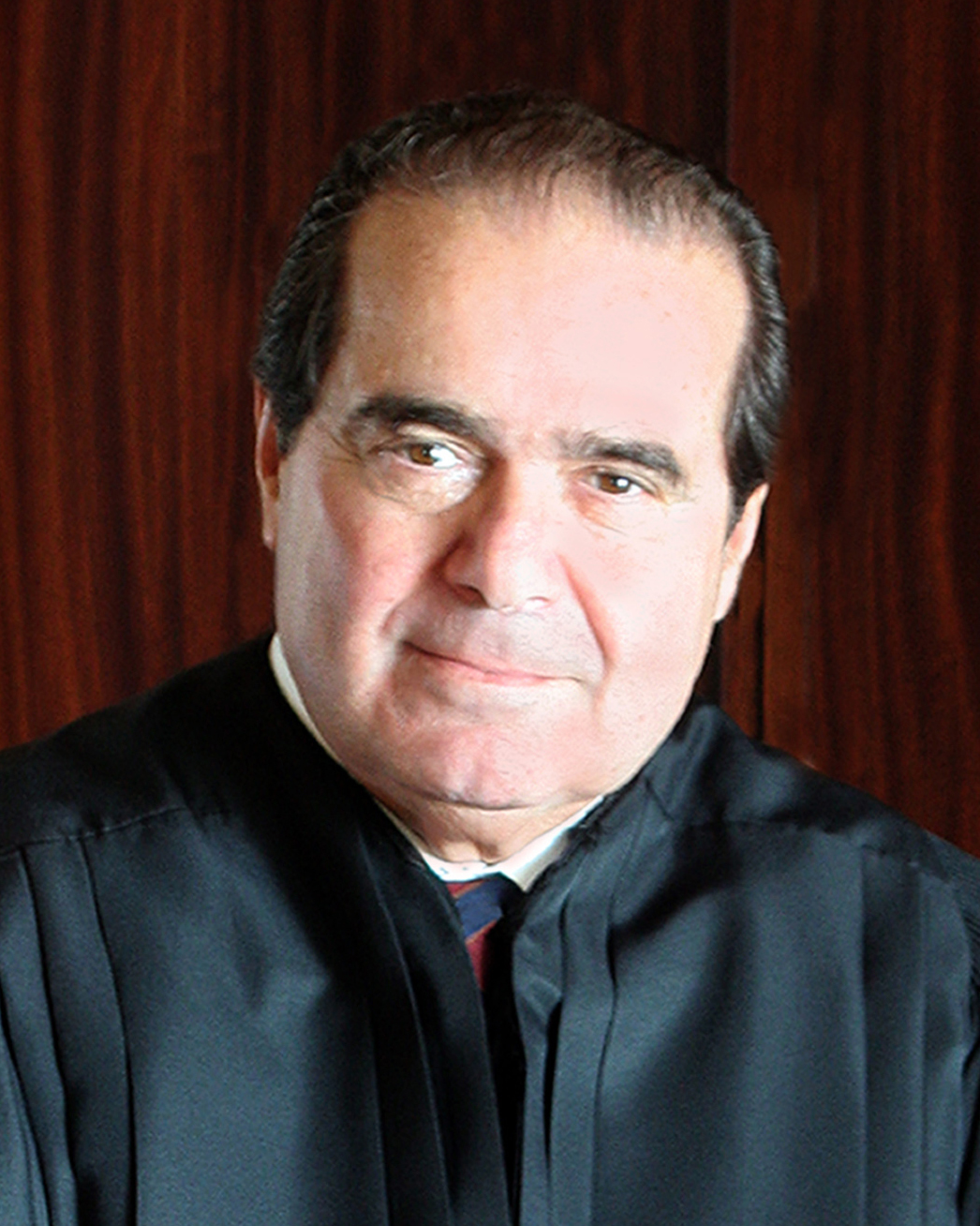
Requiescat in pacem, Antonin Scalia

Oddly enough, according to a couple of sources, Associate Justice Antonin G. Scalia’s best friend was AJ Ruth Bader Ginsburg. Said Marcia Coyle on PBS NewsHour Weekend, Scalia, who passed away Saturday at the age of 79, “was widely liked ... a very colorful writer, and in person ... a consummate gentleman, ... could be very funny. He is going to be missed ... especially by Justice Ginsburg, with whom he had a special friendship — they called each other best friends — and with whom he went to opera and ... to India.”

“He does not write like a happy man”

To hear Scalia described as “widely liked” and a “consummate gentleman” may sound improbable to people who only knew of him through his strident, hectoring argumentation on the bench, especially to liberals and progressives who came to hate him as a conservative obstructionist. (One gay man of my acquaintance sneered, “My condolences to the Koch brothers for their loss.”)

Because Scalia’s opinions coincided often with conservative interests, it was all too easy to claim his originalism was merely intellectual cover for his political views — in fact, so easy that more substantive legal criticism often went lacking. His dissents — and he wrote plenty of dissents in his nearly thirty years’ tenure on the SCOTUS bench — often sacrificed detailed analysis of the legal principles involved in favor of sarcastic fiskings of the majority opinion and fervent homilies on the wider implications of the decision; e.g., his dissent in Obergefell v. Hodges (513 U.S. ___ [2015]; pp. 69 ff.). So acidic were his opinions that, as Conor Clarke observed in Slate, “Scalia’s opinions read like they’re about to catch fire for pure outrage. He does not, in short, write like a happy man.”

Saturday, February 6, 2016

Bernie Sanders, OWS, and the Children of Allentown

Bernie Sanders. (Credit: AP/Rich Pedroncelli.)
Does anybody remember Occupy Wall Street? As nutty and quixotic as it was, it grew out of real social problems and concerns. And the improbable success of Bernie Sanders as a presidential candidate is a reminder that the problems didn’t go away just because the protesters did.

“We Are the 99%”

To refresh your memory: OWS never had a single public list of demands, although several people posted lists on their website which the press then published as “official”. Nevertheless, Roger Lowenstein wrote in Bloomberg.com, “the overall message is reasonably coherent. They want more and better jobs, more equal distribution of income, less profit (or no profit) for banks, lower compensation for bankers, and more strictures on banks with regard to negotiating consumer services such as mortgages and debit cards. They also want to reduce the influence that corporations — financial firms in particular — wield in politics, and they want a more populist set of government priorities: bailouts for student debtors and mortgage holders, not just for banks.”

This “reasonably coherent message”, give or take an exaggeration or two, could just as easily be Sanders’ platform.

Even near the end, OWS had support from about one-third of American voters, finding some little support even among Republicans, according to Public Policy Polling, while just over half the Democrats responded favorably. The cry “We are the 99%”, as inapposite as it was, found resonance with a significant percentage of the people; Paul Taylor of the Pew Research Center told Scott Horsley of NPR that it was “arguably the most successful slogan since ‘Hell no, we won’t go,’ going back to the Vietnam era. … [It] certainly triggered a lot of coverage about economic inequality.”

Monday, January 11, 2016

Defining the “Disappearing Middle Class”

Michael J. Perry
(Image source: sacbee.com.)
On December 30, 2015, economist Mark J. Perry published in his American Enterprise Institute blog Carpe Diem a couple of charts purporting to show that the American middle class, so far as it can be said to be disappearing, is doing so into higher-income households. Said Perry:

Over the last nearly 50 years the biggest gain for US households has been the 16.6 percentage point increase in the share of high-income households earning $100,000 or more per year, which accounts for the declining share of low-income and middle-income households (by two different measures). Yes, the middle-class has been disappearing over the last generation or more, but they have moved into higher-income categories of household income, not moving down into lower-income categories of household income.


“Cooking the Books”

Of course, Perry is a recognized economist, and I’m just a smart-aleck with a computer and three credit-hours in Econ 201. But I’m also a son of a bookkeeper, and have seen many interesting tricks people can play with numbers. Science is heavily dependent for its effectiveness on the honesty by which it applies numbers to phenomena, and is therefore vulnerable to anyone who knows how to “cook the books”. And the “dismal science”, like the others, tends to suffer when the numbers collide with policy preferences.

The picture Perry paints is of a middle class that was better off in 2014 than it was in 1967 — at the very least, that said middle class is making more money even after inflation is taken into account. However, to get an apples-to-apples comparison, he has to account for inflation. And here’s where the problem begins: there are a number of tools an analyst can use for inflating and deflating number … but none of them are 100% accurate. (For a comparison of four common price indexes used in policy analysis, see this post in The FRED Blog.)

Thursday, December 24, 2015

Book Review: To the Martyrs, by Cdl. Donald Wuerl

Cdl. Donald Wuerl
Emmaus Road Publishing
Cover Price: $22.95
Recommended

 Anti-Christians condemn Christians for their hypocrisy. However, not a single Christian martyr has ever suffered persecution by non-Christians for failing to live the gospel message perfectly. Rather, Christians were and are persecuted just for associating themselves with the gospel message in the first place. Imperfection of religious practice has hardly been a barrier to execution, imprisonment, maiming, rape, or torture by those who hate Christianity and that for which they think it stands.

This is the first thought that occurs to me after reading To the Martyrs: A Reflection on the Supreme Christian Witness by Cdl. Donald Wuerl. The title reflects both the title of a letter by the Church Father Tertullian and Wuerl’s own personal fascination with, and dedication to, the millions of martyrs and confessors who have been “the seeds of the Church” over the last two millennia. It’s a “reflection” as well in that it’s obviously not an exhaustive treatment of martyrdom intended for scholars and Church historians, but rather a brief overview for the ordinary layman. Written in a very accessible style, it has just enough footnotes to show that the good archbishop didn’t rely on his own memory or make things up as he went along.

As one reads To the Martyrs, though, a theme recurs. G. K. Chesterton famously noted that the Christian ideal hadn’t been “tried hard, and found wanting,” but rather had been “found difficult; and left untried.” However, as Cdl. Wuerl shows, the centuries of persecution didn’t come from people who found the Christian ideal too difficult to live up to, but rather from people who found that ideal too challenging, too uncomfortable to live with.

Monday, November 23, 2015

Welcome to the (Dysfunctional) Catholic Family!

Image source: thecatsdiary.com
So you’ve completed the RCIA program, been confirmed (possibly baptized, if you weren’t before), and have even got your first rosary, bottle of Holy Water, and collection envelopes. Congratulations, and benedicamus Domino! You’ve joined the Catholic Church! Like the song in The Music Man says, “So what the heck, you’re welcome; glad to have you with us, even though we may not ever mention it again.”

It’s theoretically possible that you were comatose for the last twenty years and, like Rip Van Winkle, just woke up before you began the conversion process. Or, you could be young enough to not remember the scandals of the “Long Lent” of 2002 (and haven’t seen Spotlight yet) — was it really that long ago? In any event, I’ll trust you decided that the people of the Church don’t have to be perfect in order for the Church to teach the fullness of Christ’s truth. Many former Protestants and non-Christians convinced themselves of the truth of the Church’s doctrines, through self-directed study, even before they registered for the classes.

If we were perfect, we wouldn’t need the Church to begin with. “Those who are well have no need of a physician, but those who are sick. ... I came not to call the righteous, but sinners” (Matthew 9:12-13).

Monday, November 16, 2015

“Safe Spaces” and the Fear of Growing Up

Protesters at Amherst College. (Twitter via Daily Beast)
On Thursday, November 12, Amherst College in Amherst, Massachusetts joined the list of institutions that have suffered student protests. According to MassLive, the protest “was sparked by the shared experiences of students who felt discriminated against on campus ..., as well as recent incidents on campus, like the papering-over of ‘Black Lives Matter’ posters with anti-abortion messaging that said ‘All Lives Matter.’”

“The turning point and why it got so large is that multiple students of all sorts of background recognized a feeling of feeling marginalized, or feeling invisible or  feeling isolated in some important way,” [organizer Mercedes] MacAlpine said. “It really took off just being to come together and talk about those experiences.”

What began as a sympathetic sit-in strike in support of the protests at Yale and the University of Missouri took an uglier turn when signs appeared claiming that freedom of speech was the “real victim” at Mizzou. In a response freighted with irony, the protesters demanded that Amherst president Biddy Martin issue a statement saying that Amherst would not tolerate the actions of the students behind the “All Lives Matter” stickers and the “Free Speech” posters, and that said students could be punished and re-educated in “racial and cultural competency”.

Devin Foley, in a post on Intellectual Takeout, asks what’s the matter with kids these days. “At the same time some students are flexing their political muscles (with the help of some professors) at the University of Missouri, Yale, and other schools demanding ‘safe space’, we’re treated to an increasing number of stories about the lack of resilience and overall fragility of many college students.”

This juxtaposition of intolerance and delicacy isn’t as oddly self-contradictory as it appears on the surface. The need for “safe spaces” is individual, while the strong-arm tactics belong to the group: “safety in numbers”, as the saying goes. However, it’s clear more is happening on our campuses than an increase in racial tensions and student political activism. The safety the protesters seek is far less from physical assault than it is from fear itself: more and more students are demanding that colleges rescue them from everything that causes them the least anxiety or unhappiness, from racism and sexism to bad break-ups and failing grades.

Leftist politics has found its home in the children of helicopter parents.

Saturday, September 5, 2015

Absolution, excommunication, and abortion

Photo credit: Giampiero Sposito/Reuters.
Welcome to another edition of What Did the Pope Really Say? Today’s confusion is over Pope Francis’ recent letter to the President of the Pontifical Council for the Promotion of the New Evangelization, Abp. Salvatore “Rino” Fisichella. Specifically, what did the Pope command to be done about abortion for the Extraordinary Jubilee of Mercy year that is not already being done in parishes throughout the world? Did the Pope declare abortion to not be a sin? Were women unable to be absolved of the sin before? What gives?

In this case, the normal amount of mainstream-media misinformation is compounded by what Edward Peters calls “the pervasive ignorance of canon law among rank-and-file faithful brought about by fifty years of ecclesiastical antinomianism.”[*] Abortion is not only a sin in traditional Christian moral doctrine; in the Code of Canon Law it’s also a delict, analogous to a tort in civil law, with a defined punishment. Per Canon 1398, “A person who procures a completed abortion incurs a latae sententiae excommunication.”[†]

The confusing part of Pope Francis’ letter is his stated decision “to concede to all priests for the Jubilee Year the discretion to absolve of the sin of abortion those who have procured it and who, with contrite heart, seek forgiveness for it.” Boston archbishop Cdl. Seán O’Malley reinforces the bewilderment when he tells us, “Under the provisions of canon law, absolution of certain serious sins, including abortion, was reserved to the diocesan bishop. For many years in the United States, including in the Archdiocese of Boston, diocesan bishops have granted their priests the faculty to absolve the sin of abortion.” [Bold type mine.—ASL] In all fairness, canon law is a recondite subject, and neither Francis nor Cdl. O’Malley were educated as canon lawyers.

Monday, August 17, 2015

Altruism Without a Chest

© United Feature Syndicate.
It almost sounds like the plot of an absurdist comedy written by the team that brought us Revenge of the Nerds: Computer scientists gather to combat global poverty, only to become increasingly obsessed with interstellar travel and potential artificial intelligence-driven doomsday scenarios. Yet that’s what Dylan Matthews of Vox found at the Effective Altruism Global conference at the Google Quad campus in Mountain View, Calif., a couple of weeks ago — a convention of (mostly) white males more worried about a Terminator-like Götterdämmerung in a speculative future than about the homeless in present-day Los Angeles.

Pascal’s Mugging

Explains Matthews:

Effective altruism (or EA, as proponents refer to it) is more than a belief .... It’s a movement, and like any movement, it has begun to develop a culture, and a set of powerful stakeholders, and a certain range of worrying pathologies. At the moment, EA is very white, very male, and dominated by tech industry workers. And it is increasingly obsessed with ideas and data that reflect the class position and interests of the movement’s members rather than a desire to help actual people.
In the beginning, EA was mostly about fighting global poverty. Now it’s becoming more and more about funding computer science research to forestall an artificial intelligence-provoked apocalypse. At the risk of overgeneralizing, the computer science majors have convinced each other that the best way to save the world is to do computer science research. Compared to that, multiple attendees said, global poverty is a “rounding error.”

In a review of Jeremy Beer’s The Philanthropic Revolution: An Alternative History of American Charity, philanthropist Fred Smith muses, “I often wonder if philanthropy is one of those words that has either lost its traditional definition (love of mankind) or never should have been used to describe giving in the first place.” Certainly, a preference for saving 1052 estimated future lives rather than improving the lives of 3 billion existing people who live on less than $2.50 a day (2013) speaks more of a love of numbers than a love of mankind.

The mathematics by which the EA Global nerds justify this preoccupation with existential risk is a kind of “Pascal’s Mugging”, creating a false risk-reward analysis by slapping high probability values on events which are too hypothetical to give honestly estimable odds. Even within the often-repugnant calculations of utilitarianism, a life five generations from being conceived has no claim on us equal to that of a life currently being lived.

Thursday, August 6, 2015

The Chittister Challenge

Sister Joan Chittister, OSB, is arguably the Church in America’s best-known “Spirit of Vatican II” relic, a visible reminder of why so many orders of nuns are failing. The Limousine Left loves Sr. Joan not only because she’s a programmatic liberal but also because she’s an exponent of the “primacy of conscience” argument, which is the Catholic left’s favorite fig leaf for its divergences from orthodoxy. Nevertheless, occasionally, like a broken clock, she’s right every once in a while.

Some years ago, Sr. Joan said (to the delight of the pro-abortion establishment):

I do not believe that just because you’re opposed to abortion, that that makes you pro-life. In fact, I think in many cases, your morality is deeply lacking if all you want is a child born but not a child fed, not a child educated, not a child housed. And why would I think that you don’t? Because you don’t want any tax money to go there. That’s not pro-life. That’s pro-birth. We need a much broader conversation on what the morality of pro-life is.

A person on Facebook asked a question that The Blogger Who Must Not Be Named reprinted: “Would you accept a 50% income tax if it ensured that no woman would ever feel compelled to have an abortion because of financial worries?” It’s the same question Sr. Joan asks from a different angle — how far is the pro-life movement prepared to go to diminish the incidence of abortion?

Despite what Leslie Salzillo of the Daily Kos thinks, there are plenty of pro-lifers who support government safety-net programs, especially those geared toward poor single mothers. Contrapositively, there are also those who plug abortion to save tax money paid in welfare; so it’s not as if the pro-life movement has a monopoly on anti-tax tightwads.

Still, as Elizabeth Stoker Bruenig points out, “If a woman considers herself too destitute to care for a child, there is no transvaginal ultrasound demoralizing enough and no accompanying narration excoriating enough to make her decision [to abort] seem any less plausible.” So are we prepared to pay higher taxes if by doing so we could see a reduction in abortions?